 Society

ECO Expo Asia opens at Hong Kong AsiaWorld-Expo in late October
1.
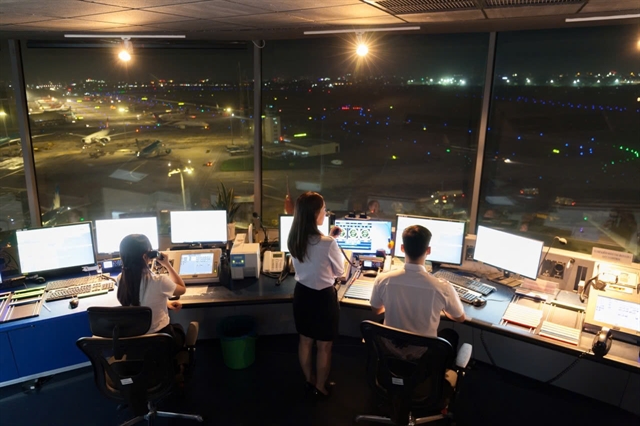 |
| Operations at Tân Sơn Nhất International Airport are managed in accordance with actual conditions, with the highest priority placed on safety. — Photo from the Việt Nam Air Traffic Management Corporation (VATM) |
HÀ NỘI — The discovery of unmanned aerial vehicles (UAVs) near Tân Sơn Nhất International Airport in HCM City on Tuesday evening disrupted 73 flights and twice forced the temporary suspension of airport operations, prompting calls for specialised systems to detect and neutralise drones.
According to the Việt Nam Air Traffic Management Corporation (VATM), the incident occurred as aircraft crews reported UAVs operating in the vicinity of the airport. Air traffic control authorities immediately implemented safety procedures, temporarily restricting take-offs and landings at Việt Nam's busiest airport while assessing the situation.
Departing flights were held on the ground, while arriving aircraft were instructed to enter holding patterns at appropriate locations.
The Air Traffic Flow Management (ATFM) Centre subsequently adjusted traffic flows to match the airport's reduced operating capacity. A total of 71 flights scheduled to arrive at Tân Sơn Nhất were assigned calculated take-off times (CTOTs) to regulate traffic affected by the drone sightings.
More than 50 flights were placed in holding patterns, while 27 were either diverted or landed at alternate airports, according to the ATFM Centre.
The measures were designed to prevent aircraft from approaching the airport while safe operating conditions could not be guaranteed.
VATM said the response was conducted at two levels: direct air traffic control at Tân Sơn Nhất and wider air traffic-flow management. This allowed authorities to control the number of aircraft arriving at and departing from the airport, reducing pressure on the airport and limiting the risk of disruptions spreading to other routes and airports.
Airport operations suspended twice
A report by the Civil Aviation Authority of Việt Nam (CAAV) to the Ministry of Construction provided further details of the incident.
The first suspension lasted from 6:14pm to 7:14pm, after the crew of flight 3S621 from Tân Sơn Nhất to Hà Nội reported seeing a UAV at an altitude of about 1,800 feet, approximately 500m from the aircraft.
At around the same time, the crew of Vietjet flight VJ601 also reported a UAV about 10 nautical miles from the airport at an altitude of 3,000 feet.
The Southern Airports Authority immediately notified the HCM City Police duty command, the National Aviation Security Centre and the immigration police at Tân Sơn Nhất International Airport for coordination and verification.
The authority, together with Tân Sơn Nhất Airport and the Southern Air Traffic Management Company, activated the runway safety team and agreed to temporarily suspend flights to and from the airport.
After about 60 minutes, Tân Sơn Nhất resumed normal operations.
However, at 7:34pm, the 367th Air Division reported another UAV approximately 3km southwest of the airport.
The airport once again suspended flight operations from 7:34pm to 8:34pm while relevant agencies coordinated their response and aircraft already in the air were instructed to hold or divert.
The CAAV said the incident affected a number of flights, including three aircraft that had to make emergency landings after their fuel reserves became critically low while holding, 24 flights that diverted to alternate airports, 19 flights that remained in holding patterns and 15 flights that were held before departure.
VATM's broader operational statistics showed that 73 flights were directly affected during the airport's temporary restrictions.
Calls for specialised drone detection systems
The CAAV said the incident demonstrated that coordination among agencies at the airport had worked effectively, helping to control risks and maintain flight safety.
However, it also highlighted a significant limitation – the detection and potential neutralisation of UAVs currently rely heavily on visual observation and manual reporting because airports lack sufficient specialised equipment for early detection, warning and, where necessary, drone countermeasures.
The CAAV has therefore proposed that the Ministry of Construction report to the National Committee for Aviation Security and Facilitation and seek an early agreement on which agency or unit should take the lead when an unauthorised UAV enters an airport area and threatens civil aviation operations.
It also called for investment in specialised systems capable of detecting and providing early warnings of UAVs, as well as equipment capable of neutralising them when necessary.
The CAAV also proposed strengthening administrative and criminal sanctions against organisations and individuals that violate regulations governing the management and use of unmanned aircraft. — VNS
Society
 Society
 Society
 Society
 Society
 Society
 Society
 Society
 Society
 Society
 Society
 Society
 Society
 Society
 Society