 Environment

Vietnamese writer, illustrator nominated for 2028 Hans Christian Andersen Award
1.
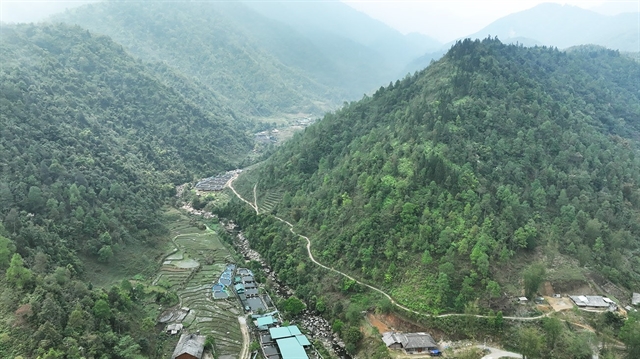 |
| A special-use forest area within Hoàng Liên National Park in the northern mountainous province of Lào Cai. — VNA/VNS Photo Vũ SInh |
LÀO CAI — From towering mountain forests to hidden valleys rich in rare wildlife, Hoàng Liên National Park in the northern province of Lào Cai remains one of Việt Nam's greatest natural treasures.
As climate change places increasing pressure on its fragile ecosystems, the park is intensifying efforts to protect its remarkable biodiversity while creating sustainable livelihoods for communities living on its fringes.
Recognised as an ASEAN Heritage Park, the park has been classified as Category A, the highest ranking for biodiversity value in Việt Nam, by the Global Environment Facility.
The park covers 28,500 hectares, with forest cover of over 90 per cent. It is home to 2,853 species of higher plants, including nearly 150 species listed in the Việt Nam and international Red Data Books, as well as around 600 vertebrate species, of which 60 are classified as rare or endangered.
The park has introduced a wide range of conservation and management measures to safeguard its rich forests and ecosystems. At the heart of these efforts is the Hoàng Liên Tourism and Wildlife Conservation Centre, which is responsible for receiving, rescuing, rehabilitating and releasing wild animals back into their natural habitats.
According to Phạm Minh Đức, the centre's deputy director, the centre is currently caring for 101 individual animals from 24 species, including 90 individuals representing 20 endangered, precious and rare species.
As of July 15, the centre had handled 76 rescue cases involving 104 animals from 21 species, achieving 253 per cent of its annual target. It successfully rehabilitated 101 of the 104 animals.
Since the beginning of the year, the centre has also conducted four wildlife release operations, twice its annual target. Most recently, on July 12, the park released 57 rescued wild animals from 18 species back into the wild after they had been successfully rehabilitated at the centre.
Plant propagation
The park's conservation area is also home to thousands of valuable plant species. Species such as Ngọc Linh ginseng (Panax vietnamensis), Hoàng Liên gai (Berberis wallichiana DC), Vân Sam fir (Abies delavayi subsp. Fansipanensis) and Sa Pa cymbidium orchids have all been successfully propagated.
Known as a "Kingdom of Medicinal Plants", the park contains more than 750 medicinal plant species. Numerous national, ministerial and provincial research projects are being carried out there, helping to unlock the economic potential of non-timber forest products while supporting long-term conservation goals.
Recognising genetic resource conservation as a core mission, the park has launched several priority research projects during the first half of this year, including a study on the conservation and development of the genetic resources of Tế tân lá tim (Asarum cordifolium CEC Fischer), a valuable medicinal herb.
Another project focusing on the conservation and propagation of the medicinal tree Đỗ trọng bắc (Eucommia ulmoides Oliv.) has also produced encouraging results.
Meanwhile, in a bid to secure the sustainable development of one of the nation's most valuable medicinal herbs, the park has accelerated its 2026 pilot cultivation programme for Vietnamese ginseng. The project has sown seeds across 500 square metres and successfully replanted 700 ginseng roots aged between four and seven years in a dedicated nursery.
Beyond conservation, the national park is also integrating biodiversity protection with community development. One notable initiative is supporting livelihood recovery following Typhoon Yagi in 2024 through the development of Vietnamese ginseng and lingzhi mushrooms.
The programme has provided fresh opportunities for communities living in the park's buffer zone. It successfully organised outreach activities in Tả Van and Bản Hồ communes, while also providing Vietnamese ginseng and lingzhi mushrooms to local households, laying the foundations for a greener post-disaster economic recovery.
"We have prioritised developing the genetic resources of medicinal plants with high economic and pharmaceutical value to support local economic development and improve incomes for ethnic minority communities living in and around the national park," park director Nguyễn Hữu Hạnh said.
 |
| Technicians inspect the growth of Ngọc Linh ginseng plants cultivated and conserved at Hoàng Liên National Park. — VNA/VNS Photo Vũ Sinh |
Community support
Hạnh also said that conserving biodiversity was not solely the responsibility of forest management authorities, but would require the active participation of local communities and visitors alike.
The park has expanded programmes that combine management with environmental education and public awareness campaigns to strengthen biodiversity conservation. It has intensified awareness-raising activities while strengthening cooperation with local authorities, relevant agencies and communities living in both the core and buffer zones.
During the first six months of this year, forest rangers organised 80 forestry law awareness sessions attended by over 4,000 participants, alongside 118 mobile awareness campaigns in villages across the buffer zone.
The park also carried out 659 forest patrols, including seven extended patrols, and monitored 1,379 entries into the forest through five control checkpoints, helping improve the protection and management of forest resources.
Public awareness campaigns have also been incorporated into traditional forest protection oath-taking ceremonies held in villages across Bản Hồ and Tả Van communes, particularly those bordering the national park.
During the ceremonies, forest rangers educate residents on forest protection, biodiversity conservation and forest fire prevention. Community members discuss local forest protection regulations, vote to adopt them and pledge to uphold the agreed rules.
Lê Xuân Thắng, deputy head of the Hoàng Liên Forest Ranger Division, said, "The support and commitment of local communities are the decisive factor and the key to conserving and sustainably managing the forest resources of the national park."
In addition, the centre recently organised two training courses for 60 tour guides and porters serving visitors, further raising awareness of biodiversity and the value of ecotourism among those working in the park.
"Hiking guides and porters are not simply support staff; they are the bridge connecting visitors with nature," Đức, the centre's deputy director, said.
"When they fully understand and appreciate the ecological value of the area, they can play a significant role in protecting natural resources while promoting sustainable tourism," Đức added.
Lê Mạnh Dũng, from the north-eastern province of Quảng Ninh, who recently joined a trekking expedition to conquer Mount Fansipan, said the experience left a lasting impression. He has climbed many mountains across Việt Nam, but Fansipan within the national park was particularly memorable.
“The landscape remains pristine and spectacular. Our guides constantly reminded us not to litter or damage vegetation, while the use of fire was strictly controlled to minimise the risk of forest fires," he said.
As more people discover Hoàng Liên's spectacular landscapes, the park's long-term success will depend on striking a careful balance between conservation, sustainable tourism and the livelihoods of the communities that call these mountains home.— VNS
Environment
 Environment
 Environment
 Environment
 Environment
 Environment
 Environment
 Environment
 Environment
 Environment
 Environment
 Environment
 Environment
 Environment
 Environment