 Environment

Việt Nam, Switzerland to turn education, sci-tech, innovation into cooperation focus
1.
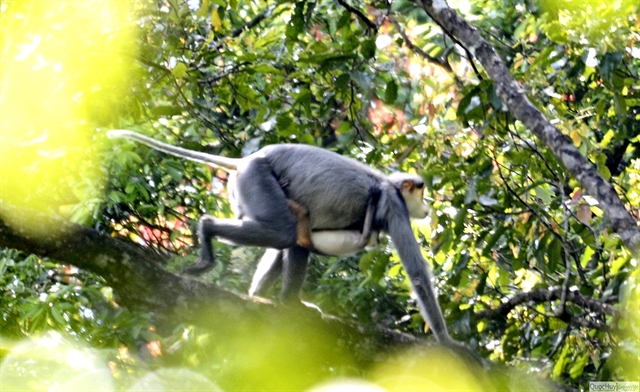 |
| An endangered grey-shanked douc langur (Pygathrix cinerea) holding its baby in a forest of Ba Tơ in Quảng Ngãi Province. — Photo courtesy of Hoàng Quốc Huy |
Công Thành
QUẢNG NGÃI — A large area of well-protected primary forest in the central province of Quảng Ngãi has sheltered 41 herds of grey-shanked douc langurs (Pygathrix cinerea) – a species classified as Critically Endangered (CR) by the International Union for Conservation of Nature (IUCN).
With 263 individuals, the province has become one of the three largest key localities conserving this endangered primate in Việt Nam.
The Centre for Biodiversity Conservation (GreenViet), an NGO, reported that field surveys conducted between 2022 and 2025 on the langurs' existence placed Quảng Ngãi on the list of leading successful conservation sites for endangered primates, alongside Đà Nẵng, Đắk Lắk, and Quảng Nam.
According to biologist Hoàng Quốc Huy from GreenViet, there are an estimated 2,500 grey-shanked douc langurs living in primary forests, with Quảng Ngãi accounting for 10 per cent of the country’s total population.
“We recognised that Trà Bồng and Ba Tơ are two major sanctuaries, hosting the largest herds with 113 individuals – making up 43 per cent of the province's total population,” Huy said.
“The currently well-protected natural forests in Tây Ba Tơ and Trà Bồng should urgently be designated as strictly protected zones for these endangered langurs.
"Meanwhile, a 16,666-hectare area of wild forest in Tây Ba Tơ needs to be upgraded to a Nature Reserve to establish a large ‘green’ corridor linking it with the Kon Plông Nature Reserve and Kon Ka Kinh National Park – areas that also home large populations of grey-shanked douc langurs.
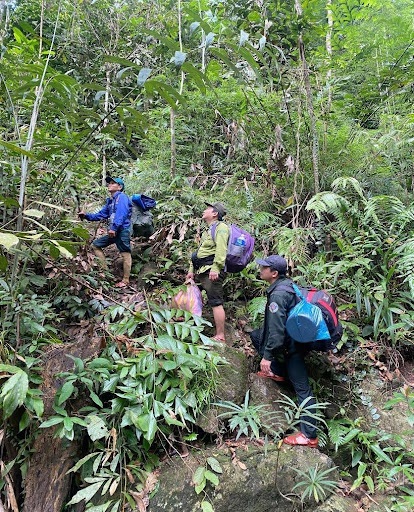 |
| Local rangers patrol a jungle in Quảng Ngãi Province. — Photo courtesy of GreenViet |
“This also provides favourable conditions for Trà Bồng to expand its protected area, as it could develop larger primary forest zones connected to Bà Nà-Núi Chúa and Tam Mỹ – two biodiversity-rich sites conserving the endangered langurs."
Ngô Vĩnh Phong, deputy head of the Quảng Ngãi provincial forest protection authority, said that local ranger forces and various agencies had actively boosted the conservation of 603,996 hectares of primary forest.
“We are accelerating an action plan to establish the Tây Ba Tơ area as a provincial Nature Reserve before upgrading it to a global biosphere reserve," Phong said.
"This will connect transborder reserves, including the An Toàn Reserve, Kon Chư Răng Nature Reserve, Kon Plông, and Kon Ka Kinh National Park, into a continuous ‘green’ corridor.
“The Tây Ba Tơ protective forest is a prime example of biodiversity value in central Việt Nam and a vital natural landscape in Quảng Ngãi Province, vital to the survival of the endangered grey-shanked douc langurs.
“Maintaining the natural state of the forest and its langur population in Tây Ba Tơ serves as a core foundation for sustainable livelihoods, driven by eco-tourism and under-canopy medicinal herb farming.”
He added that Tây Ba Tơ aimed to secure its place on the map as one of the largest conservation sites for grey-shanked douc langurs globally.
Nguyễn Văn Phương from the UK-based Fauna & Flora International (FFI) shared that a significant population of the endangered langurs was recorded during FFI's field surveys from 2022 to 2024.
The surveys also recorded 44 other endangered species, including the yellow-cheeked gibbon (Nomascus gabriellae), Siamese fireback (Lophura diardi), stump-tailed macaque (Macaca arctoides), and Northern pig-tailed macaque (Macaca leonina).
Phương noted that 39 field trips successfully dismantled 24 illegal camps and removed 17 snare traps between 2023 and 2024. Additionally, training sessions on the Spatial Monitoring and Reporting Tool (SMART) – a platform designed to help conservationists manage and protect wildlife – were organised for 10 forest ranger units and three forest owners in the province.
He also mentioned that support was provided to local households through FFI’s livelihood improvement and forest patrol programmes.
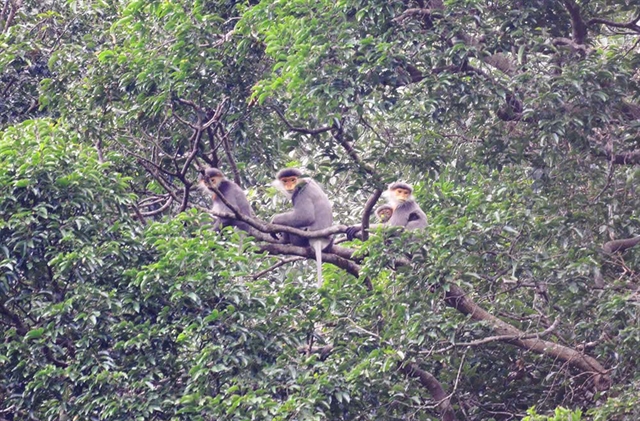 |
| A herd of three individuals of the Critically Endangered grey-shanked douc langurs (Pygathrix cinerea) in a forest in Trà Bồng of Quảng Ngãi Province. Photo courtesy of Hoàng Quốc Huy |
Trần Hữu Vỹ, director of GreenViet, emphasised that more actions would be required in the near future, including community awareness education on the importance of biodiversity and wildlife protection.
Vỹ warned that farms scattered within primary forests must be closely monitored, as human activities could severely disrupt the safe habitats of endangered wildlife.
He suggested that surveys and monitoring programmes be integrated into annual conservation action plans to boost forest and wildlife protection.
He also recommended establishing expanded inter-provincial protective zones connected with national parks and nature reserves in neighbouring areas.
Furthermore, legal enforcement against illegal logging and poaching must be strengthened alongside international cooperation for livelihood programmes, he noted.
Vỹ added that GreenViet, in co-operation with FFI, had provided technical support programmes for local ranger forces in Ba Tơ, Kon Plông, Măng Bút, Măng Đen and Sơn Kỳ.
Quảng Ngãi Province has a forest coverage rate of 55.7 per cent and currently protects key biodiversity sites, including Chư Mom Rây National Park, Ngọc Linh Nature Reserve, a section of Kon Chư Răng Nature Reserve and the Lý Sơn Marine Protected Area. — VNS
Environment
 Environment
 Environment
 Environment
 Environment
 Environment
 Environment
 Environment
 Environment
 Environment
 Environment
 Environment
 Environment
 Environment
 Environment