 Environment

HCM City honours fallen soldiers with solemn musical tribute
1.
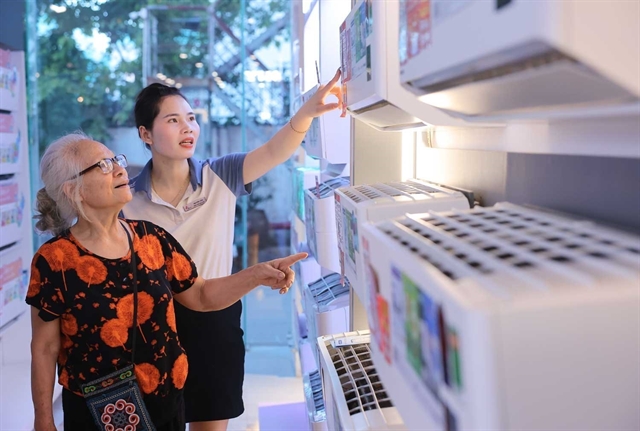 |
| A customer shops for an air conditioner in Hà Nội. —VNA/VNS Photo Hoàng Hiếu |
HÀ NỘI — Under a new project, Việt Nam could reduce greenhouse gas emissions by around 6.1 million tonnes of CO2 equivalent each year, making a significant contribution towards its goal of achieving net-zero emissions by 2050.
The projection was announced by Nguyễn Duy Sơn, Acting Country Operations Manager for the World Bank in Việt Nam, at the launch workshop for the Sustainable Management of Substances Controlled under the Montreal Protocol (SMS-MP) project, organised by the Ministry of Agriculture and Environment in Hà Nội on Friday.
The project is backed by more than VNĐ315 billion (US$12 million) in non-refundable grant funding from the Multilateral Fund for the Implementation of the Montreal Protocol.
It aims to help Việt Nam phase out hydrochlorofluorocarbons (HCFCs), curb the consumption of hydrofluorocarbons (HFCs) and accelerate the transition to environmentally friendly cooling technologies.
Sơn also said that, under the project, thousands of refrigeration technicians would receive training and certification in refrigerant handling, helping to improve workforce skills, create new employment opportunities and boost incomes across the refrigeration and air-conditioning sector.
Speaking at the opening of the workshop, Nguyễn Tuấn Quang, Deputy Director-General in charge of the ministry’s Department of Climate Change, said demand for cooling in Việt Nam was rising rapidly alongside urbanisation and industrialisation.
Without appropriate technological and policy measures, electricity consumption, refrigerant demand and greenhouse gas emissions would continue to increase, he added.
The project would play a key role in promoting technological transformation, developing skilled human resources, improving energy efficiency, encouraging innovation and strengthening the competitiveness of Việt Nam's refrigeration and air-conditioning industry, he said.
According to the department, the project will focus on four main areas of developing a skilled workforce for the refrigeration sector; strengthening import and export management of controlled substances; promoting the adoption of low-global-warming-potential (low-GWP) refrigerants; and reviewing and improving policies while advancing energy-efficient cooling solutions.
A key component of the project involves developing and updating vocational training curricula covering refrigerant management, leak prevention, the use of next-generation refrigerants and safety standards at vocational education institutions.
The project will also provide training, assessments and professional certification for refrigeration and air-conditioning technicians to improve installation, operation and maintenance practices, reduce refrigerant leakage and enhance energy efficiency.
In addition, pilot production, testing and evaluation will be carried out for railway carriage air-conditioning systems using low-GWP refrigerants.
The findings will provide a basis for assessing the technology's technical performance, energy efficiency, safety and commercial feasibility before a suitable national transition roadmap is developed.
HCFCs and HFCs are refrigerants used in air conditioners, refrigerators and other cooling equipment.
Both contain hydrogen, carbon and fluorine, while HCFCs also contain chlorine. Although widely used in the cooling industry, the two groups of substances differ significantly in their environmental impacts.
HCFCs both deplete the ozone layer and contribute to global warming, and are therefore being phased out under the Montreal Protocol. HFCs do not damage the ozone layer but have a very high global warming potential (GWP), making them subject to phased reductions under the Kigali Amendment to the Montreal Protocol.
Nguyễn Đặng Thu Cúc, Deputy Head of the department’s Greenhouse Gas Emissions Management and Ozone Layer Protection Office, said the department has been appointed as the project's implementing agency and is responsible for coordinating activities under the approved project document.
The project aims to help Việt Nam eliminate 97.5 per cent of its baseline HCFC consumption by 2030 and reduce baseline HFC consumption by 10 per cent from 2029, enabling the country to fully meet its obligations as a Party to the Montreal Protocol.
At the same time, the initiative is expected to contribute to greenhouse gas emission reductions by promoting cleaner cooling technologies, improving energy efficiency and strengthening the management of imports and exports of controlled substances. — VNS
Environment
 Environment
 Environment
 Environment
 Environment
 Environment
 Environment
 Environment
 Environment
 Environment
 Environment
 Environment
 Environment
 Environment
 Environment