 Economy

Vietnamese community serves as important bridge in Việt Nam-India ties
1.
|
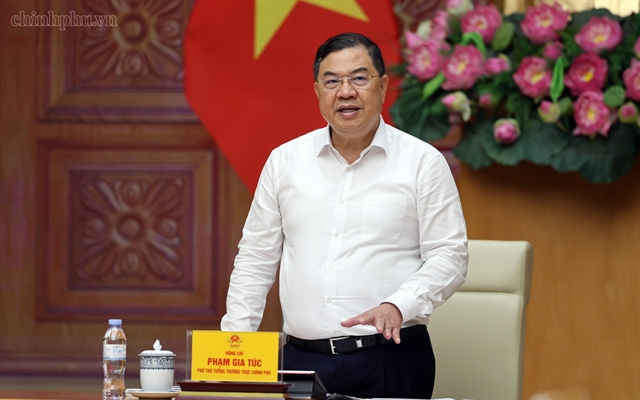
| Deputy Prime Minister Phạm Gia Túc speaking at a government meeting on August 13 to review measures to boost exports and control the trade deficit. — Photo baochinhphu.vn |
HÀ NỘI — Deputy Prime Minister Phạm Gia Túc asked efforts to be hastened to boost exports, cut logistics and compliance costs, and increase domestic production to contain a widening trade deficit.
Túc made the call at a government meeting on August 13 to review measures to boost exports and control the trade deficit. Exports grew in the first seven months of the year, but imports rose faster, putting pressure on Việt Nam's target of achieving double-digit economic growth, he said.
It is critical to clarify why imports have increased sharply while export growth among domestic companies is slowing down and how effectively imported materials, machinery and equipment are being converted into goods for production and export, Túc said.
Statistics of the Ministry of Industry and Trade showed Việt Nam recorded a trade deficit of about US$20.3 billion in January-July. Total trade reached about $659 billion in the first seven months of 2026, up 28.1 per cent from a year earlier. Exports rose 21.7 per cent to $319.7 billion and are poised to expand at 15-16 per cent for the full year.
The foreign-invested sector generated about $255 billion in exports, up 26.5 per cent, while the domestic sector saw a rise of 5.8 per cent to $64.6 billion.
Exports of several industries, including textiles, footwear, wood and agricultural products were slowing down. Coffee exports declined 11.2 per cent to $5.45 billion, rice fell 7.1 per cent to $2.62 billion and rubber dropped 4.6 per cent to $1.55 billion.
Meanwhile, imports of computers, electronics and components rose sharply, mainly to support production and investment expansion, while imports of industrial materials such as metals, steel, chemicals, ore, minerals and plastics also increased.
At the meeting, enterprises said that rising logistics, raw material and compliance costs, along with trade remedies and increasingly stringent green standards, were adding pressure to exporters, calling for further administrative reforms, lower compliance costs, easier access to production inputs and greater support to diversify markets and increase local procurement rates.
In response, Deputy Minister of Agriculture and Environment Nguyễn Hoàng Hiệp said the ministry plans to push for greater market access, diversification and investment in logistics and storage infrastructure to reach an agro-forestry-fishery export revenue of about $54 billion for 2026. The sector saw an export of $42.79 billion in the first seven months, up 7.5 per cent from a year earlier, while imports rose 10.8 per cent to about $31 billion, meaning a trade surplus to $11.67 billion.
Deputy Minister of Science and Technology Lê Xuân Định said that it is necessary to enhance capacity in standards, technical regulations, testing, certification and measurement to help Vietnamese products meet increasingly demanding export-market requirements. He also urged better early warning of technical trade barriers.
The ministry proposed using import data to identify raw materials and inputs that should be prioritised for domestic production and gradually replace imports as well as raising local procurement rates.
The Ministry of Construction called for greater use of multimodal transport, inland waterways and railways, while addressing infrastructure bottlenecks and reviewing regulations on port service charges to reduce logistics costs.
State Bank of Vietnam’s Deputy Governor Phạm Thanh Hà said the central bank will continue to prioritise funding for exports, particularly for the purchase, processing and export of agricultural products, citing data that outstanding credit for exports stood at nearly VNĐ849 trillion ($32.3 billion) at the end of July, up about 30 per cent.
On trade policy, the Ministry of Finance will review proposals to adjust preferential import tariffs on certain product groups. The ministry said much of the current trade deficit was concentrated in raw materials and fuels, with energy imports particularly affected by global prices and market developments.
The Ministry of Foreign Affairs will step up economic diplomacy, support negotiations on new free trade agreements and help businesses tap markets with further growth potential, including Africa and Halal markets.
|
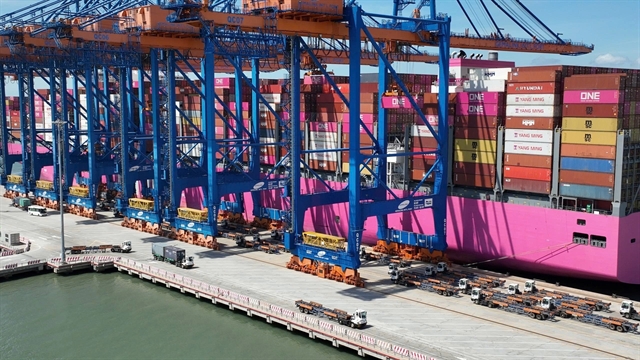
| Containers handled at Gemalink Port, HCM City. Boosting exports together with stronger domestic production is essential to easing pressure from the trade deficit. — VNA/VNS Photo Hoàng Nhị |
Concluding the meeting, Deputy PM Túc said boosting exports is essential to easing pressure from the trade deficit.
He cited estimates by the Ministry of Industry and Trade that Việt Nam would need to generate a substantial trade surplus in the remaining months of the year to balance its trade position, while global markets remain uncertain.
He ordered ministries and local authorities to remove bottlenecks, expand market opening and help exporters connect directly with international distribution and retail networks.
Efforts must be enhanced to promote exports to markets with further growth potential, including Halal markets, Latin America and Africa, while accelerating negotiations on new free trade agreements.
He asked the Ministry of Agriculture and Environment to accelerate negotiations to open more markets for Vietnamese agricultural products and fruit while stepping up efforts to combat illegal, unreported and unregulated (IUU) fishing and speed up the processing of applications for growing-area and farming-area codes, as well as approvals for packing and processing facilities.
Deputy PM Túc also called for faster VAT refunds, better access to credit with appropriate interest rate policies for industries serving exports as well as lower logistics costs.
To contain the trade deficit, Deputy PM Túc said efforts to curb imports must go hand in hand with stronger domestic production.
To reduce reliance on imports, he ordered relevant ministries and agencies to promote domestic production of materials and industrial inputs, develop supporting industries and increase localisation rates.
Review should be carried out for industrial products that can already be produced domestically to propose appropriate tax policy adjustments to encourage greater use of local inputs.
Túc also ordered closer monitoring of foreign-invested companies with large import volumes and businesses whose imports have risen sharply. Authorities should continue reviewing products and materials that could be produced domestically to reduce dependence on imported supplies. — VNS
Economy
 Economy
 Economy
 Economy
 Economy
 Economy
 Economy
 Economy
 Economy
 Economy
 Economy
 Economy
 Economy
 Economy
 Economy