 Economy

VN-Index extends its losing streak to fourth day
1.
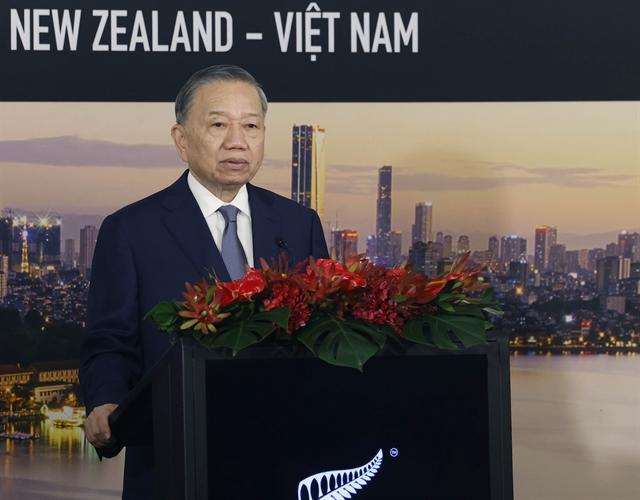 |
| Party General Secretary and President Tô Lâm speaks at a Việt Nam-New Zealand business roundtable in Auckland on August 13 during a state visit to New Zealand. — VNA/VNS Photo |
AUCKLAND — General Secretary of the Communist Party of Việt Nam Central Committee and State President Tô Lâm called on Việt Nam and New Zealand to deepen cooperation in science, technology, innovation and green transformation to create new drivers of economic growth.
Speaking at a Việt Nam-New Zealand business roundtable in Auckland on Thursday during his state visit to New Zealand, the top leader encouraged New Zealand businesses to see Việt Nam not only as a market, but also as a partner for research, product development, manufacturing and innovation in Southeast Asia.
The event was attended by New Zealand Minister of Trade and Investment Todd McClay, leaders of ministries and agencies, and representatives of businesses from both countries.
In his opening remarks, McClay said the visit takes place at an important time for bilateral relations. More than five decades since diplomatic ties were established on June 19, 1975, the relationship has developed into a dynamic partnership spanning trade, education, investment, science, innovation and people-to-people exchanges.
The elevation of ties to a Comprehensive Strategic Partnership in 2025 reflects growing trust, respect and expectations between the two sides, he noted.
The minister described Việt Nam as one of New Zealand’s most important partners in Southeast Asia, highlighting its fast-growing economy, market of more than 100 million people, young workforce and deep integration into global trade.
He said that beyond traditional areas such as agriculture and food, there remains significant potential for cooperation in high-tech agriculture, health technology, education, research and skills development.
The next phase of bilateral economic ties will be increasingly driven by knowledge, technology and innovation, he went on, adding that New Zealand hopes to become a trusted partner of Việt Nam in economic modernisation, productivity improvement and sustainable development.
Business representatives from both countries highlighted growing cooperation in technology, aviation, market connectivity and innovation, saying the partnerships are creating new business models and opening new markets.
General Secretary and President Lâm called for businesses to upgrade agricultural and food cooperation through green value chains, with a focus on smart agriculture, biotechnology, deep processing, cold-chain logistics, traceability and branding.
He also urged the two sides to work together to address standards, quarantine and market access barriers, saying the goal is not only to increase trade, but also to build green, transparent, sustainable and resilient supply chains.
Việt Nam is ready to serve as a gateway for New Zealand businesses seeking to expand into ASEAN, while New Zealand could act as a bridge for Vietnamese companies to integrate more deeply into high-quality value chains in the Pacific region, Lâm said.
He also called for stronger links between universities, research institutions and businesses in training, applied research, technology transfer, skills development and innovation.
Lâm said Việt Nam is committed to improving its investment environment to make it stable, transparent and competitive. It is also committed to facilitating long-term investment by New Zealand businesses, particularly in high-tech agriculture, food processing, education, science and technology, innovation and the green economy, he added.
He said bilateral economic cooperation should be translated into concrete programmes, projects and results. Its success should be measured not only by trade turnover or the number of projects, but also by the quality of connectivity, technological content, participation in emerging value chains and tangible benefits for businesses and people.
At the roundtable, witnessed by Vietnamese Minister of Finance Ngô Văn Tuấn and McClay, businesses and organisations from the two countries exchanged cooperation documents aimed at turning the agreed directions into concrete initiatives. — VNS
Economy
 Economy
 Economy
 Economy
 Economy
 Economy
 Economy
 Economy
 Economy
 Economy
 Economy
 Economy
 Economy
 Economy
 Economy