 Economy


Quảng Trị allocates $3.48m for landmine clearance in six communes
1.
|
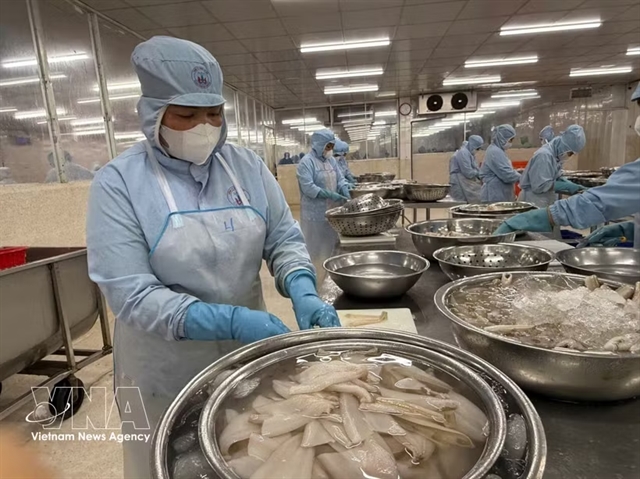
| Fish processing for export to Japan. — VNA/VNS Photo |
HÀ NỘI — Year-end festival demand and positive signals from key markets are giving Việt Nam’s seafood exporters a chance to accelerate in the final months of this year.
That puts the industry on course for a record US$12 billion, though price competition, traceability rules and compliance costs remain heavy pressures.
Momentum holds
The Ministry of Agriculture and Environment data show that total seafood output reached 7.89 million tonnes in January-September, 78.1 per cent of the annual plan and up 3.9 per cent annually. Aquaculture drove growth at 4.86 million tonnes while exports hit $9.7 billion by October 15.
Shrimp and tra fish remain the backbone.
According to the Việt Nam Association of Seafood Exporters and Producers (VASEP), shrimp exports stood at $3.75 billion, up 11 per cent year-on-year, accounting for 41 per cent of total seafood export value, making shrimp the swing factor for the sector.
VASEP market expert Phùng Thị Kim Thu said China and some Comprehensive and Progressive Agreement for Trans-Pacific Partnership (CPTPP) markets kept growth alive, but momentum slowed in September as shrimp exports to the US fell.
Tariffs, international competition and raw material constraints are the main risks for the rest of the year.
Tra fish had a stronger September, at about $214 million, up 18.6 per cent; nine-month exports hit $1.74 billion, up 10.7 per cent.
VASEP Deputy Secretary General Lê Hằng said tighter supply of some whitefish species creates room for Việt Nam. Japan is a notable but still small signal as tra fish enters professional distribution channels. Price advantage and stable supply are improving traction.
Export gains were matched by decent production and aquaculture growth, helping secure supply for domestic consumption and processing.
The ministry said nine-month output totalled 7.89 million tonnes: fish at 5.41 million tonnes, shrimp at nearly 1.38 million tonnes and other seafood at 1.1 million tonnes. Aquaculture remains the main growth engine, with marine fishing supplementing raw material.
Aquaculture growth has been supported by science, technology and higher productivity, quality and efficiency.
In the Mekong Delta, brackish-water shrimp farms are in the main harvest; shrimp-rice and shrimp-forest models remain effective while intensive and super-intensive hi-tech areas expand. Tra fish output is stable; tilapia and marine aquaculture are diversifying supply.
Year-end sprint
Trần Gia Long, deputy director of the Planning-Finance Department at the ministry, said in order to meet and exceed the $74 billion target for agro-forestry and fisheries exports this year, seafood alone needs about $1 billion a month in the final months, with shrimp still expected to lead.
To deliver, the sector must stabilise raw materials, improve quality and raise production efficiency. In aquaculture, more technology, disease control and market-linked production will reduce risk and improve economic efficiency.
Stronger links among farmers, fishermen, processors and exporters will make procurement planning more proactive, limit supply swings and improve order fulfillment. Companies also need flexibility in production, product mix and market selection, plus cost control to stay competitive. — VNA/VNS
Economy
 Economy
 Economy
 Economy
 Economy
 Economy
 Economy
 Economy
 Economy
 Economy
 Economy
 Economy
 Economy
 Economy
 Economy