 Society
Quảng Trị allocates $3.48m for landmine clearance in six communes
1.
|
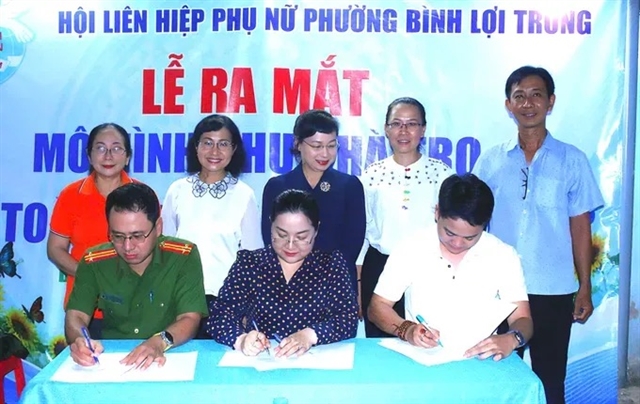
| Mass organisations in HCM City’s Bình Lợi Trung Ward sign a coordination agreement at the launch of the “Safe Rental Housing for Women and Children” model on October 30. — Photos www.sggp.org.vn |
HCM CITY — HCM City has established 194 “Safe Rental Housing for Women and Children” models across 128 communes and wards, creating a robust safety net for female migrant workers and children as local authorities pivot toward long-term operational quality and sustainability.
The initiative was highlighted at a conference hosted by the city Women’s Union on October 30 to review and expand the model citywide.
The event, attended by delegates in person and online across wards, communes, and special administrative zones, served as a platform to showcase effective practices, identify operational bottlenecks, and chart the city’s strategic vision for rental housing safety through 2030.
Multidimensional safety shield
Rapid urbanisation has drawn millions of migrant workers to the city, placing growing pressure on local authorities to ensure public order, fire safety, and social welfare in densely populated lodging areas.
To address these challenges, the city Women’s Union collaborated with local authorities, police forces, and property owners to launch the safe rental housing framework.
The model evaluates complexes across five core criteria: security and order, fire prevention, protection for women and children, community self-management, and green, civilised living environments.
In practice, participating rental complexes have installed security cameras, fire extinguishers, clear internal regulations, and emergency hotline numbers.
They have also established self-managed security teams and volunteer firefighting units.
In Linh Xuân Ward, local police and the ward’s Women’s Union recently established a self-management team at a lodging facility on Street 7, pairing physical safety measures with direct legal awareness sessions on anti-trafficking and narcotics prevention led by PC01 officers of the city Police.
Beyond security, the initiative addresses holistic well-being.
Local unions and property owners have partnered to provide health check-ups, legal consultations, and educational support for children.
Vũ Thị Châu, permanent vice chairwoman of the Vietnam Fatherland Front Committee and chairwoman of the Women’s Union of Hòa Bình Ward, said several locations have integrated the city's Cultural Spaces and green recreational areas into lodging grounds to foster community cohesion.
Safety criteria for women and children as well as inter-family fire safety protocols have been seamlessly integrated into the city's existing foundation of drug-free lodging complexes to better protect vulnerable residents.
"We are expanding recreational spaces and cultural hubs within rental units so workers can enrich their knowledge and build connected communities,” Châu said.
Refocusing on quality over quantity
Despite initial success in reducing crime risks and domestic violence, delegates at the conference pointed out key implementation hurdles.
Certain self-managed teams operate formalistically, post-recognition inspections remain irregular, emergency response protocols can be hesitant, and inter-agency coordination varies across districts.
In response to these operational limitations, the city Women’s Union stressed the need for a strategic pivot, prioritising tangible quality improvements and standard enforcement over simply expanding the quantity of lodging models.
Local union chapters have been instructed to prioritise routine monitoring, maintain strict criteria compliance, and prevent the drop in quality after formal recognition.

|
| Gifts are presented to disadvantaged women at a “Safe Rental Housing for Women and Children” complex in HCM City’s Bình Thới Ward on October 30. |
Nguyễn Tấn Lực, permanent deputy secretary of the Party Committee of Tân Thới Hiệp Ward, said local authorities regularly arrange legal counseling sessions for lodging residents while encouraging landlords to maintain or reduce rental fees for individuals facing financial hardship.
"Once recognised, facilities must sustain their performance over time to avoid short-lived efforts," he said.
Human-centred care toward 2030
At its core, the model leverages social compassion to ease the financial burden on low-income workers.
Local union chapters across various wards, including Bình Thới, Bình Tiên, and Phú An, routinely provide essential goods, financial aid, and educational support to underprivileged families living in lodging facilities.
Huỳnh Thị Thúy Phương, Vice Chairwoman of the HCMC Women’s Union, underscored that the city actively coordinates resources to support workers in distress.
“Landlords are encouraged to offer rent reductions and utility subsidies, while local chapters step in to assist sick children or struggling families.”
Looking ahead to 2030, the city aims to build at least 50 fully standardised safe rental complexes while scaling up proven localised practices.
Through structured oversight and community involvement, the city is transforming basic lodging units into safe, civilised, and compassionate living spaces for all residents. — VNS
Society
 Society
 Society
 Society
 Society
 Society
 Society
 Society
 Society
 Society
 Society
 Society
 Society
.jpg) Society
 Society