 Society
Vietnamese, Lao legislatures strengthen strategic ties
1.
|
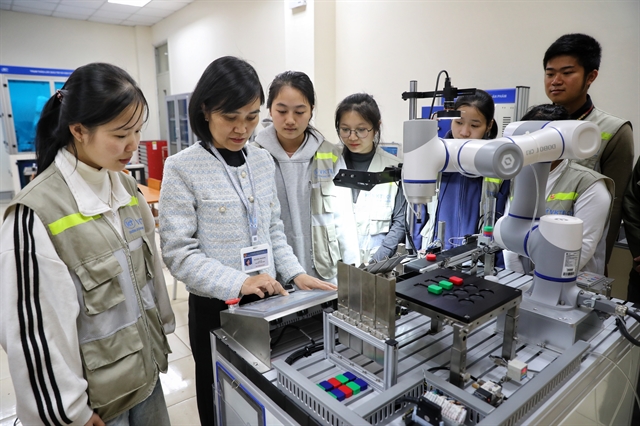
| Students attend a microcontroller programming practical session at Việt Nam-Korea College of Technology in Bắc Ninh Province. — VNA/VNS Photo Danh Lam |
HÀ NỘI — The Government plans to allocate around 0.1 per cent of gross domestic product annually to attracting and developing talent, as it seeks to strengthen strategic industries and boost innovation.
Deputy Prime Minister Phạm Thị Thanh Trà recently signed a resolution on outlining an action plan to implement a directive by the 14th Party Central Committee on attracting and making better use of talented people.
The funding will come from overall allocations for science and technology, innovation and digital transformation. Authorities with independent budget control may allocate more.
The plan calls for special policies on recruitment, payment and benefits, and professional development, as well as investment in research facilities and measures to attract overseas Vietnamese and foreign experts.
The Ministry of Home Affairs will develop a national framework for identifying talent, review existing recruitment policies and propose improvements to salaries, housing and land policies. Mountainous, border and island areas will receive priority.
A national talent database, index system and information portal will also be established to improve recruitment and workforce planning while protecting personal data.
The Government plans to introduce safeguards for people undertaking innovative work in good faith for the public interest, while distinguishing legitimate risk-taking from fraud and other legal violations.
The Ministry of Science and Technology will identify priority industries, strategic programmes and major national projects requiring highly skilled personnel.
Investment will focus on research teams, national laboratories, strategic technology centres, innovation hubs and high-performance computing facilities. Digital platforms will also be developed to identify talent, connect candidates with opportunities and forecast workforce needs.
A programme called 'Talent leads talent', led by the Ministry of Education and Training, will connect leading experts with young professionals through mentoring, training and research opportunities.
It will prioritise talented students in strategic fields and help scientists, engineers, managers, entrepreneurs and highly skilled workers reach international standards.
Outstanding scientists and young talent will also be selected for training and research at leading overseas universities, research institutes and technology companies, with their work linked to domestic development needs.
The Government will encourage businesses to co-finance training, research and innovation, particularly in strategic industries and emerging technologies. Selected universities, research institutes and laboratories will receive investment to reach regional and international standards.
Ministries and local authorities will incorporate talent development into their development plans, with recruitment results serving as one criterion for assessing agency leaders.
Selection procedures will be diversified and based on candidates' abilities, achievements and actual contributions. Administrative formalities will also be simplified.
The plan calls for stronger cooperation among universities, research institutions, businesses and local authorities, as well as expanded international partnerships to attract overseas Vietnamese and foreign experts for research, training and technology transfer.
Ministries and agencies will be required to identify recruitment needs and funding for sector-specific talent programmes while avoiding overlapping initiatives and policies. — VNS
Society
 Society
 Society
 Society
 Society
 Society
 Society
 Society
 Society
.jpg) Society
 Society
 Society
 Society
 Society
 Society