 Society
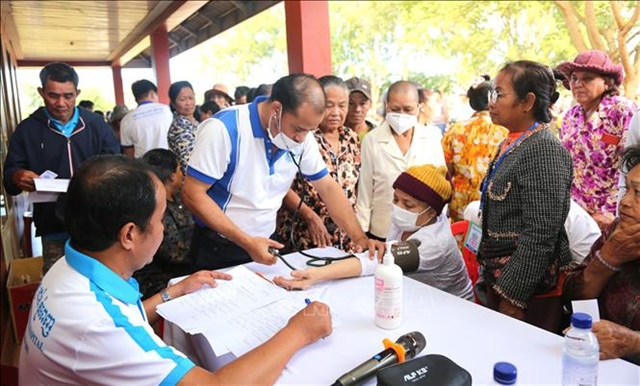
Free medical examinations provided to remote communities in Cambodia
1.
 |
| Experts discuss support initiatives for Vietnamese interns and workers in Germany. — VNA/VNS Photo Thùy Linh |
BERLIN — The Union of Vietnamese Associations in Germany (VBD Vietnam), in coordination with the programme shaping development-oriented migration (MEG/GIZ), held a seminar on building a fair and ethical labour migration model in Germany, at Đồng Xuân cultural house in Berlin.
The Friday event, which attracted more than 160 participants, took place against the backdrop of growing cooperation between Việt Nam and Germany in labour migration and vocational training.
However, this cooperation also raises a number of issues concerning the protection of workers’ rights and their safety as well as the integration conditions for migrant workers and vocational trainees.
Through the seminar, the organisers aim to promote a shift from spontaneous support activities towards an organised coordination mechanism, while harnessing the experience, resources and networks of the Vietnamese community in Germany to support migrant workers.
Professor Nguyễn Xuân Thính, acting chairman of VBD Vietnam, said the Vietnamese community was well positioned to provide guidance and support to newcomers, helping them identify potential difficulties early and find opportunities to integrate into local society.
VBD Vietnam should develop into a federal-level coordination hub, while its member associations should take responsibility for reaching out to and supporting Vietnamese people in their localities, serving as a “bridge” to help newly arrived workers integrate and engage with the community, he said.
Phan Quang Văn, first secretary in charge of educational cooperation and student affairs at the Vietnamese Embassy in Germany, stressed the need to strengthen coordination among the Vietnamese community, businesses, training institutions, German authorities and the Vietnamese Embassy in this regard.
Lichtenberg district Mayor Martin Schaefer said Germany had a strong demand for migrant workers, particularly skilled labour, to meet the needs of its labour market.
The Lichtenberg administration will remain a reliable partner and provide long-term support to foreign communities, including the Vietnamese community, he pledged.
Participants highlighted several persistent challenges, notably differing German-language proficiency requirements, shortcomings in language training, cases in which Vietnamese trainees were turned away by some companies, and instances where workers’ rights were not fully protected. They also stressed the need to ensure recruitment quality from the outset.
They noted that population ageing would mean Germany continued to need workers from third countries, including Việt Nam.
In this context, strengthening the Vietnamese community’s role and voice in shaping fair migration policies, while enhancing the accountability of recruiting companies and labour brokers, was considered key to ensuring safe and sustainable labour migration to Germany. — VNA/VNS
Society
 Society
.jpg) Society
 Society
 Society
 Society
 Society
 Society
 Society
 Society
 Society
 Society
.JPG) Society
 Society
 Society