 Society
Railway investment boom must translate into domestic industrial capacity
1.
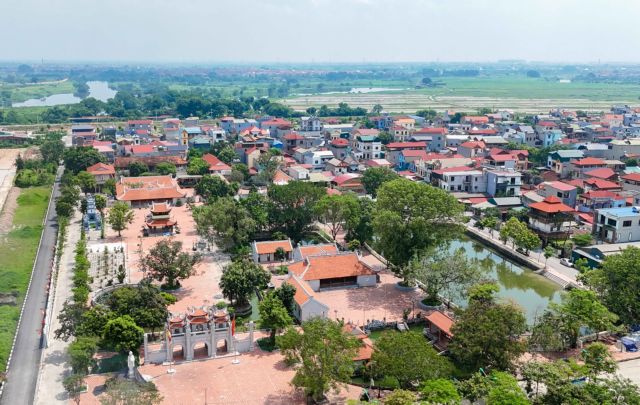 |
| An aerial view of Hà Nội's Thư Lâm Commune, one of two communes selected to pilot the ‘socialist commune’ model. — VNA/VNS Photo |
HÀ NỘI — Hà Văn Đạm found the right counter by following the signs. It was his first time handling paperwork at the one-stop administrative centre in Thư Lâm, a rural commune on the outskirts of Hà Nội, and not a trip he had expected to make.
When he bought a plot of land last year, he assumed the authorities would update his tax records once the sale went through. Only when he started asking did he learn there was another procedure to complete.
An official talked him through the declaration and gave him a date to come back for the result. "The staff were really helpful. They walked me through it using the guidance sheet," Đạm said.
What struck him was the sense of order: everything happened in sequence, which made the whole process easier to navigate.
Trần Thanh Hải came to the same centre on behalf of her son, who had completed the online application for a certificate of his marital status but could not get away from work.
Staff dealt with her quickly, she said; she hardly had to wait. Her hope is that it stays that way, with nobody sent back and forth because one procedure overlaps with another.
Clear instructions, a process that makes sense and officials who take ownership of the job are perhaps modest demands, but they are exactly what Hà Nội now says it will measure.
Thư Lâm and Phúc Thịnh are the two communes chosen to pilot the city’s model of the 'socialist commune'. Banners, slogans and brightly coloured flags line their main roads. The promise behind the bunting is that progress will be counted not only in new buildings and economic indicators but also in how satisfied, and how happy, residents are.
The experiment was launched in July by the Hà Nội authorities. According to Nguyễn Xuân Lưu, vice chairman of the municipal People's Committee, the two communes were picked for their location, cultural traditions, the capacity of their officials and the cohesion of their communities.
The idea is to test a model of governance at the level closest to the people before deciding whether to roll it out more widely.
That ambition has been broken down into 54 criteria, scored out of 100 and spanning everything from governance and infrastructure to culture, security and digital transformation. Alongside the familiar material targets sit less conventional ones: a score of 9.5 out of 10 on a residents’ happiness index, and overall satisfaction of at least 95 per cent.
Moving forward
These are goals to work towards, not results either commune has achieved, according to Trần Đức Thắng, secretary of the city’s Communist Party Committee. Every policy, building and project must ultimately be measured by the quality of people’s lives and by whether they are satisfied and happy.
A project finished on schedule still has to prove it serves the people using it. In Phúc Thịnh, on the Red River at the capital’s northern gateway, the happiness index is treated as the measure that pulls everything else together. "Every local initiative is meant to raise it," said Đặng Minh Thắng, the commune’s deputy party secretary.
That means attending to jobs, incomes, welfare, culture and community ties, not just growth. The commune is digitising welfare records, strengthening local health services and supporting families living below the poverty line.
In Thư Lâm, every task now comes with a named owner, a deadline and a defined result, according to Nguyễn Thị Thanh Tâm, the commune’s party secretary.
The aim is to end the vague instructions that made it hard to hold anyone to account. The pilot calls for at least 98 per cent of procedures to be handled on time, and at the counter the commune has introduced a 'No Come-Back Day': any application that can be settled on the spot should be. If it can’t, staff must explain the hold-up and give a date for the result.
Out in the villages, the campaign leans on residents themselves. In Hà Lâm, local groups each took on a job during the commune’s 100 days of action, a campaign dedicated to the people’s happiness.
The women’s union adopted a flower-lined road; the war veterans’ association spruced up the ponds; the farmers’ association took charge of a stretch of road; the youth union set up a 'digital' community hall.
 |
| Commune officials in Thư Lâm go door to door to explain the ‘socialist commune’ pilot programme and listen to residents’ opinions. — VNA/VNS Photo |
Everything was finished on schedule, said Nguyễn Hữu Tửu, who heads the village branch of the Việt Nam Motherland Front. But the value lay less in the money spent than in the way the work was shared out, giving residents a stake in maintaining what they had built.
Listening and acting
Nguyễn Đức Nhân was born and raised in Lỗ Giao, another of Thư Lâm’s villages, and has pitched in on village projects from his youth into old age. He is proud to see the commune take on the pilot, he said, and what he and his neighbours want is for life to keep getting better.
Away from the counter, the hardest questions are about land. New roads and sprawling urban developments are remaking Thư Lâm’s countryside, and families whose land is being acquired want to know what compensation and support they will receive, and how they will earn a living afterwards. It is here that the commune’s willingness to listen is really tested.
Tâm described cases in which one family’s land falls within two projects, with different policies and different payouts, and people have unsurprisingly asked why. The commune has sent outreach teams to hear such concerns and explain the rules, and has set up forums where residents can put forward opinions and ideas.
Listening, though, is only the start. What matters is whether people can see what became of what they said: which petitions have been resolved, which are still pending, and who is responsible.
The pilot aims for at least 95 per cent of petitions to be resolved at the grassroots level and 90 per cent of families to take part in policy consultations. Those targets will mean little unless the counting is transparent and it is clear what 'resolved' and 'taken part' actually mean.
Phúc Thịnh has gone further and created a commune-level 'discussion council' of village and community representatives. Its members serve two-year terms and have a formal say on public funding projects, planning proposals and the assessment of local officials.
Hà Nội plans an interim review in 2030 and a full one in 2035, but residents will be looking for progress well before then. From a village lane to a major decision, the test is the same: whether people get to take part, are listened to and end up better off.
The flowers on Hà Lâm’s road will still need tending long after the day the job was declared done – and whether anyone keeps watering them may say as much about the experiment as any of its criteria. — VNS
Society
 Society
 Society
.JPG) Society
 Society
 Society
 Society
 Society
 Society
 Society
 Society
 Society
 Society
 Society
 Society