 Society

Bamboo circus show tells Vietnamese village stories on Hà Nội stage
1.
|
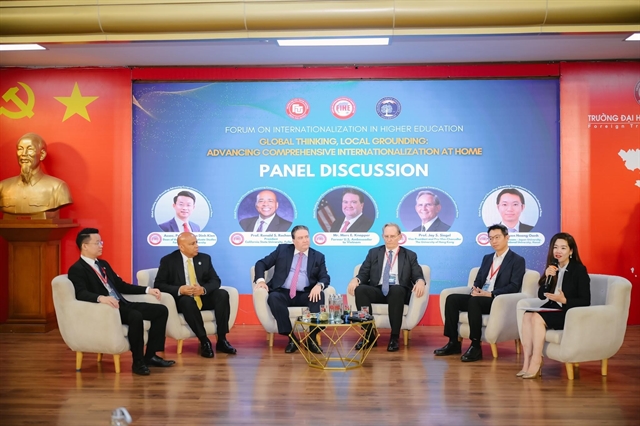
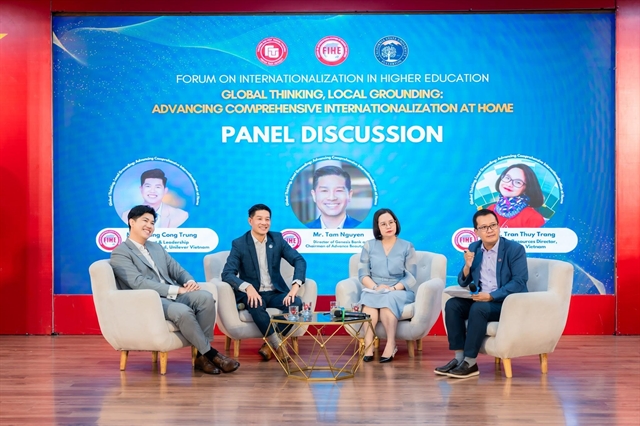
| A panel discussion at the 8th Forum on the Internationalisation of Higher Education (FIHE 8), held in Hà Nội on October 29. — Photo courtesy of the FTU |
HÀ NỘI — Higher education leaders from Việt Nam and abroad discussed advancing internationalisation during the 8th Forum on the Internationalisation of Higher Education (FIHE 8), held in Hà Nội on Thursday.
Themed 'Global Thinking, Local Grounding: Advancing Comprehensive Internationalisation at Home', the forum was jointly organised by the Foreign Trade University (FTU) and California State University, Fullerton (CSUF).
FIHE 8 served as a platform for universities, international partners and businesses to exchange ideas on how to bring international opportunities closer to learners within their own domestic educational environments.
|
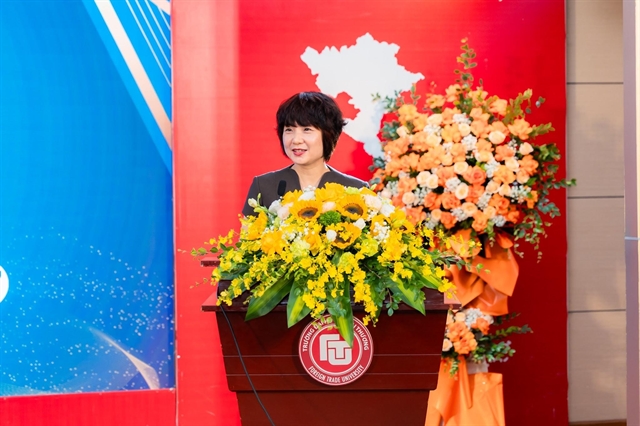
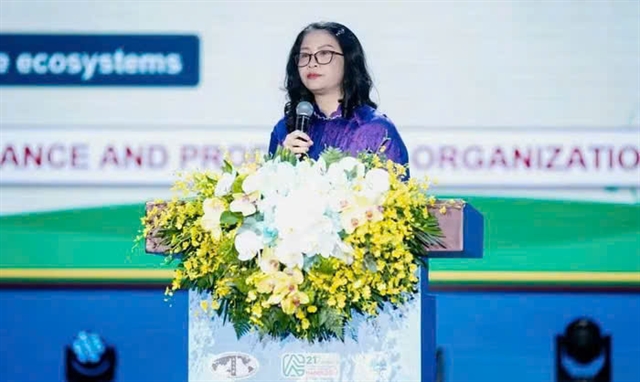
| Associate Professor Dr Phạm Thu Hương, president of FTU, speaks at the event.— Photo courtesy of FTU |
In her opening remarks, FTU President and Associate Professor Dr Phạm Thu Hương addressed the rapid changes in higher education driven by emerging technologies, global challenges and shifts in the labour market.
According to Dr Hương, students today need not only professional knowledge, but also global competencies, intercultural understanding and adaptability. However, not every student has the opportunity to study abroad. Internationalisation must bring value to all learners, including those who do not participate in international student exchange programmes.
Against this backdrop, FIHE 8 focused on two main questions: how universities can fully implement internationalisation at home, and how this process can create greater value for students, universities and businesses.
|
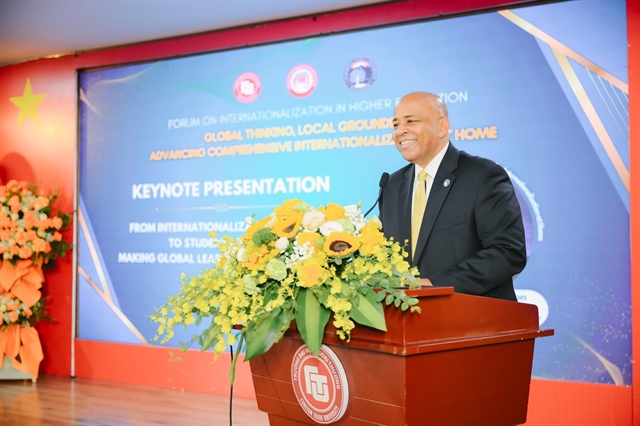
| Dr Ronald Rochon, president of California State University, Fullerton (CSUF), speaks at the event.— Photo courtesy of FTU |
CSUF President Dr Ronald Rochon said that while internationalisation was previously often associated with students going abroad, the more important question today is how international learning opportunities can reach students who cannot participate in exchange programmes.
He noted that students at CSUF speak as many as 94 different languages, but a diverse environment does not necessarily create mutual understanding on its own. What matters is that universities create opportunities for students to meet, interact and learn from people with different backgrounds.
Professor Jay Siegel, vice president and pro vice-chancellor of the University of Hong Kong, focused on the cultural dimension. He said that if universities expect students to develop global mindsets, international understanding and the ability to work across differences, they must first create an environment open enough for students to truly experience these values.
He emphasised the message 'Integrate, but don’t dissolve' as an important principle: internationalisation does not mean losing one's identity, but learning to respect differences, understand others and remain confident in one's own values.
Experts at the forum discussed how universities can create international learning opportunities and experiences on campus, while preparing students with the competencies needed to study and work in a global environment.
In the discussion, panellists agreed that internationalisation at home cannot be measured solely by the number of programmes or students going abroad. What matters more is what students actually gain: a sense of belonging, the ability to work across differences, an open mindset and specific skills developed through each experience.
The assessment of internationalisation thus needs to shift from asking 'How many students participated?' to 'What did students actually achieve?'
|
| Panellists discuss how university-industry partnerships and international educational experiences can be transformed into student competencies. — Photo courtesy of FTU |
Delegates also discussed how university-industry partnerships and international educational experiences can be transformed into students' actual competencies.
FTU Vice President and Associate Professor Dr Nguyễn Minh Hằng said that universities and businesses need closer and more innovative cooperation. According to Hằng, what matters is not the number of agreements signed, but the quality of cooperation and the practical value students receive.
From a business perspective, the delegates agreed that the skills needed for a global workplace, such as adaptability, the ability to collaborate with people from different backgrounds and perspectives, applying knowledge in practice and learning from experience, need to be developed while students are still at university.
Universities and businesses thus need to participate in students' development from an early stage, connecting academic knowledge with real-world requirements and contexts to jointly develop the global competencies students need.
Across both sessions, FIHE 8 demonstrated that internationalisation at home is not simply about organising more international activities within universities.
More importantly, it is about creating an environment where all students have opportunities to encounter different perspectives, learn to work across differences and gradually develop the skills needed for the future. — VNS
Society
 Society
 Society
 Society
 Society
 Society
 Society
 Society
 Society
 Society
 Society
 Society
 Society
 Society
 Society