 Society

YF Life Proudly Claims Two Top 3 Accolades at the Hong Kong Insurance Awards 2026
1.
|
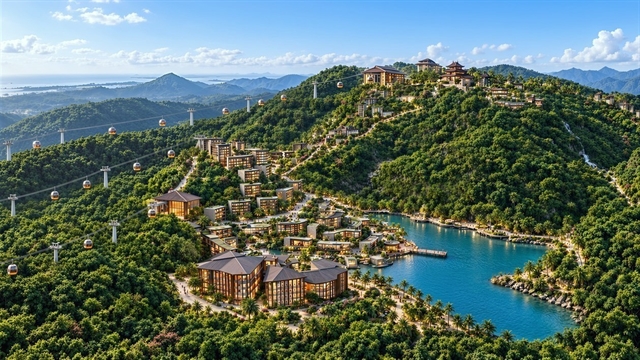
| Overall perspective of the U Bò Mountain – Thác Chuối Lake eco-tourism, resort, and entertainment complex in the central province of Quảng Trị. — VNA/VNS Photo |
QUẢNG TRỊ — A groundbreaking ceremony for the U Bò Mountain – Thác Chuối Lake eco-tourism, resort, and entertainment complex, with a total investment of over VNĐ16.2 trillion (US$640 million), took place on Friday morning in the central province of Quảng Trị.
The ceremony was jointly organised by the provincial People’s Committee and the private developer Sun Group.
Covering approximately 167.48 ha across the communes of Bố Trạch, Thượng Trạch and Trường Sơn, the project comprises two main areas of Thác Chuối (Banana Waterfall) Lake and the summit of U Bò Mountain, which rises more than 1,000 metres above sea level. The two areas will be connected by a network of five cable car routes.
The project will be developed in four phases from the fourth quarter of this year to the second quarter of 2037.
The first phase is expected to be completed in the second quarter of 2028, with two cable car routes and essential infrastructure facilities scheduled to begin operations.
Making use of the area's lakes, mountain forests and highland climate, the complex is designed to offer a range of resort, entertainment and cultural and nature-based experiences.
It will connect attractions from the foothills to the mountain summit, catering to visitors seeking both sightseeing opportunities and extended stays.
At the foot of the mountain, the Thác Chuối Lake area will be developed into an eco-resort destination along the lakeshore, inspired by the layout of traditional river-based settlements.
Planned facilities include an art and cultural museum, an open-air theatre, a traditional market and a floating food and dining area, providing spaces for visitors to discover and experience local culture.
At an elevation of more than 1,000m, the U Bò Mountain summit area will combine entertainment, cultural experiences and resort facilities.
Its centrepiece will be the Nagara entertainment complex, inspired by Kalan temple architecture and Champa cosmology.
The development will be arranged across three levels of the mountain slope, featuring a recreation of an ancient kingdom, an ethnic cultural village, a scenic lake, the iconic U Bò Tower and observation decks overlooking the surrounding mountains, forests and sea of clouds.
Under the master plan, the project's maximum overall construction density will be approximately 18.8 per cent. Buildings will be designed to follow the natural terrain, minimising impacts on the landscape and adjacent forest areas.
The five cable car routes will connect the project's different zones, each with a designed capacity of 3,500-4,500 passengers per hour. Together, they will form a sightseeing journey of approximately 7km.
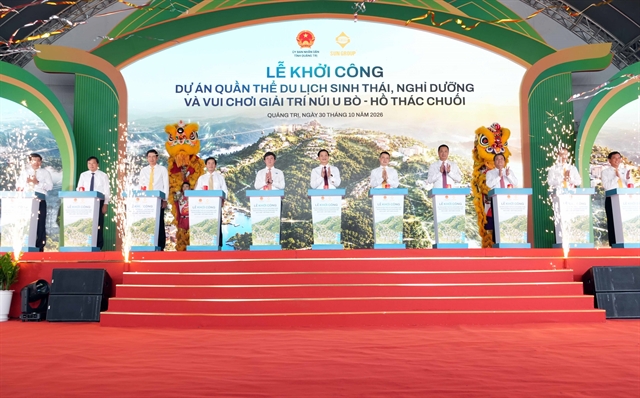
|
| Delegates perform the groundbreaking ceremony for the U Bò Mountain – Thác Chuối Lake eco-tourism, resort, and entertainment complex in the central province of Quảng Trị on Friday. — VNA/VNS Photo Tá Chuyên |
Speaking at the ceremony, Chairman of the provincial People's Committee Bùi Hoàng Phương said the large-scale project was located within the buffer zone of Phong Nha–Kẻ Bàng National Park.
Both the provincial authorities and the investor had therefore adopted a cautious and thorough approach from the preparation stage, with particular attention paid to heritage conservation and environmental protection.
"We believe tourism development must go hand in hand with heritage conservation. Harnessing the potential of nature must be accompanied by preserving landscapes, protecting the environment and ensuring sustainable livelihoods for local residents,” he said.
With the approach, the project has undergone a rigorous heritage impact assessment process, with professional consultation from domestic and international expert councils and relevant ministries and sectors. The project dossier has also been submitted to UNESCO for consultation, he said.
Phương also said breaking ground on the project also meant entrusting the investor with a valuable natural asset that required responsible conservation and development.
He described the area as a "precious gem" with the potential to contribute to the development of the province and the country's tourism sector if properly invested in and managed.
The province has considerable tourism potential, with Phong Nha–Kẻ Bàng National Park, a UNESCO World Natural Heritage Site, its extensive cave systems, the landscapes of the Trường Sơn mountain range, a long coastline and numerous historical and cultural sites.
In 2025, the province welcomed approximately 9.6 million visitors, generating an estimated VNĐ11.04 trillion ($428 million) in tourism revenue.
However, its tourism infrastructure still lacks large-scale, high-quality integrated resort and entertainment complexes capable of encouraging longer stays and increasing visitor spending.
Against this backdrop, the U Bò Mountain–Thác Chuối Lake project is expected to diversify the province's tourism offerings with resort facilities, entertainment attractions and experiences centred on nature and local culture.
Once completed, the complex could be incorporated into wider itineraries linking exploration of Phong Nha–Kẻ Bàng with coastal, historical and cultural tourism, helping expand the province's tourism development space. — VNS
Society
 Society
 Society
 Society
 Society
 Society
 Society
 Society
 Society
 Society
 Society
 Society
 Society
 Society
 Society