 Society
Việt Nam advances child development strategy towards 2045
1.
|
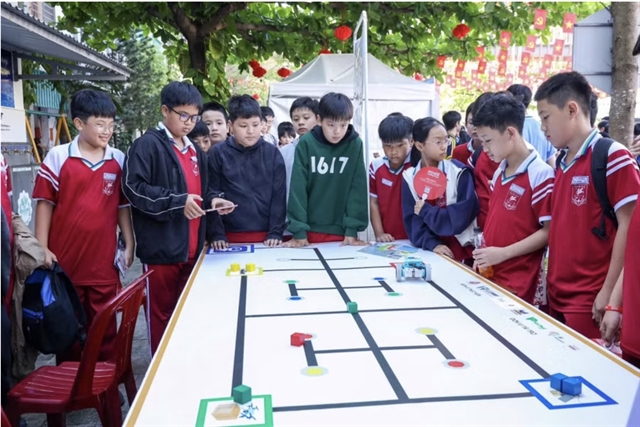
| Students at Nguyễn Huệ School in Đà Nẵng City during a STEM-related activity. Photo giaoducthoidai.vn |
ĐÀ NẴNG - At an 11th-grade chemistry lesson on preparing natural pH indicators at Trần Phú High School in Đà Nẵng, the class starts with a question from the kitchen: why does purple cabbage turn pink when lemon juice is added to it for a salad?
Instead of sitting through a lecture on pH and colour indicators, students were asked to prepare colour indicators themselves from natural materials, such as cabbage, butterfly pea flowers, hibiscus flowers or red amaranth. They learned how to extract their juices, experimented with acidic and basic solutions, and observed the colour changes themselves.
Then, they had to note down the results, calculate costs and present the process, while teachers proposed potential products for a commercially viable pH indicator.
For lessons like this in science, technology, engineering and mathematics (STEM) education, teachers need both knowledge of chemistry as well as product design, so they can help students carry out the experimental process and create solutions.
Developing teachers' STEM skills through a practice-oriented approach, combined with ongoing support, is key to help ensure the effectiveness of STEM education, according to many working in the sector.
Chemistry teachers at Trần Phú School said that STEM lessons create opportunities for students to use theories in practice, develop their problem-solving, research and planning skills, and put all of these together to create and improve potential products.
School principal Nguyễn Cửu Huy told giaoducthoidai.vn: “STEM teaching and learning at the upper-secondary level place high demands on teachers’ subject expertise and their ability to work across and integrate different disciplines.
“Not all teachers have the skills needed to guide students through such a wide range of activities. For example, a physics teacher may have a strong grasp of the subject, but may still need to develop skills in project management and helping students to design and build products."
Huy added: “STEM training for teachers should go beyond simply introducing a number of activities. Teachers need to develop the ability to design tasks, organise learning processes, ask thought-provoking questions and help students find solutions."
Drawing on her practical experience in developing teachers' STEM education skills, Dr Nguyễn Thị Khánh Hồng from the University of Technology and Education under the University of Đà Nẵng said the effectiveness of STEM education depends on teachers’ capabilities rather than the number of pieces of equipment available.
According to Hồng, STEM teachers need three core competencies: lesson design, activity organisation and learning assessment.
“When developing a STEM topic, teachers must start with a real-world problem and then select interdisciplinary knowledge to address it, while ensuring that the learning outcomes meet the requirements of the 2018 General Education Curriculum,” Hồng said.
In organising lessons, teachers shift from delivering knowledge to guiding students as they explore, experiment with and refine their solutions. Methods such as project-based learning and inquiry-based learning can be applied flexibly according to the objectives and content of each lesson.
Assessment is another area that requires particular attention.
“A STEM lesson cannot be assessed solely on whether the final product works. Teachers need to establish criteria covering the entire process, from how students identify a problem and select a design solution to testing, improving their products, collaborating and presenting their work,” Hồng said.
Phạm Thị Thùy Loan, vice principal of Nguyễn Huệ Secondary School in Đà Nẵng’s Hải Châu Ward, said teachers are the decisive factor in the success or failure of STEM education.
The essence of STEM is integrated learning and problem-solving, rather than training students to become specialised scientists. The school thus plans to focus teacher training on a learning by doing approach, in which teachers take on the role of learners and gain first-hand experience in product design and trial-and-error processes before guiding students.
Nguyễn Huệ Secondary School also encourages subject teams to select topics based on natural phenomena or real-life problems that are familiar to students and appropriate to their learning conditions.
During projects, teachers encourage students to work in teams, give presentations, engage in critical discussion and develop their own design solutions within appropriate constraints.
The school has formed a group of key STEM teachers to give expertise and support to other teachers. They share their experiences in STEM education, including brainstorming topics, carrying out projects and testing products.
The demand for STEM education training among teachers is substantial, but needs vary across regions and subject areas.
Training courses could adopt a blended learning approach, combining face-to-face and online sessions to enable teachers to gain hands-on experience, exchange professional knowledge and independently study materials on digital platforms.
Each teacher should develop a specific lesson plan that can be put into practice in the classroom immediately after training. Training should also be followed by ongoing support, consultation and exchanges as teachers implement what they have learnt.
This stage is often overlooked, meaning that knowledge acquired during training is not fully applied in classroom teaching.
A sustainable STEM education ecosystem cannot rely solely on isolated events. It requires a transformation driven by the teaching workforce itself. Once schoolteachers have mastered STEM teaching methods, they can become the most effective advocates for STEM education at the local level. VNS
Society
 Society
 Society
 Society
 Society
 Society
 Society
 Society
 Society
 Society
 Society
 Society
 Society
 Society
 Society