 Society

Vision Engineering Brings 4K Inspection to Malaysia
1.
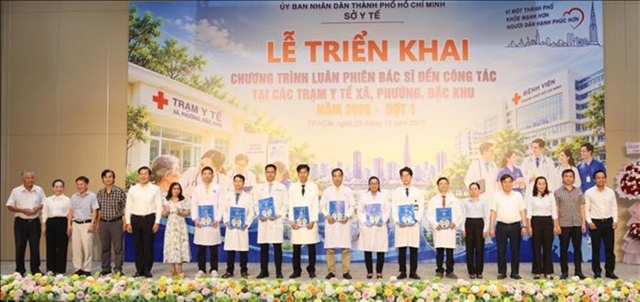 |
| A ceremony held by the HCM City Department of Health on October 28 to kick-start a physician rotation programme, under which doctors will be assigned to work at commune, ward, and special-zone health stations. — VNA/VNS Photo |
HCM CITY — Seventy nine experienced general practitioners and specialists from hospitals in HCM City have been assigned to work on a rotational basis at 37 health stations under the city’s physician rotation programme.
The municipal Department of Health on Wednesday held a ceremony to kick-start the first phase of the physician rotation programme which dispatches hospital physicians to serve at health stations across wards, communes, and special administrative zones.
The programme is part of the broader programme to connect hospitals with health stations for the 2026–30 period in an effort to enhance primary healthcare capacity and build a sustainable health system.
Speaking at the ceremony, Dr Nguyễn Văn Vĩnh Châu, deputy director of the department, said that the city serves over 14 million residents with a network comprising 169 hospitals, 168 local health stations, and nearly 300 satellite medical points.
Primary health stations serve as the first point of contact where citizens access medical professionals and receive continuous, lifelong healthcare management.
The assigned physicians dispatched to grassroots stations will directly provide emergency care and examinations, manage non-communicable diseases, and offer hands-on guidance and training to enhance the professional capacity of their colleagues at these stations.
Among the physicians assigned to grassroots health stations in the first phase, Dr Phan Trung Việt from the Intensive Care and Emergency Department at Nhân Dân Gia Định Hospital is assigned to work at Châu Pha Commune Health Station.
Việt said that he will provide specialised support in emergency care and resuscitation, participate in managing chronic diseases within the community, and quickly identify critical cases that exceed primary care capabilities to ensure timely and safe referrals to higher-tier hospitals.
He hoped to contribute to enhancing the capacity of primary healthcare and deliver better initial medical care to the community.
Programme on connecting hospitals with health stations
The city Department of Health has issued a plan to implement the Programme on Connecting Hospitals with Health Stations for the 2026–30 period in an effort to enhance primary healthcare capacity and build a sustainable health system.
Under the plan, all 168 local health stations across wards, communes, and special administrative zones in the city will be paired with a general hospital or regional health centre to receive continuous technical support, alongside specialised hospitals offering in-depth expert assistance when required.
Along with technical assistance, hospitals will rotate doctors to local health stations and conduct on-site staff training, striving to ensure each station has at least five doctors directly providing healthcare services.
Technical transfers will prioritise high-demand, safe procedures aligned with local disease patterns, enabling residents to access care close to home without unnecessary hospital visits.
Based on local health profiles, disease burdens, and current station capacities, general and specialised hospitals will assist health stations in performing more clinical procedures, managing a larger patient volume, improving initial emergency handling, and maintaining long-term clinical autonomy after receiving support.
The programme combines staff rotation with on-site training.
The goal is to strengthen health station capabilities, deliver better care for citizens, and build a sustainable municipal health system.
The city aims to ensure that every local health station has at least five doctors directly participating in community healthcare, combining permanent staff with personnel rotated from city-supported programmes.
Health stations will be assisted to expand primary medical services, manage hypertension, diabetes, and common non-communicable diseases, provide emergency first-aid, and deliver home-based care for the elderly, persons with disabilities, pregnant women, and children. — VNS
Society
 Society
 Society
 Society
 Society
 Society
 Society
 Society
 Society
 Society
 Society
 Society
 Society
 Society
 Society