 Society

Nội Bài aims to transform into dynamic tourism hub
1.
|
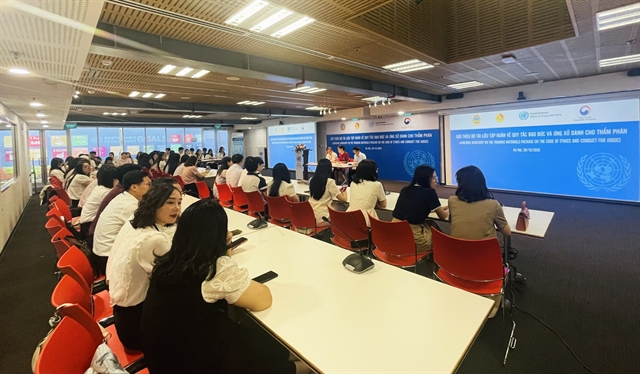
| An overview of the conference introducing the training materials package. — VNS Photo Thu Trang |
HÀ NỘI — A training materials package on code of ethics and conduct for judges, comprising materials for trainers and trainees, was introduced in Hà Nội on Wednesday.
The training package is the result of cooperation between the Việt Nam Court Academy (VCA), the Supreme People’s Court of Việt Nam and the United Nations Office on Drugs and Crime (UNODC) in Việt Nam.
It has been revised and adapted from UNODC’s Judicial Ethics Training Package.
Designed to support the training and professional development of Vietnamese judges, and to enhance their awareness and practical capacity in judicial ethics, the materials seek to selectively incorporate international standards, principles and experience that are relevant to Việt Nam.
They also provide a basis for applying these standards in the legal, institutional and operational context of the Vietnamese courts, ensuring that the universal values of judicial ethics are aligned with the practical requirements of adjudication in the country.
Associate Professor Dr Nguyễn Đức Hạnh, director of the VCA, said that the quality of a justice system was reflected not only in the delivery of justice, but also in whether people could see and trust that justice is being administered independently, fairly and with integrity.
“This is why ethical standards and codes of conduct for judges are of particular importance in Việt Nam,” he said.
The Code of Ethics and Conduct for Judges, issued in 2018, established fundamental standards for members of the judiciary, including independence, integrity, impartiality and objectivity, fairness and equality, propriety, diligence and timeliness, competence and diligence.
“This demonstrates that the requirements for Vietnamese judges are both rooted in the characteristics of Việt Nam’s legal system and judicial practice, and consistent with the progressive values recognised by the international judicial community,” said Hạnh.
“For the administration of justice, public trust is built not only through lawful judgments and decisions. It is also shaped by the character, resolve, attitude and conduct of those entrusted with exercising judicial power on behalf of the State,” he said.
Every judicial decision may directly affect a person’s rights, obligations, property, reputation, liberty, legal status and even their life.
“Society therefore expects judges to possess not only sound legal knowledge and strong adjudication skills, but also independence, integrity, impartiality, objectivity, fairness, propriety, diligence and a sense of responsibility towards the Fatherland and the people,” said Hạnh.
In the new context, particularly as we enter the digital era and as Việt Nam’s justice system becomes increasingly engaged in and integrated with the international community, the ethical standards and codes of conduct for judges also need to evolve accordingly.
A rule has real value only when a judge not only knows the rule, but also understands why it must be observed; can recognise when an ethical issue arises; is able to weigh competing values; and can choose an appropriate course of conduct in real-life situations.
It is precisely such questions that show that training on judicial ethics and conduct must go beyond simply disseminating provisions.
“Professional ethics need to be developed through awareness, experience, self-reflection and professional practice. This is also the important spirit that we hope to convey in the books being launched today,” he said.
The materials focus on the fundamental principles of judicial ethics and conduct, as well as the significance and practical requirements of upholding standards of integrity, independence, impartiality, objectivity, fairness, propriety, diligence and responsibility in the performance of judicial duties.
In addition to providing foundational knowledge, the materials emphasise the ability to apply these principles to specific situations that may arise in professional practice. They help judges identify potential ethical conflicts, consider possible courses of action and make decisions consistent with the law, professional ethical standards and the responsibility to uphold justice.
Through discussions, practical exercises and case studies, the materials promote active learning methods, strengthen the exchange of experience and enhance judges’ capacity to address practical issues arising in adjudication.
|
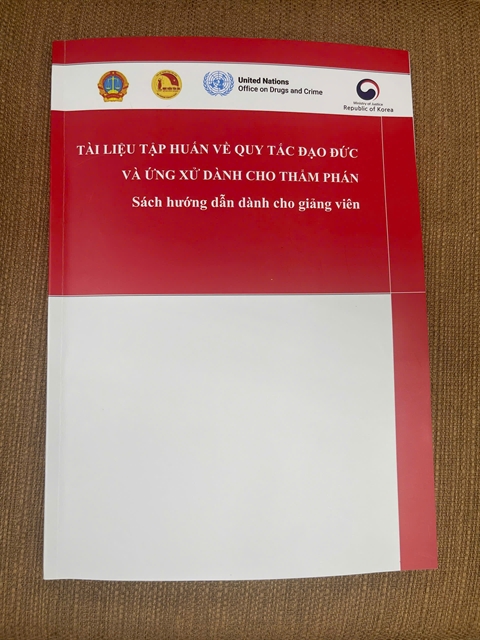
| The book for trainers – a part of the training materials package. — VNS Photo Thu Trang |
Myungwon Keum, crime prevention and criminal justice officer at UNODC, said that, through activities under the Global Judicial Integrity Network and broader rule-of-law initiatives, UNODC had found that investment in ethics education and professional development not only strengthens institutions but also enhances public confidence in the administration of justice.
“We hope that this training package will serve as a useful reference for judges, judicial trainers and judicial institutions across Việt Nam. It will support them in carrying out their duties with professionalism, integrity and independence, while contributing to the continued strengthening of the rule of law and improving the quality of justice in Việt Nam,” she said. — VNS
Society
 Society
 Society
 Society
 Society
 Society
 Society
 Society
 Society
 Society
 Society
 Society
 Society
 Society
 Society