 Society
Environmental protection needs smart governance
1.
|
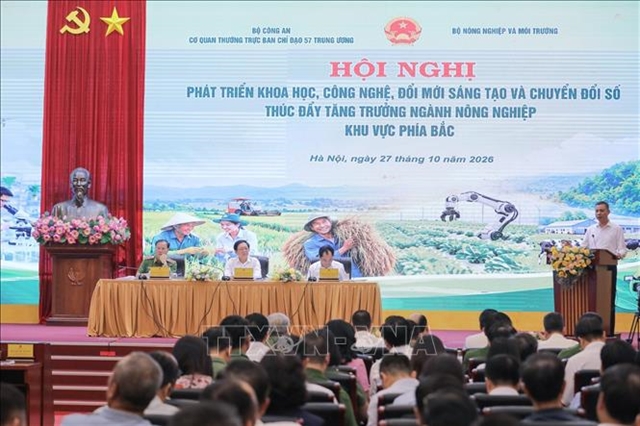
| Delegates participate in the conference. — VNA/VNS Photo Lê Đông |
HÀ NỘI — Deputy Prime Minister Hồ Quốc Dũng has called for stronger application of science and technology innovations in farming to remove bottlenecks related to seed varieties, value chain links and bringing research results into agricultural production.
He made the request as he chaired a conference on Tuesday.
Titled ‘Developing science, technology, innovation and digital transformation to promote growth in the agriculture and environment sector in northern Việt Nam’, the conference was organised by the Ministry of Agriculture and Environment (MAE) and the Ministry of Public Security.
According to the deputy PM, agriculture plays an important role in socio-economic development, ensures food security and serves as a pillar of the economy.
The country’s agricultural development potential, particularly in the northern region, remains very large.
However, the sector still faces numerous challenges related to seed varieties, production technology, value chain links, post-harvest preservation and processing, and disease prevention and control as well as market access.
The deputy PM said that science, technology, innovation and digital transformation must become direct drivers of agricultural growth. Research tasks should be based on practical needs and closely connect the State, scientists, businesses, cooperatives and producers, with the aim of applying and commercialising research results.
In the near future, the MAE plans to work with the Ministry of Science and Technology to identify priority tasks, focusing on developing new-generation seed varieties, veterinary vaccines, biological products, smart production technologies and agricultural product traceability systems.
One main priority will be to remove obstacles relating to institutions, financial mechanisms, technology transfer and intellectual property, and to accelerate the development and connection of sectoral data to support management, forecasting and production planning.
Dũng asked localities in the northern region to select three to five priority tasks linking production with processing, consumption and the building of sustainable brands.
The MAE must finalise the list of priority tasks before December 15 and start carrying them out in the first quarter of next year. Implementation must be regularly inspected and evaluated, with clear objectives, timelines and output results.
Towards intensive growth
Delivering the opening remarks, Minister of Agriculture and Environment Trịnh Việt Hùng said that, amid increasingly fierce trade competition, stricter green standards and traceability requirements and the unpredictable impacts of natural disasters and climate change, the sector must shift from extensive to intensive growth.
This could be done using science and technology, innovation and digital transformation as key drivers, in line with the spirit of Politburo’s Resolution 57-NQ/TW, Hùng noted.
The northern region has advantages in research institutes, universities, experts and technology enterprises, but connection between research and production remains fragmented, and scientific and technological resources have not been used effectively, according to Hùng.
The conference thus focused on proposing solutions to harness research resources and address bottlenecks in production, processing and markets.
According to Deputy Minister of Agriculture and Environment Đặng Ngọc Điệp, the sector achieved growth of 3.8 per cent last year, with exports of agricultural, forestry and fishery products reaching over US$70.6 billion. In the first nine months of this year, growth reached more than 4 per cent, with export turnover of $56.3 billion.
He identified five major bottlenecks: small-scale and fragmented production; dispersed research and technology transfer; limitations in seed varieties and input technologies; a lack of preservation and deep-processing technologies; and non-interconnected data alongside a weak digital workforce.
In livestock farming, around 65 per cent of feed materials still have to be imported, while modern technologies are mainly concentrated in large farms.
For fisheries, the potential of marine aquaculture has yet to be fully exploited due to limitations in seed varieties, infrastructure and market links.
Meanwhile, in forestry, key value chains such as acacia, bamboo and cinnamon still face difficulties relating to seed varieties, pests and diseases, processing technology and export standards.
To address these issues, the sector plans to focus resources on high-quality seed varieties, biotechnology, automation, deep processing and traceability. Research tasks should be driven by the needs of businesses and the market, and linked to specific products, commercialisation potential and economic efficiency.
This year, the agriculture sector is expected to complete the assignment of strategic technology tasks and to create a list of 187 new science and technology tasks for next year, ensuring business commitments to apply the results.
During the 2027–2030 period, key tasks will include implementing digital traceability for priority product chains, developing high-tech agricultural logistics centres and conducting a mid-term review of the digital transformation project in 2028. — VNS
Society
 Society
 Society
 Society
 Society
 Society
 Society
 Society
 Society
 Society
 Society
 Society
 Society
 Society
 Society