 Environment

Việt Nam seeks to turn farm research into economic growth
1.
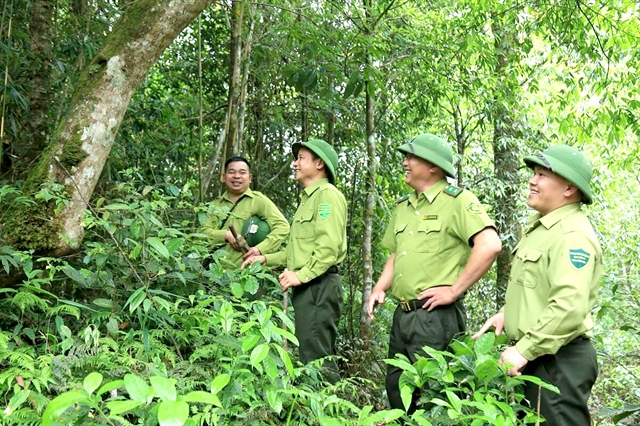 |
| Authorities on duty at Bát Xát National Park in the northern mountainous province of Lào Cai. — Photo nongnghiepmoitruong.vn |
LÀO CAI — The launch of Bát Xát National Park’s management board this month marks a new step in the northern mountainous province of Lào Cai efforts to protect biodiversity, conserve endangered wildlife and restore threatened species, while strengthening the protection of genetic resources and traditional knowledge associated with them.
The provincial People’s Committee has issued a decision establishing the Bát Xát National Park Management Board following the reorganisation of the Bát Xát Nature Reserve Management Board.
The new body officially began operations this month.
The management board operates under the Lào Cai Forest Protection Division. Its responsibilities include protecting the integrity of forest ecosystems, conserving biodiversity and genetic resources, conducting scientific research, promoting environmental education and protection, and maintaining stable water supplies.
These activities are intended to go hand in hand with ecotourism development and the provision of forest environmental services.
The board is also expected to help improve livelihoods in communities surrounding the park, support local socio-economic development and contribute to national defence and security.
Nguyễn Việt Hà, head of the division, said the establishment of the national park would help conserve and restore endangered wildlife, particularly endangered, precious and rare animal species prioritised for protection, as well as migratory species.
It would also strengthen genetic resource conservation, the management of access to genetic resources, benefit-sharing arrangements and the protection of traditional knowledge associated with genetic resources.
Upgrading the nature reserve to national park status is expected to bring greater investment in forest protection, biodiversity conservation, scientific research and ecotourism, commensurate with the park’s ecological value.
The upgrade was approved under Decision No. 780 issued by the provincial People’s Committee in March 2026, bringing the total number of national parks in Việt Nam to 36.
A rich ecosystem
Ngô Kiên Trung, director of Bát Xát National Park, said the Bát Xát Nature Reserve was established in 2016 under a decision by the provincial People’s Committee and included in the national master plan for special-use forests.
The national park covers more than 18,600 ha across five communes of Y Tý, Dền Sáng, Sàng Ma Sáo, Trung Lèng Hồ and Nậm Pung.
Following its upgrade, the national park was divided into three functional zones: a strictly protected area covering more than 14,600 ha, an ecological restoration zone of about 3,400 ha, and a service and administrative zone of more than 380 ha.
Beyond the core area, the buffer zone encompasses 32 villages across three communes, home to local communities, mainly ethnic minority groups.
Located at the northern end of the Hoàng Liên Sơn mountain range, the national park is noted for its rich biodiversity and distinctive high-altitude dwarf forest ecosystem.
Surveys conducted during the preparation of the proposal to establish the nature reserve initially recorded 940 plant species and 157 terrestrial vertebrate species.
Of these, 22 animal species were listed in the International Union for Conservation of Nature’s Red List, while 58 were included in Việt Nam’s Red Data Book.
Subsequent in-depth biodiversity surveys identified an additional 36 plant species and 16 animal species.
Six of these were new to science, including one recorded only on Ky Quan San Mountain, highlighting the distinctive ecological value of the area.
The national park is now known to contain four forest ecosystem types: lower montane subtropical evergreen broadleaf humid forest; lower montane subtropical mixed broadleaf and conifer forest; mid-montane evergreen broadleaf forest; and cold, high-altitude temperate evergreen broadleaf forest.
The high-altitude temperate evergreen forest is considered one of the country’s most important forest ecosystems.
The national park is also home to six newly described amphibian species, published between 2013 and 2021. Among them, the Botsford’s leaf-litter frog (Leptobrachella botsfordi) was successfully proposed for inclusion on the global Red List in the Critically Endangered category.
Overall, 225 rare and threatened species have been recorded under various classification systems, including Việt Nam’s Red Data Book, the global Red List, international conventions on wildlife trade and the Government’s Decree No. 06/2019. These comprise 173 plant species and 52 animal species.
The national park’s recorded flora and fauna are diverse. Its inventory includes 976 species of vascular plants and 173 terrestrial vertebrate species, alongside numerous endemic plants and species associated with the Sa Pa area. — VNS
Environment
 Environment
 Environment
 Environment
 Environment
 Environment
 Environment
 Environment
 Environment
 Environment
 Environment
 Environment
 Environment
 Environment
 Environment