 Environment

Ministry pledges further tax, customs reforms to address firms’ concerns
1.
|
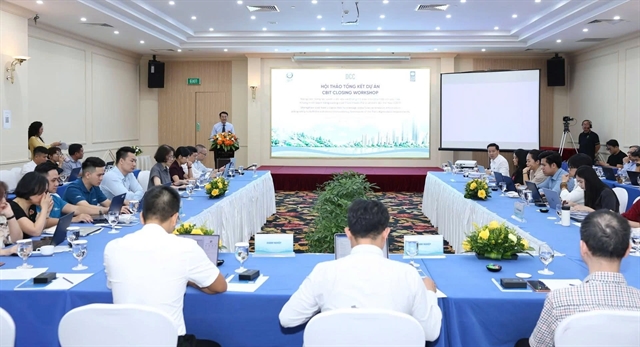
| The workshop on Enhancing Capacity for Data Management and Reporting in Line with the Requirements of the Paris Agreement’s Enhanced Transparency Framework held in Hf Nội on October 21. VNS Photo |
HÀ NỘI — The Capacity-building Initiative for Transparency (CBIT) project has achieved four excellent and eight satisfactory performance indicators, helping standardise greenhouse gas inventories, digitalise emissions data and strengthen Việt Nam’s capacity to fulfil its climate commitments after more than four years of implementation.
The Department of Climate Change under the Ministry of Agriculture and Environment, on Wednesday, held a workshop in Hà Nội to review the project, titled Enhancing Capacity for Data Management and Reporting in Line with the Requirements of the Paris Agreement’s Enhanced Transparency Framework.
Funded by the Global Environment Facility (GEF) through the United Nations Development Programme (UNDP), the project ran from April 2022 to October 2026, with total resources of nearly US$3.77 million, including a GEF grant of nearly $2 million.
Through three components, the CBIT project supported the development of technical guidelines and tools to track implementation of nationally determined contributions (NDCs), while building capacity among ministries, sectors, local authorities and businesses.
These results contribute to the implementation of the Enhanced Transparency Framework the Paris Agreement and provide a technical foundation for domestic regulations on greenhouse gas inventories and emission reductions.
From a development partner’s perspective, Vũ Thái Trường, UNDP Việt Nam’s assistant resident representative and head of its Climate Change, Energy and Environment team, said that the Enhanced Transparency Framework was not merely an international reporting requirement but also helped Việt Nam assess the effectiveness of climate policies, monitor progress towards its NDCs and mobilise financial resources.
The UNDP representative highlighted four major project achievements: strengthening institutional and technical foundations; promoting the digitalisation of climate data; improving transparency in climate finance; and developing capacity while ensuring inclusiveness.
Electronic reporting tools, sector-specific guidelines and an NDC tracking system have laid the groundwork for a shift from manual data compilation to systematic information management, he said.
Reporting at the workshop, Chu Thị Thanh Hương, deputy head of the Emissions Management and Ozone Layer Protection Division under the Department of Climate Change, said the project had delivered significant results in greenhouse gas inventories, emissions data management, climate finance tracking and human resource training.
A key achievement was the development of four procedures for greenhouse gas inventories and MRV, helping standardise methods for collecting, calculating and reporting emissions data.
The project also developed technical guidelines for the construction, agriculture and fisheries sectors, as well as major emission sources, providing a basis for improving the national greenhouse gas inventory system.
Notably, it drafted tools and inventory forms for major emission sources across four sectors: energy; industrial processes and product use (IPPU); agriculture, forestry and other land use (AFOLU); and waste.
The project also proposed adding 271 statistical indicators to support greenhouse gas inventories, helping improve input data and the accuracy of emissions calculations.
In digital transformation, software to track NDC implementation and electronic reporting forms were developed to support systematic data management, monitor emission reduction progress and meet international reporting requirements.
The project also supported a pilot greenhouse gas inventory in Quảng Ninh City, including the preparation of an inventory report and proposed emission reduction measures for 2025.
The pilot enabled the province to gain experience in data collection, inter-agency coordination and the selection of emission reduction measures, while providing practical lessons for other localities.
In climate finance, the project developed a handbook and templates for tracking public investment in climate change, incorporating gender considerations and piloting the approach in agriculture.
These tools have provided an initial methodology for identifying, classifying and compiling financial flows, helping improve transparency in the management of resources for the green transition.
Human resource development was another major achievement of CBIT. The project directly supported 699 beneficiaries, exceeding its target of 400, and trained 147 trainers, surpassing its target of 90.
Training courses and workshops helped improve the capacity of officials, experts and businesses in greenhouse gas inventories, reporting and data management.
Bùi Đức Hiếu, deputy director of the Department of Climate Change, said that Việt Nam was entering a critical phase in fulfilling its climate commitments, particularly its goal of achieving net-zero emissions by 2050.
In this context, transparency in reporting greenhouse gas emissions, emission reduction results and resources for climate change response was not only an international obligation but also an essential requirement for improving the effectiveness of state management, he said. VNS
Environment
 Environment
 Environment
 Environment
 Environment
 Environment
 Environment
 Environment
 Environment
 Environment
 Environment
 Environment
 Environment
 Environment
 Environment