 Environment

Việt Nam urged to turn overseas talent into national development force
1.
|
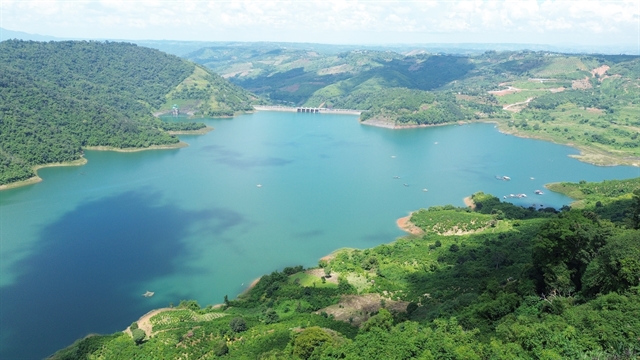
| Tà Đùng Lake in the Central Highlands province of Lâm Đồng, lies within the Đồng Nai River basin and plays an important role in storing water for hydropower plants and supplying water for domestic use and production in the region. — VNA/VNS Photo Huy Thành |
HÀ NỘI — Việt Nam is advised to move from reacting to water shortages to proactively forecasting, allocating and using water more efficiently amid mounting pressure from climate change, drought, saltwater intrusion and rising demand.
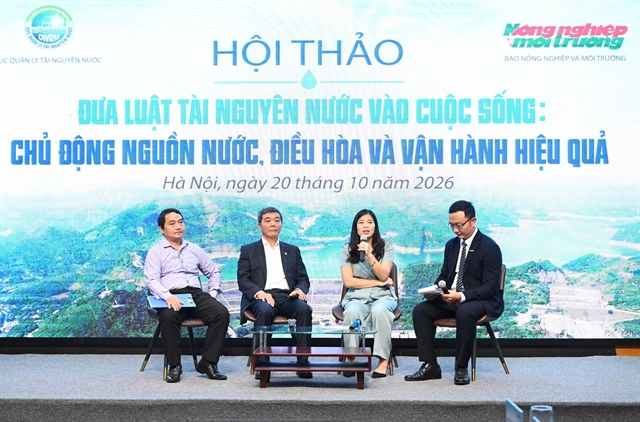
The message was delivered at a conference entitled 'Bringing the Law on Water Resources to Life: Proactive Water Management, Regulation and Efficient Operation', held in Hà Nội on Tuesday by the Department of Water Resources Management under the Ministry of Agriculture and Environment and the Nông nghiệp và Môi trường (Agriculture and Environment) newspaper.
Lý Thị Hồng Điệp, deputy editor-in-chief of the newspaper, said water was not an inexhaustible resource.
“Việt Nam needs to move beyond conventional water management towards ensuring water security through better forecasting, regulation and distribution, while linking water extraction with resource protection and restoration,” she said.
The 2023 Law on Water Resources, which took effect on July 1, 2024, provides a framework for shifting from a system centred largely on water-use permits to integrated management by river basin, taking into account the needs of different sectors and localities. It also introduces tools such as water-resource scenarios, water allocation and coordinated reservoir operations.
However, these tools can only deliver results when translated into practical decisions that secure supplies for households and production.
Nguyễn Ngọc Hà, deputy director-general of the National Centre for Water Resources Planning and Investigation, said meteorological and hydrological forecasts provided information on rainfall and river flows, while water-resource scenarios assessed whether supplies would meet demand, identifying where and when shortages might occur.
The scenarios cover three conditions of normal water levels, water shortage and severe water shortage, that provide a basis for water-supply planning, reservoir operations and preparations for drought and saltwater intrusion.
Hà stressed that scenarios must be updated regularly, provide detailed information at local level and be closely linked to water-supply plans. Even when supplies across an entire river basin remain relatively stable, individual areas may face localised shortages.
He also called for better forecasting and data sharing among reservoir operators, irrigation authorities, hydropower companies and water suppliers. Forecasts must ultimately inform practical decisions, from pumping schedules to crop selection.
Enhancing efficiency
With demand rising and opportunities to build large reservoirs increasingly limited, improving the efficiency of existing water resources and exploring inter-regional water transfers are becoming more important.
Phạm Công Thành, head of the Northern Central Region Irrigation Planning Office, said the region had more than 2,500 reservoirs, including Cửa Đạt, Bản Mồng, Ngàn Trươi and Tả Trạch.
Annual water demand in the region currently stands at around 10.8 billion cu.m and is projected to reach 11.72 billion cu.m by 2050.
The annual shortfall could reach approximately 2.9 billion cu.m as demand grows in urban areas, coastal economic zones and communities along the Hồ Chí Minh Road.
Thành said water-transfer schemes must be based on comprehensive assessments of supply and demand in each area. Areas supplying water must meet their own needs before transferring it elsewhere.
Projects must also be assessed for infrastructure safety, flood drainage capacity, environmental impacts, effects on local livelihoods and economic viability.
Water allocation should balance the needs of households, agriculture, industry, power generation and environmental protection, rather than focusing solely on increasing supply.
|
| Speakers at the conference in Hà Nội on Tuesday. — VNS Photo Tố Như |
AI role
Nguyễn Quốc Dũng, chairman of the Việt Nam Association on Large Dams and Water Resources Development, said science, technology and artificial intelligence (AI) were increasingly important for improving reservoir operations and ensuring sustainable water use.
However, figures presented at the conference showed that only around 17 per cent of reservoirs were equipped with dedicated automatic meteorological and hydrological monitoring systems.
Data remained fragmented across sectors, with limited connectivity, while coordination between hydropower and irrigation reservoirs within the same river basin was not yet consistent.
These shortcomings undermine forecasting and decision-making, particularly when reservoirs must simultaneously provide water, support irrigation, generate electricity, control floods and protect the environment.
Dũng called for research to focus on practical challenges in individual river basins, backed by regular funding to maintain datasets, service monitoring equipment and update forecasting models.
He also proposed establishing a shared data system and decision-support tools combining monitoring data, weather forecasts and flood-risk maps. These could help authorities determine appropriate water releases, coordinate multiple reservoirs and provide early warnings to downstream communities.
Technology alone, however, will not be enough. Its effectiveness depends on reliable data, common standards, stable funding and adequately trained personnel. — VNS
Environment
 Environment
 Environment
 Environment
 Environment
 Environment
 Environment
 Environment
 Environment
 Environment
 Environment
 Environment
 Environment
 Environment
 Environment