 Environment
NA deputies call for lower business costs to achieve double-digit growth
1.
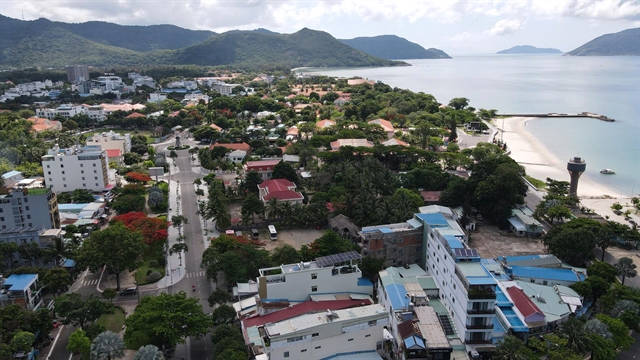 |
| An aerial view of the Côn Đảo Special Zone in HCM City where authorities plan to build a green, smart and liveable island model. — VNA/VNS Photos Huỳnh Sơn |
HCM CITY — HCM City is committed to transforming Côn Đảo Special Zone, an offshore island under its administration, into a green, smart and liveable model while strictly preserving natural heritage and ecological limits, attendees heard at a scientific conference held on October 30.
With the theme "Developing Côn Đảo into a Green, Smart, and Liveable Island Associated with Natural Heritage Conservation and Sustainable Development", the conference brought together leading ecological experts, urban planners, and municipal department leaders.
The event sought breakthrough solutions to concretise the Politburo’s Resolution No. 09-NQ/TW on the city’s development in the new era.
Speaking at the conference, the city People's Committee Vice Chairman Bùi Minh Thạnh highlighted Côn Đảo's special strategic position.
He said local development must align with the island's ecological carrying capacity rather than pursuing growth at all costs.
“Our consistent view is that we will absolutely not trade the environment, natural resources, and historical heritage for short-term economic growth, in which conservation must become the foundation, driving force, and long-term competitive advantage.”
Under the municipal vision to 2050, Côn Đảo is planned to become an internationally prestigious destination for eco-tourism and heritage.
The master plan relies on five key pillars.
These include making nature and heritage conservation the core foundation, and developing a green, circular economy alongside high-quality eco-tourism.
The framework also prioritises synchronous green infrastructure adapted to island conditions, and applies science, technology, and digital transformation for smart island governance.
Finally, it places people at the centre while ensuring national defence and security.
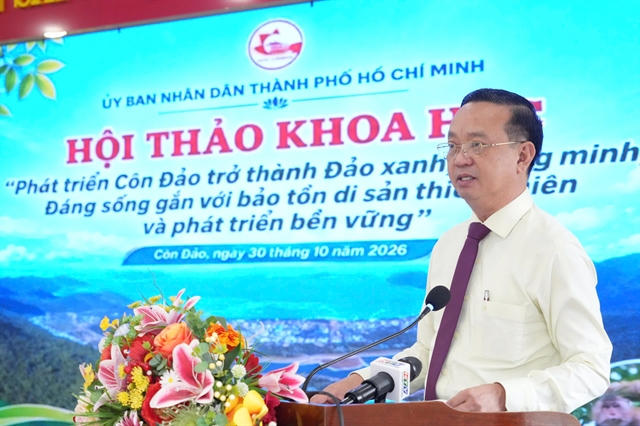 |
| Bùi Minh Thạnh, vice chairman of the HCM City People's Committee, delivers the opening address at the scientific conference on October 30. |
The city will effectively utilise the Politburo’s Resolution No. 09-NQ/TW, action programme No. 21-CTrHĐ/TU of the Municipal Party Committee, and the Urban Development Law to thoroughly remove institutional bottlenecks and pave the way for local breakthroughs.
Associate Professor Dr Nguyễn Chu Hồi proposed shaping Côn Đảo within a comprehensive framework consisting of key axes to balance economic growth and ecological conservation.
These include exploiting conservation economics through eco-tourism, coral reef diving, and recreational fisheries in buffer zones.
The strategy also focuses on building a green, smart and liveable urban area. In addition, it aims to advance high-end tourism tied closely to cultural identity.
“Furthermore, the city must modernise sustainable marine industries and tightly link economic development with national defence.”
He also said zoning must be clearly demarcated to strictly protect special-use forests and historical monuments, with all investment projects carefully calculated based on ecological carrying capacities.
From a forest science perspective, Dr Nguyễn Chí Thành, director of the Center for Forest and Wetland Research, said Côn Đảo must preserve its three core values: ecology, history, and pristine nature.
“Developing a green island requires protecting special-use forests and marine protected areas; a liveable island must secure freshwater security; and a smart island aims for a 100-year long-term master planning vision.”
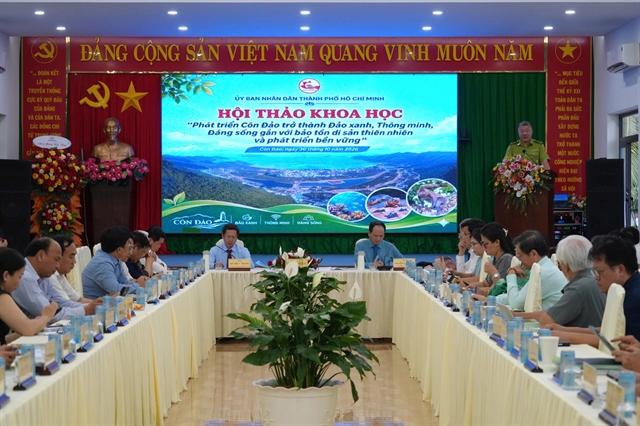 |
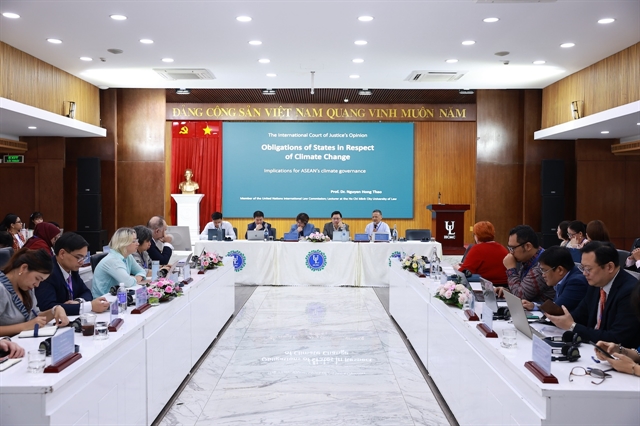
| Delegates and experts gather at the scientific conference discussing sustainable development and heritage conservation strategies for Côn Đảo Special Zone in HCM City on October 30. |
Phan Trọng Hiền, chairman of the Côn Đảo Special Zone People's Committee, said the locality aims to transition all island vehicles to electric vehicles starting in 2027.
“Environmental infrastructure and water safety are also prioritised, targeting 100 per cent domestic wastewater treatment and the complete handling of long-standing accumulated waste.”
Regarding connection infrastructure, the study on expanding Côn Đảo Airport will be carefully considered to balance economic-tourism development and ecological conservation, attracting high-end visitors to low-density green resorts while ensuring spaces for citizens nationwide to pay tribute to heroic martyrs.
Concluding the conference, delegates agreed on strategic imperatives for the future of Côn Đảo, including renewing development mindsets with conservation as the foundation, and establishing growth limits based on ecosystem carrying capacity.
They also emphasised the need to transition from administrative management to data-driven smart governance.
Furthermore, the locality must urgently resolve pressing issues regarding water security, solid waste, plastic pollution, and forest-marine ecosystems, while outlining priority projects for the 2026-30 period with clear roadmaps. — VNS
Environment
 Environment
 Environment
 Environment
 Environment
 Environment
 Environment
 Environment
 Environment
 Environment
 Environment
 Environment
 Environment
 Environment
 Environment