 Environment
al protection needs smart governance
1.
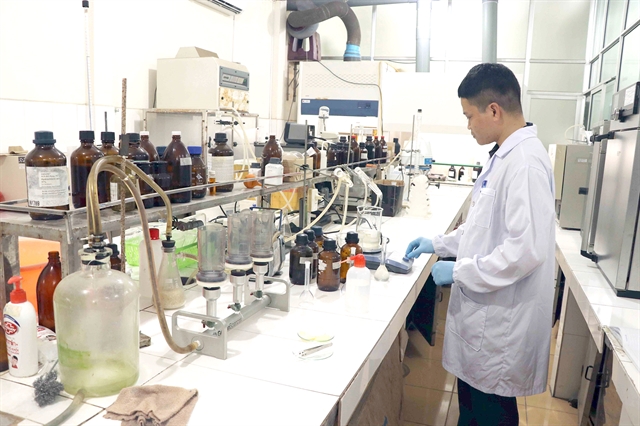 |
| A staff member analyses samples at the Environmental Monitoring Centre under the Hải Phòng City's Department of Agriculture and Environment. VNA/VNS Photo Hoàng Ngọc |
HÀ NỘI — Automatic and continuous environmental monitoring systems are essential to efforts to assess environmental quality and enforce compliance with environmental laws.
Experts say stricter controls on measuring instruments, more rigorous data quality assurance and stronger post-inspection oversight are needed to ensure reliable monitoring results.
In environmental governance, these systems help track changes in environmental conditions and provide information for regulatory oversight and enforcement.
However, reliable data depends not only on stable equipment operation but also on the proper verification and calibration of instruments, testing procedures and measurement standards in accordance with technical requirements and regulations.
Vũ Đình Nam, General Deputy Director of the Ministry of Agriculture and Environment’s Environment Department, told Voice of Vietnam that as the country continues to refine its legal framework for metrology and environmental protection, regulatory oversight must go beyond ensuring that organisations meet the statutory conditions for operation.
Authorities needed to strengthen their assessment of actual technical capabilities, monitor compliance with technical procedures and evaluate the quality of work performed.
According to the department's leadership, a key priority is to safeguard data integrity throughout the entire process of data acquisition, processing, storage and transmission, while promptly identifying and preventing any attempts to manipulate measurement results.
In the southern region, on-site verification, calibration and testing present additional technical challenges due to environmental conditions and the specific operating characteristics of different monitoring systems. Organisations must therefore take a proactive approach to equipment quality control, ensure measurement stability and strengthen their ability to address problems arising under actual operating conditions.
Addressing gaps
Assessing current practices in the verification and calibration of measuring instruments and measurement standards, experts have identified gaps in safeguarding data integrity, ensuring the reliability of monitoring results and maintaining the quality of information used for environmental management.
Trương Mạnh Tuấn of the Environmental Quality Management Division under the Environment Department said international experience showed that, in the United States, the European Union, Japan and China, data quality depended not only on equipment but also on technical procedures, staff competence, quality assurance mechanisms and record management.
Drawing on these experiences, Việt Nam needs to strengthen risk-based post-inspection oversight while clearly defining the responsibilities of system operators, quality control teams and data approval units. Protecting raw data, controlling changes to equipment configurations and software, and ensuring adequate resources for operation, maintenance, verification and calibration are also essential.
Another important consideration is the need to distinguish preliminary data from validated data and avoid confusing equipment failures with genuine changes in environmental conditions. If not identified promptly, errors in measurement or data processing could distort assessments of environmental conditions and undermine the effectiveness of policy implementation.
From an operational perspective, Nguyễn Xuân Dư of the Southern Centre for Environmental Monitoring (SCEM) said organisations should maintain comprehensive records of equipment, operating logs, reference material test results, verification and calibration certificates, and measurement uncertainty information. These records would be essential for traceability, assessing the validity of results and identifying the causes of anomalies.
In practice, monitoring systems use a wide range of equipment, while personnel with expertise spanning environmental monitoring, metrology and quality standards remain in short supply. Coordination among system operators, verification and calibration service providers, and regulatory authorities is also not always consistent. The calculation of measurement uncertainty and the traceability of measurement standards at certain stages of the process require further improvement.
Strengthening tech capacity
Against this backdrop, closer coordination between state agencies responsible for environmental protection and those overseeing metrology has been identified as a key measure to improve the quality of environmental monitoring data, the experts have said.
Oversight should shift from focusing primarily on whether organisations conducting verification, calibration and testing meet operational requirements towards assessing the actual quality of the entire data-generation process. Post-inspection activities should place greater emphasis on identifying potential sources of error, monitoring data acquisition, processing, storage and transmission, and clarifying the responsibilities of each organisation when incidents occur.
At the same time, technical training and professional development should be expanded, independent quality control strengthened, record-management procedures standardised and the traceability of measurement results improved. Adequate resources must also be allocated to maintenance, periodic verification and calibration to minimise the risk of disruptions or declining measurement quality.
Crucially, data quality control must extend across the entire process, from the initial measurement equipment to data processing and transmission. This should go hand in hand with protecting raw data and controlling changes to equipment configurations and software. When abnormal results emerge, organisations need clear procedures for inspection, verification and root-cause analysis before the data are used for regulatory purposes.
Resolving implementation challenges, improving technical coordination and strengthening monitoring and post-inspection oversight will not only help ensure the accuracy and reliability of environmental monitoring data but also enhance the effectiveness of state environmental management. These efforts will provide a stronger foundation for regulatory decisions, inspections and enforcement action based on objective, transparent and verifiable data. — VNS
Environment
 Environment
 Environment
 Environment
 Environment
 Environment
 Environment
 Environment
 Environment
 Environment
 Environment
 Environment
 Environment
 Environment
 Environment