 Environment

Việt Nam urged to take cautious approach to carbon capture technology
1.
|
|
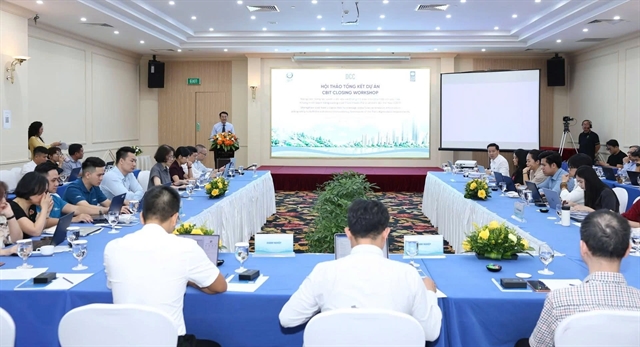
| Speakers at the seminar in Hà Nội on Tuesday. — VNS Photos Tố Như |
HÀ NỘI — Carbon capture and storage (CCS) as well as carbon capture, utilisation and storage (CCUS) must be carefully researched and assessed before being deployed on a large scale.
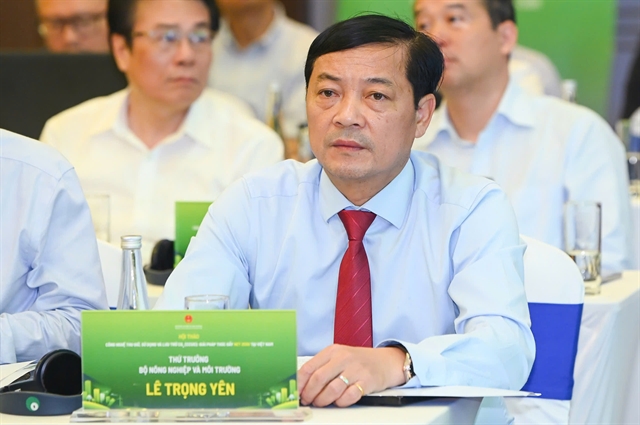
Deputy Minister of Agriculture and Environment Lê Trọng Yên made the statement at a seminar entitled 'Bringing CCS/CCUS Equipment and Technology into Practice in Việt Nam: Opportunities, Challenges and an Implementation Roadmap' held in Hà Nội on Tuesday.
He also said meeting Việt Nam’s commitment to achieving net-zero emissions by 2050 required the country to transform its growth model and shift production methods and resource use towards greater efficiency and lower emissions.
This process must go hand in hand with ensuring energy security, improving business competitiveness and creating new drivers of economic growth, he said.
Emissions-reduction solutions should be selected on the basis of scientific evidence, feasibility and the country’s actual conditions, he added.
To prepare for the adoption of carbon capture and storage technologies, the deputy minister called on the seminar to focus on four key areas.
First, it should clarify the role and scope of CCUS in Việt Nam’s emissions-reduction roadmap, particularly in hard-to-abate industries.
It should also assess the scientific basis, technological requirements and safety standards across the entire CO2 chain, from capture and transport to utilisation and storage.
In addition, Việt Nam needs to refine its mechanisms, policies and legal framework, while clearly defining the responsibilities of participating agencies, organisations and businesses.
Mobilising investment, developing a skilled workforce and strengthening domestic capabilities to master the technology are also essential to move CCUS from research into practical application, he said.
|
| Deputy Minister of Agriculture and Environment Lê Trọng Yên at the seminar. |
Speaking at the seminar, Nguyễn Ngọc Thạch, editor-in-chief of Nông nghiệp và Môi trường (Agriculture and Environment) newspaper, said achieving the net-zero target required appropriate technological solutions, sufficient resources and the participation of society as a whole.
CCS/CCUS offered an additional pathway to emissions reduction, particularly in industries where cutting emissions was difficult, he said.
However, significant challenges remained in translating the technology’s potential into practical applications, including investment costs, infrastructure, policy mechanisms and Vietnamese businesses’ ability to access and master the technology.
Lương Quang Huy, head of the Greenhouse Gas Emissions Management Office at the Ministry of Agriculture and Environment’s Department of Climate Change, said Việt Nam was revising the Law on Environmental Protection and related regulations, gradually moving towards mandatory emissions quota requirements.
Power generation, iron and steel, and cement facilities were being included in pilot emissions quota schemes.
These sectors also had significant potential for CCUS because of their high emissions and the difficulty of reducing them through conventional measures, he said.
Identifying priority sectors correctly would help concentrate resources on projects capable of delivering measurable emissions reductions while providing a basis for assessing costs, technology requirements and the conditions needed for wider deployment.
Nguyễn Hữu Lương, a senior expert at the Vietnam Petroleum Institute (VPI), said Việt Nam has the potential to store around 71 billion tonnes of CO₂ across three sedimentary basins, including more than one billion tonnes in depleted oil and gas fields.
He proposed piloting small-scale CCS projects between 2027 and 2030, with priority given to research into CO₂ injection to enhance oil recovery in the Cửu Long Basin.
The country should also assess the potential for CO₂ storage in saline aquifers in the Cửu Long, Nam Côn Sơn and Red River basins, using three-dimensional geological modelling alongside well data, he said.
These studies would help establish the technical, economic and environmental feasibility of such projects, laying the groundwork for the development of centralised carbon capture and storage hubs and paving the way for expansion after 2030.
According to data from the Global CCS Institute updated as of July 31, 2026, there were 113 commercial CCS projects in operation worldwide, 59 under construction, 308 in advanced development and 352 in early development.
The operational projects had a combined CO₂ capture capacity of around 68 million tonnes a year, while those under construction had a total capacity of approximately 56 million tonnes a year. — VNS
Environment
 Environment
 Environment
 Environment
 Environment
 Environment
 Environment
 Environment
 Environment
 Environment
 Environment
 Environment
 Environment
 Environment
 Environment