 Environment
Việt Nam, Argentina see ample potential to elevate bilateral ties: ambassador
1.
|
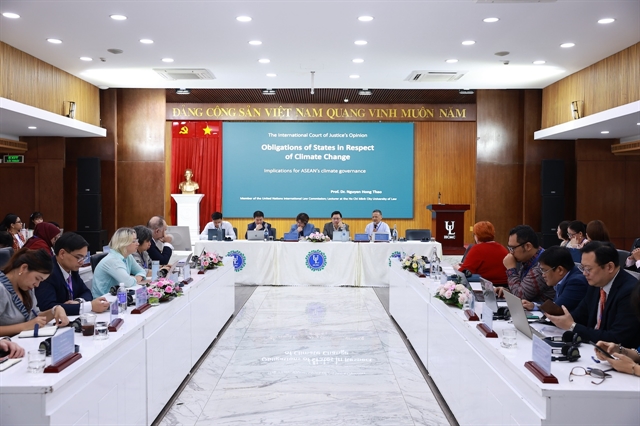
| Participants at the conference, themed 'Shaping the climate regime in Southeast Asia through international law' in HCM City on Friday. — Photo hcmulaw.edu.vn |
HCM CITY — The Association of Southeast Asian Nations (ASEAN) needs stronger international legal frameworks and regional cooperation to translate climate commitments into practical action while ensuring a fair green transition, experts said at fifth annual ASEAN conference on climate change (ACCC5 2026) in HCM City on Friday.
The conference, themed “Shaping the climate regime in Southeast Asia through international law,” was jointly organised by the Hồ Chí Minh City University of Law (ULAW) and the Centre for International Law at the National University of Singapore (CIL-NUS).
It brought together experts, scientists, researchers, universities and representatives of domestic and international management agencies to discuss emerging legal issues in climate change response and the links between climate commitments, trade, investment, energy transition and sustainable development in Southeast Asia.
In his remarks, Dr. Lê Trường Sơn, Rector of ULAW, stressed that climate change is not merely an environmental challenge but also directly affects coastal livelihoods, business operations and the development prospects of future generations.
Law should provide the foundation for translating climate goals into concrete, implementable, monitorable and assessable actions, Sơn said, adding that the effectiveness of the green transition should be measured by emission reductions and by its ability to safeguard livelihoods and development opportunities, particularly for communities with limited adaptive resources.
With countries preparing for the 31st United Nations Climate Change Conference (COP31), scheduled for November 9-20, in Antalya, Türkiye, Associate Profession Danielle Yeow of CIL-NUS highlighted the increasingly close links between climate change, ocean affairs, investment and trade. She called for multidisciplinary approaches, stronger dialogue and greater efforts to connect research findings with policymaking and governance by governments, businesses and civil society.
One of the key topics that attracted considerable attention from delegates was the obligations and responsibilities of States in addressing climate change, with reference to the advisory opinions issued by the International Court of Justice (ICJ) in 2025 and the International Tribunal for the Law of the Sea (ITLOS) in 2024. Discussions covered the right to a safe and healthy environment, the interests of future generations, the preservation of maritime baselines amid rising sea levels, and accountability.
Participants examined the impact of environmental standards and emission controls on trade, investment, production and business. As emissions reporting and transparency requirements increase, ASEAN businesses need to strengthen their capacity to meet green standards and maintain access to international markets, while adapting to the ongoing transformation of global supply chains.
Addressing fairness in the green transition, Associate Professor Dr. Trần Thị Thùy Dương, Dean of ULAW’s Faculty of International Law, highlighted the need to balance costs and benefits for Vietnam’s traditional craft villages participating in green production chains. She stressed that environmental standards must take account of the adaptive capacity of traditional producers and businesses with limited financial and technological resources.
Participants also discussed corporate responsibilities and the role of judicial bodies in resolving climate disputes and investor-state disputes, highlighting the need for a transparent, stable and enforceable legal environment. — VNA/VNS
Environment
 Environment
 Environment
 Environment
 Environment
 Environment
 Environment
 Environment
 Environment
 Environment
 Environment
 Environment
 Environment
 Environment
 Environment