 Environment

Exotic Food Showcases Its Position as a Leading Global Sriracha Producer and Exporter at SIAL Paris 2026
1.
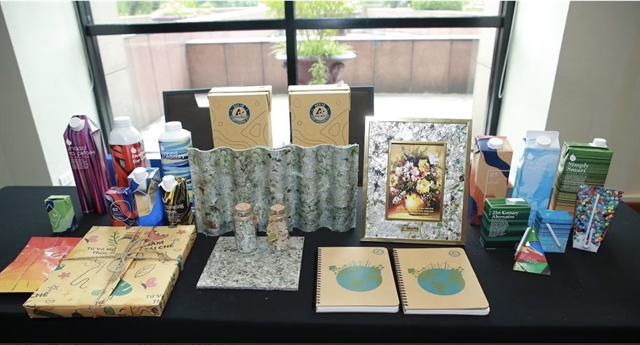 |
| Products made with recycled paper cartons. — VNA/VNS Photo |
HÀ NỘI — Billions of paper cartons are discarded in Việt Nam every year, yet only a small proportion find their way back into the production cycle.
Behind this seemingly simple figure lies a complex challenge: recycling technology remains limited, while sorting and collection at source have yet to become common practice.
Against this backdrop, community-based collection networks are emerging as a practical link in the recycling chain, helping turn seemingly worthless cartons into valuable materials for reuse.
Regarding milk cartons specifically, data released earlier this year indicates that approximately 10–15 billion cartons are discarded annually, yet less than 10 per cent are properly collected and recycled.
Although paper cartons can be reused after recycling, the treatment of the packaging requires proper technology.
According to Tetra Pak, a leading global food processing and packaging solutions provider, liquid food containers consist of several layers of paper, plastic and even aluminium to protect the products inside.
To recycle the material, the plant must separate the paper fibres for use as raw material and then process the remaining plastic and aluminium components.
The collection of packaging must thus be followed by its transport to a facility capable of processing it.
Collection at source has also faced many obstacles.
Informal waste collectors, a key link in the urban waste collection network, often neglect to collect paper cartons because they are lightweight, bulky and hold less economic value than hard plastics or metals.
Adding to the challenge, many users still discard cartons immediately after use without rinsing or flattening them. Residual milk can then ferment and produce unpleasant odours, making the cartons difficult to store and transport to recycling facilities.
As a result, most cartons end up in landfills, where their plastic and aluminium layers can take hundreds of years to break down. This not only wastes valuable resources, but also adds to environmental pollution.
To address the wasteful practice of landfilling, the Extended Producer Responsibility (EPR) mechanism has been incorporated into Vietnamese law, requiring producers and importers to take responsibility for collecting and treating packaging waste from products they place on the market.
“Rather than prompting avoidance, this mandatory regulation is creating an incentive for businesses to seek solutions and stable sources of secondary raw materials,” Hùng said.
With the pressure of the EPR, packaging businesses have started working with environmental entities to set up a systematic collection infrastructure.
A prime example is the collaborative effort by domestic recycling companies to integrate collection systems across schools and residential areas.
Việt Nam Lagom Company is cooperating with Đồng Tiến Paper Company to receive dozens of tonnes of milk paper cartons from thousands of schools in Hà Nội and HCM City to recycle into construction materials, eco-friendly roofing sheets and notebooks.
In the consumer sector, VietCycle Joint Stock Company acts as a bridge, directly investing in technology and establishing standardised collection stations.
The company provides training and support to informal waste collectors, enabling them to collect packaging efficiently and supplying clean raw materials to major corporations.
Through a dedicated website, the programme digitises the locations of carton collection points and guides residents on a three-step at-home handling process: cleaning, flattening and disposing of the cartons in the proper receptacles.
The combination of State management policies, the collection infrastructure of food and beverage corporations and efforts by domestic recyclers to standardise processes is gradually resolving the industry's bottlenecks.
Once this ecosystem is fully aligned, paper cartons will truly enter the circular economy rather than becoming an environmental burden. — VNS
Environment
 Environment
 Environment
 Environment
 Environment
 Environment
 Environment
 Environment
 Environment
 Environment
 Environment
 Environment
 Environment
 Environment
 Environment