 Environment
PM urges Hưng Yên to become dynamic growth hub by 2030
1.
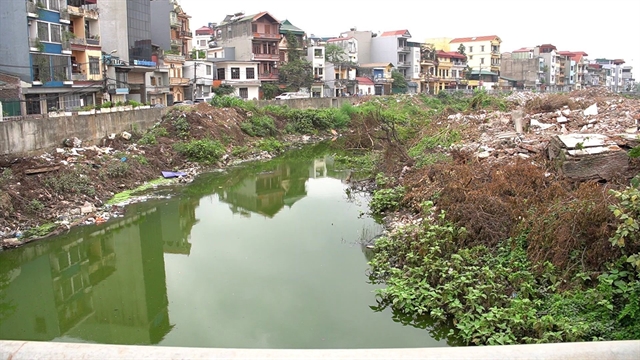 |
| Household and construction waste piles up along both banks of the Nhuệ River in Hà Nội. VNA/VNS Photo Kim Anh. |
By Khánh Linh
HÀ NỘI — Hà Nội is seeking to promote the recycling and reuse of construction and demolition waste, turning what is traditionally treated as waste into materials for urban development as the capital accelerates major infrastructure projects.
The issue was highlighted at a workshop titled ‘Promoting the Circularity of Construction Waste: From Waste to Resources', organised by Hà Nội Urban Environment One Member Co. (URENCO) in the capital city.
The event brought together representatives of France's Île-de-France region and businesses and environmental groups from both France and Việt Nam, along with other experts.
It provided a platform for participants to share practical experience, explore technologies and discuss solutions for recycling and reusing construction waste, with a view to promoting a circular economy in construction and urban environmental management.
Rising pressure from construction waste
Hà Nội is facing mounting pressure from construction and demolition waste as the city carries out a large number of major infrastructure and transport projects.
According to the Hà Nội Department of Agriculture and Environment, the city currently generates around 10,000 tonnes of construction waste a day, about three times the average in previous years. Since the beginning of 2026, the volume has reached approximately 1.5 million tonnes.
The surge is largely attributed to the simultaneous implementation of more than 1,400 key infrastructure projects aimed at driving the capital's socio-economic development.
Meanwhile, Hà Nội currently has only around 10 collection, transfer and treatment sites, with a combined capacity of about 4,500 tonnes per day, or roughly 30 per cent of the total amount generated.
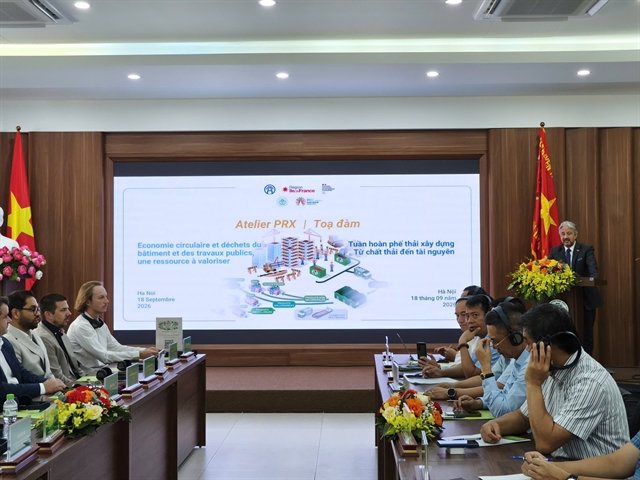 |
| The workshop titled ‘Promoting the Circularity of Construction Waste: From Waste to Resources' was held by Hà Nội Urban Environment One Member Co. (URENCO) in Hà Nội. VNS Photo Khánh Linh |
The significant gap between waste generation and treatment capacity has placed increasing pressure on the collection system and contributed to illegal dumping in suburban areas, along canals, on vacant land and even beneath bridges.
Some traditional landfill sites have also become overloaded and are no longer able to receive additional waste.
Construction waste is bulky and heavy and consists largely of inert materials, but it can also contain hazardous contaminants and is difficult to sort at source. These characteristics increase collection and treatment costs.
The traditional ‘collection and transport to landfill’ approach therefore puts additional pressure on land, public finances and the environment, highlighting the urgent need for more sustainable solutions.
From waste to secondary resources
Experts and businesses at the workshop pointed to several barriers to expanding construction waste recycling, including an incomplete legal framework, insufficient infrastructure and a lack of clear standards for recycled products.
Nghệ An Urban Environment and Public Works JSC said regulations governing the recycling and reuse of construction waste remained insufficiently detailed, leaving businesses and waste generators uncertain about implementation.
It also called for better planning of collection points, transfer stations and treatment facilities, as their uneven distribution could increase the risk of violations and illegal dumping.
Clear technical standards and economic and technical norms for recycled materials are also needed to enable such products to be used in construction projects.
The company proposed a three-party cooperation model involving State management agencies, recycling and treatment operators, and construction companies or waste generators.
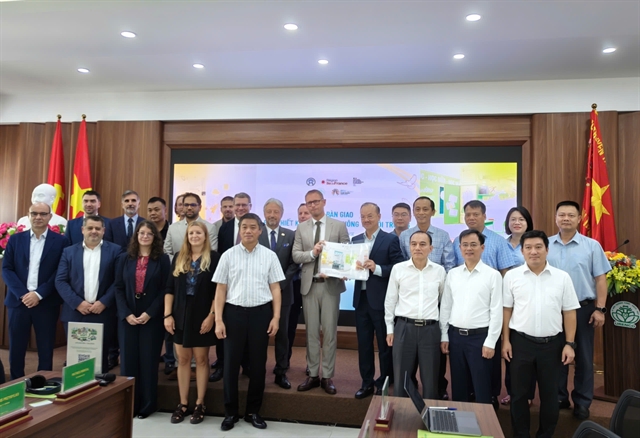 |
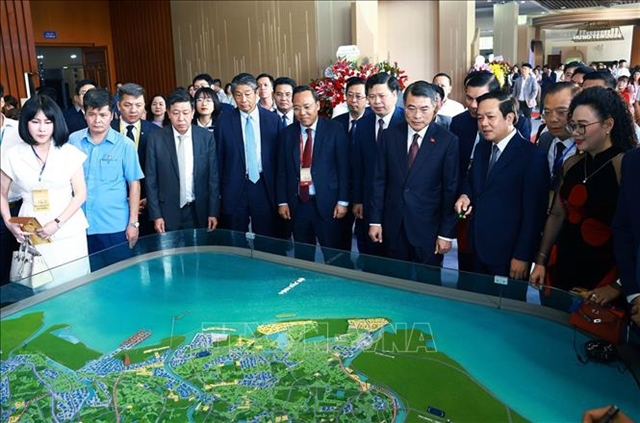
| Stéphane Beaudet, vice president of the Île-de-France region in France, presents the design dossier for the Environmental Communication Centre to Nguyễn Hữu Tiến, chairman of URENCO Hà Nộii’s Members’ Council. VNS Photo Khánh Linh |
Under the model, the State would play the role of a conductor, providing direction, creating an enabling framework and supervising implementation, while environmental service providers would serve as a link connecting technology, material flows and management data.
The company recommended completing local regulations on the collection, transportation and treatment of construction waste, developing integrated infrastructure for waste reception and recycling, and standardising recycled products so they could be safely and legally used in construction projects.
Hà Nội Construction Waste Treatment and Environmental Development Investment JSC proposed five measures to promote construction waste recycling: dedicated incentives for land access, investment, price support, green procurement and promotion of recycled products.
It also called for standards and markets for products such as non-fired bricks, concrete components and road base materials, as well as regulations requiring a certain proportion of recycled materials in infrastructure projects funded by the State budget.
The company further proposed giving treatment enterprises a greater role throughout the process, from demolition and sorting to final treatment.
Participants said that when policies, treatment technologies, digital platforms and markets for recycled products are linked into a unified value chain, construction waste can be transformed from an environmental burden into a valuable source of secondary materials, contributing to a sustainable circular economy.
French experience
At the workshop, Vice President of the Île-de-France region Stéphane Beaudet said cities around the world face the challenge of protecting agricultural and natural areas while accommodating growing populations.
“We therefore also have to rebuild the city within the existing city and accept greater urban density, while at the same time enabling cities to reduce pollution and decarbonise,” he said.
He described demolition and reconstruction as a major challenge in this process, adding that the treatment and recycling of demolition waste is essential to facilitate urban redevelopment.
“This is a challenge faced by all major cities around the world,” he said.
Beaudet also highlighted the need to ensure a good quality of life in cities while adapting to climate change, noting that the global community had experienced exceptionally hot conditions in recent times.
He said French companies attending the workshop could provide practical solutions through innovative technologies and ideas.
French experts said that in many developed countries, construction and demolition waste is increasingly regarded as an important secondary resource rather than something to be discarded.
Nina Le Duc, who is responsible for the circular economy and construction waste at the Île-de-France Circular Economy and Waste Department, said many types of construction waste could be processed for use as filling materials, road foundations and in other infrastructure projects.
“This is an approach that is consistent with the circular economy, in which waste is not considered something to be thrown away, but becomes an input resource for production and construction activities,” she said.
She said recycling construction waste is particularly relevant as Hà Nội is carrying out a large number of major infrastructure projects.
Recycling would not only provide an additional source of construction materials and reduce pressure on natural resource extraction, but also help minimise negative environmental impacts, she added.
Chairman of URENCO's Members' Council Nguyễn Hữu Tiến said the company's centre is intended not only to introduce environmental solutions and technologies, but also to serve as a platform for environmental communication and education, particularly among young people.
The aim is to promote green lifestyles and encourage people to develop waste sorting, reuse and recycling habits from an early stage, he said.
The workshop also provided an opportunity to establish longer-term cooperation between URENCO, the Île-de-France region and experts and businesses from France and Việt Nam.
Participants discussed potential cooperation in expert exchanges, knowledge sharing, technology research and future environmental and circular economy projects.
The discussions reflected a broader shift in the approach to construction waste management from simply collecting and disposing of waste towards recovering materials and keeping them in circulation for as long as possible. — VNS
Environment
 Environment
 Environment
 Environment
 Environment
 Environment
 Environment
 Environment
 Environment
 Environment
 Environment
 Environment
 Environment
 Environment
 Environment