 Environment
French experts share digital administrative experience with Vietnamese public servants
1.
|
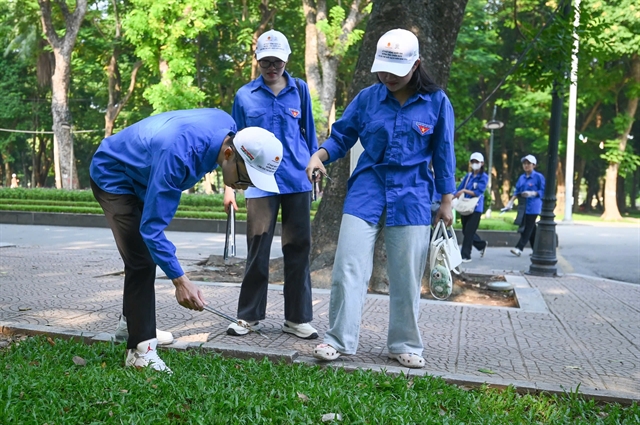
| Young people clean up Thống Nhất Park at the launching ceremony of World Cleanup Day 2026 in Hà Nội on Sunday. — VNS Photos Tố Như |
HÀ NỘI — More than 1,000 people joined the launch ceremony for the World Cleanup Day 2026 at Thống Nhất Park in Hà Nội on Sunday morning with focus on food waste.
Themed 'From a Clean Plate to a Clean City', the event attracted the participation of youth union, sanitation workers and residents.
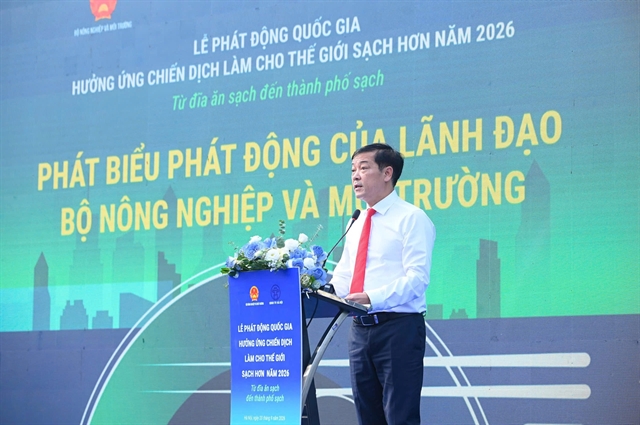
Speaking at the ceremony, Deputy Minister of Agriculture and Environment Lê Trọng Yên said reducing waste and food loss at source, together with promoting waste separation at source, should be regarded as the foundation of modern waste management.
He called on households, agencies, schools, restaurants, hotels, markets, and food and beverage businesses to gradually change their shopping, food preparation and consumption habits toward greater efficiency and reduced waste.
The World Cleanup Day was launched by the United Nations Environment Programme (UNEP) in 1993, with Việt Nam joining the campaign in 1994.
After more than 30 years, it has become a widespread environmental initiative, helping turn environmental awareness into concrete actions in daily life.
According to UNEP’s 2024 Food Waste Index Report, an estimated 1.05 billion tonnes of food was wasted in 2022 by households, food service providers and retailers, equivalent to about 19 per cent of food available to consumers.
In Việt Nam, food and organic waste currently account for around 50-70 per cent of total household waste. Without proper separation, collection and treatment, this could place significant pressure on urban infrastructure and the living environment.
|
| Deputy Minister of Agriculture and Environment Lê Trọng Yên speaks at the event. |
Deputy Minister Yên said the theme 'From a Clean Plate to a Clean City' is not merely a call for environmental hygiene, but also reflected a more comprehensive approach of starting with saving food at the dining table and properly separating waste in the kitchen, creating a circular resource chain.
“A clean city is not simply a city that collects and treats waste effectively, but first and foremost a city that generates less waste and uses resources more efficiently,” he said.
He urged businesses to reduce losses during production, processing, storage and distribution, while improving processes and business models to use raw materials, energy and water more efficiently.
Collection, transportation and treatment systems should be upgraded in a coordinated manner to meet source-separation requirements and align with local conditions and the capacity of treatment facilities, he said.
He also highlighted another requirement which is to shift from a 'waste treatment' mindset to 'managing resources from waste'. This includes promoting reuse, recycling, material recovery, energy recovery and appropriate treatment of organic waste, while encouraging the application of advanced and environmentally friendly technologies.
Businesses are encouraged to innovate their technologies, save raw materials and energy, reduce packaging, extend product lifespans and design products to be easier to repair, reuse and recycle.
“Waste is not simply something to be discarded. When properly managed, it can become a resource serving the economy,” the deputy minister stressed.
He also called for continued efforts to make environmental protection part of urban culture and a civilised way of life.
Nguyễn Thanh Sơn, deputy general director of Hà Nội Urban Environment Company (URENCO), said source separation is the first and decisive link in the process of recovering resources from waste.
A plastic bottle separated from other waste, a dry cardboard box kept in good condition, or a metal can delivered to the proper collection point are all concrete actions that help extend the life of materials, he said.
“When thousands or tens of thousands of people carry out these actions regularly, small individual efforts will create a sufficiently large, stable and measurable stream of resources for the recycling industry,” Son said.
URENCO is currently developing a network of 100 hubs to establish resource recovery infrastructure close to communities. At these sites, recyclable waste is received, sorted, weighed, recorded and transferred to appropriate recycling systems.
Digital maps are also being used to help residents locate convenient collection points, while supporting the organisation of collection routes and monitoring material flows.
The network aims to establish a clear cycle: source separation - recovery - recycling - returning materials to production and daily life.
Pauline Tamesis, UN Resident Coordinator in Việt Nam, said governments, businesses and communities need to work together to prevent losses along supply chains, keep edible food in circulation and turn unavoidable organic waste into useful resources.
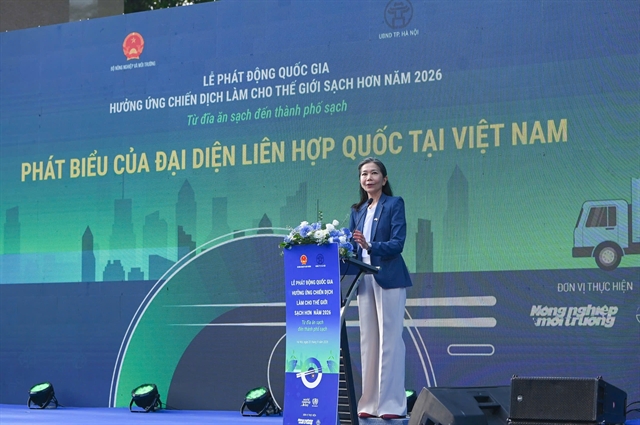
|
| Pauline Tamesis, UN Resident Coordinator in Việt Nam, calls on everyone to work together to prevent losses along supply chains |
After the launching ceremony, participants took part in a 'Waste for Gifts' programme and joined a campaign to collect waste and clean Thống Nhất Park and several other locations across the city. — VNS
Environment
 Environment
 Environment
 Environment
 Environment
 Environment
 Environment
 Environment
 Environment
 Environment
 Environment
 Environment
 Environment
 Environment
 Environment