 Society
Exporters asked to strengthen risk management in ASEAN markets
1.
|
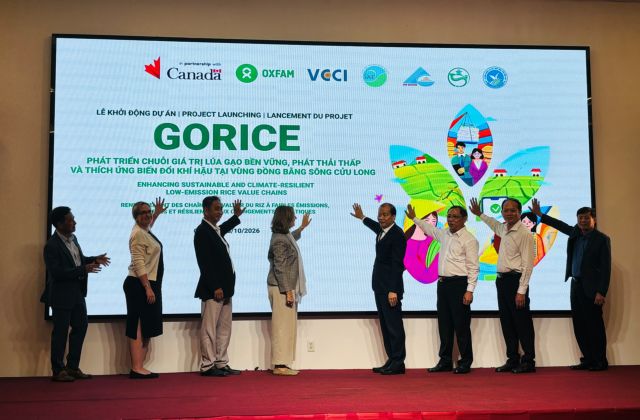
| Delegates launch the GORICE – Enhancing Sustainable and Climate-Resilient Low-Emissions Rice Value Chains Project in Cần Thơ City on Wednesday. — VNS Photo Khánh Dương |
CẦN THƠ — Three localities in the Mekong Delta region are expected to apply high-quality, low-emissions farming practices to 180,000ha of rice-growing area by 2030, benefiting about 48,200 residents in Cần Thơ City, An Giang Province and Vĩnh Long Province.
The target was set out at the launch of the GORICE – Enhancing Sustainable and Climate-Resilient Low-Emissions Rice Value Chains Project in Cần Thơ City on Wednesday.
Funded by Global Affairs Canada, the project will be carried out by Oxfam in partnership with the Vietnam Chamber of Commerce and Industry (VCCI), the Institute of Agricultural Environment and the departments of agriculture and environment in the three localities.
Under the project, the three localities look to reduce emissions by around 748,000 tonnes of carbon dioxide equivalent and benefit about 100,000 consumers with the aims to improve the economic, social and environmental well-being of rice farmers, especially women and ethnic groups, through inclusive, gender-responsive and climate-smart rice production practices in the Mekong Delta.
Key activities include training farmers in low-emissions farming techniques, promoting the circular economy and growing the market for low-emissions rice, particularly among Vietnamese consumers. It also includes expanding access to green technology and green finance, conducting research and sharing best practices.
.JPEG)
|
| VCCI Vice Chairman Hoàng Quang Phòng. — Photo courtesy of Oxfam |
VCCI Vice Chairman Hoàng Quang Phòng said the Mekong Delta produces more than half of Việt Nam’s rice output and over 90 per cent of the country’s rice exports. But the rice bowl is increasingly affected by climate change, with losses estimated at around US$2.4 billion annually.
Rice production also accounts for nearly half of greenhouse gas emissions from the agricultural sector. Meanwhile, markets are increasingly demanding higher-quality rice that is more traceable, involves lower emissions and is produced more responsibly, he said.
Low-emissions rice production is not only an environmental requirement, but also a pathway to increasing the value of Vietnamese rice and improving farmers’ incomes, according to Phòng.
But a lot of smallholder farmers, particularly women and ethnic communities, still face difficulties accessing resources like land and credit for rice production, and have limited opportunities to participate in training and capacity-building programmes, access technologies and machinery and take part in decision-making.
The GORICE Project is designed to directly contribute to the implementation of the one-million-hectare high-quality, low-emissions rice project in the Mekong Delta, Phòng said.
He noted that the project provides farmers and cooperatives with low-emissions cultivation techniques and input-saving solutions, promotes circular economy models based on rice straw, facilitates more stable market links and creates opportunities to benefit from emissions reductions.
For businesses, it provides production areas with data and traceability that can meet the requirements of premium markets, while for authorities, it offers tools, data and practical experience to help improve policymaking.
He said that businesses play a key role in the low-emissions rice value chain. As an important link in the chain, businesses can simultaneously provide financing, transfer production processes, control quality and secure market outlets.
Under the GoRice Project, VCCI will support links between businesses and cooperatives, with the goal of helping 1,500 rice farmers establish purchasing arrangements with companies. It will also promote access to green finance for cooperatives and producers, raise consumer awareness to increase demand for low-emissions rice in domestic and international markets, and work with cooperatives and businesses to develop low-emissions rice labels, he said.
“VCCI will serve as a bridge connecting businesses and cooperatives with investors, technology providers and Canadian partners, helping them leverage opportunities under the Comprehensive and Progressive Agreement for Trans-Pacific Partnership,” Phòng said.
Nguyễn Đỗ Anh Tuấn, director of the Department of International Cooperation at the Ministry of Agriculture and Environment, said a key focus of the GORICE project is to promote gender equality and social inclusion, empowering women and supporting ethnic communities.
Of the 48,200 local residents set to benefit from the project, half are women.
“I believe that when the State provides the enabling framework, local authorities take the initiative, businesses join hands, science drives innovation and farmers take ownership, we can transform every rice field into a more advanced, efficient and higher-value production space,” Tuấn said.

|
| Francesca Bellone, head of cooperation at the Embassy of Canada in Việt Nam. — Photo courtesy of Oxfam |
Francesca Bellone, head of cooperation at the Embassy of Canada in Việt Nam, said: “We particularly welcome Việt Nam's one million hectares of high-quality and low-emissions rice programme for the Mekong Delta for 2023-2030. This ambitious initiative has the potential to transform rice production, improve farmers' livelihoods, reduce emissions and strengthen Việt Nam's competitiveness in international markets.”
Emphasising that rice is central to Việt Nam's food security, rural livelihoods and exports, she pointed out that the sector faces growing challenges from climate change and changing market requirements. Rice cultivation is also a significant source of methane emissions, making the transition to more sustainable production practices particularly important.
Addressing these challenges requires a collective effort across the entire rice value chain, from farmers and cooperatives to businesses, research institutions, financial partners and Government agencies, she said, adding that Canada is pleased to work with trusted partners to support Việt Nam's agricultural transformation.
“Canada also brings valuable expertise and experience that can support Việt Nam's priorities. Canadian institutions, researchers and businesses have developed internationally recognised strengths in climate-smart agriculture, climate resilience, nature-based solutions, carbon accounting, measurement, reporting and verification systems, environmental monitoring and sustainable resource management.
“These capabilities can help strengthen the evidence-based transparency and long-term sustainability of low-emissions agricultural development and climate action in Việt Nam,” she said. — VNS
Society
 Society
 Society
 Society
 Society
 Society
 Society
 Society
 Society
 Society
 Society
 Society
 Society
 Society
 Society