 Society

HCMC chairman concludes AEF 2026 with development committments
1.
|
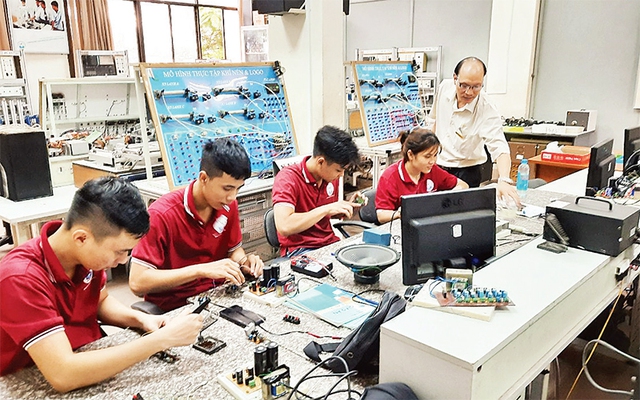
| Focus on training and enhancing the quality of the capital's human resources. — Photo chinhphu.vn |
HÀ NỘI — Hà Nội is facing increasingly complex development challenges, ranging from improving urban governance and developing infrastructure to tackling traffic congestion and environmental pollution, while promoting digital transformation, innovation and green economic growth.
Alongside financial resources and policy mechanisms, human resources play a particularly important role in addressing these challenges.
The city’s issuance of a list of 30 “major challenges” for the 2026–30 period marks a shift in development governance, from an approach centred on administrative tasks towards identifying strategic issues requiring comprehensive, long-term and breakthrough solutions, in line with the spirit of Politburo Resolution 57.
Ngô Minh Hoàng, former deputy director of the Hà Nội Department of Home Affairs, said that high-quality human resources are no longer merely an input but are increasingly becoming a decisive factor in a major city’s governance capacity, labour productivity, innovation and competitiveness.
“An important aspect of implementing Resolution 57 is establishing a targeted investment mechanism for human resources, linking training and professional development with recruitment needs and the practical challenges facing the city,” Hoàng said.
Accordingly, Hà Nội is prioritising human resource development in three groups of fields.
The first is science, technology, innovation and digital transformation, with a focus on technologies such as artificial intelligence, big data, semiconductor technology and automation, as well as the operation of the city’s digital platforms.
The second comprises experts and scientists directly involved in researching and proposing solutions to major challenges, particularly those relating to urban planning, infrastructure, environmental management, pollution control and intelligent transport systems.
The third covers human resources in key sectors and occupations, with the aim of reaching advanced regional and international standards. These include high-tech engineering, high-quality services, public administration and legal affairs.
For doctoral candidates involved in addressing the city’s major challenges, Hà Nội has introduced support mechanisms covering living expenses, research, international scientific publications, participation in international conferences and dissertation completion.
The policy is intended to enable candidates to focus on their research while directing their work towards issues for which the city urgently needs solutions.
The Hà Nội Department of Science and Technology has also issued preliminary guidance on implementing support policies for doctoral candidates studying at domestic educational institutions. The city plans to select 100 candidates for support in 2026.
Under the department’s guidance, the candidate’s field of study and dissertation research must directly contribute, or have the potential to make a practical contribution, to resolving the city’s major challenges.
Research topics are encouraged to stem from real-world needs, demonstrate scientific rigour, originality and feasibility, and aim to produce results that can be applied or transferred.
Ensuring the effective use of human resources
In addition to supporting doctoral candidates, the city has introduced post-graduate training policies for cadres, civil servants and public employees, as well as support for outstanding pupils and students and those studying in key sectors and occupations.
Identifying and developing high-quality human resources from an early stage is also a priority.
The city is facilitating access to high-quality education institutions for outstanding pupils and students, while linking financial support to responsibilities and commitments to contribute after completing their studies.
“However, the effectiveness of these policies depends not only on the level of financial support but also on how they are implemented and how trained personnel are subsequently deployed,” Hoàng said.
“Beneficiaries must fulfil their commitments, while those who fail to complete their programmes or meet their obligations under the regulations must repay the support received,” Hoàng said.
The city is prepared to invest resources in people, but such investment must target the right beneficiaries, meet actual needs and ultimately generate value for Hà Nội’s development, she said. — VNS
Society
 Society
 Society
 Society
 Society
 Society
 Society
 Society
 Society
 Society
 Society
 Society
 Society
 Society
 Society