 Society

HANIFF VIII aims to turn Hà Nội into hub for film cooperation
1.
|
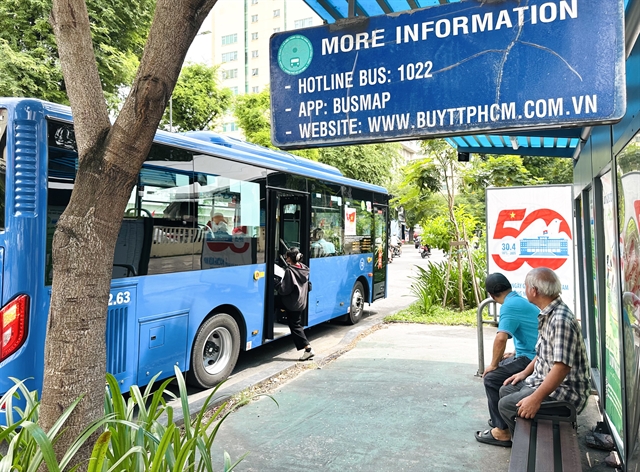
| An electric bus picks up commuters at a bus stop in HCM City, where bus ridership has topped 40 million trips under a free-fare initiative. — VNS Photos Nguyễn Diệp |
HCM CITY — HCM City’s bus network has recorded over 40 million passenger trips nearly four months after implementing a free-fare policy across 134 bus routes, demonstrating a positive public response as the city accelerates plans for an integrated transit network.
The strong growth in bus ridership provides a solid foundation for the city to advance its soft transit infrastructure alongside major urban railway developments.
Integrated bus-metro ticketing system by 2027
The city is upgrading its fare payment system to encourage a shift from private vehicles to public transit.
Passengers will be able to use a single integrated ticket for both bus and Metro Line No 1 services starting from 2027.
Under the proposal, the unified ticketing system will offer flexible time-based options, including daily passes for VNĐ47,000 (US$1.8), three-day passes for VNĐ104,000 ($4), and monthly passes priced at VNĐ412,000 ($16) for regular passengers and VNĐ206,000 ($8) for students.
These passes will allow seamless transfers between buses and Metro Line No 1 without purchasing separate tickets.
In addition, a transfer discount mechanism will apply within 120 minutes of the initial trip.
Bus fares during transfers will drop to between VNĐ3,000 and VNĐ5,000 ($0.12-0.19) depending on distance. Combined bus and Metro Line No 1 fares will range from VNĐ3,000 to VNĐ16,000 ($0.12-0.62) based on the number of stations passed.
The city has built a modern cashless payment platform in partnership with major financial institutions, with cashless transactions accounting for over 90 per cent of all payments.
Integrated with the national population database application VNeID, the platform enables passenger identity verification, management of preferential fare policies, and operational support.
Phạm Ngọc Dũng, director of the city Public Transport Management Centre, said modern payment hardware has been installed on 135 out of 182 bus routes, covering more than 2,000 out of the city's 2,462 buses.
"Authorities plan to extend this integrated payment framework to water buses, public bicycles, and taxis," said Dũng.
On October 23 alone, the free-fare routes operated 17,689 trips serving 458,157 passenger trips, representing a 49 per cent surge compared to the same period in 2025, with identity verification rates exceeding 92 per cent.
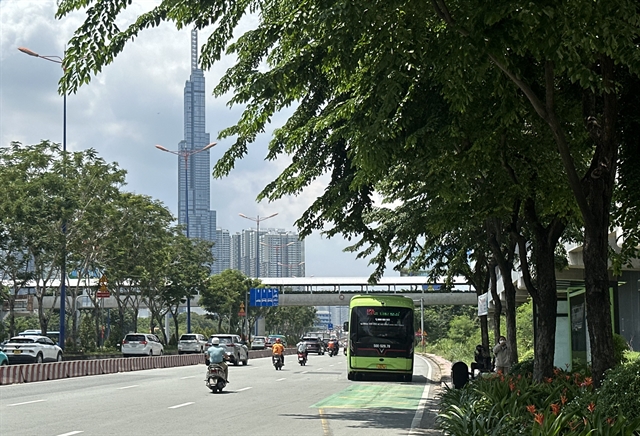
|
| A bus stop situated near a Metro Line No 1 station in HCM City. The city plans to roll out an integrated bus-metro ticketing system by 2027 to encourage public transit usage. |
High-capacity metro corridors to airports and hubs
Alongside fare integration, the southern metropolis is pushing forward major urban railway corridors.
Under its long-term master plan, the city aims to build 28 urban railway lines spanning nearly 1,500km by 2050, when public transport is projected to meet 55 to 60 per cent of total travel demand.
The city targets completing 255km of metro lines by 2030 and expanding the network to over 500km by 2035.
Trần Quang Lâm, director of the city Department of Transport, said: “Developing an integrated urban railway network is essential for a megacity like HCM City, where road expansion alone can no longer resolve chronic traffic congestion.”
Five priority railway projects are scheduled for groundbreaking by the end of 2026.
Two public-private partnership projects comprise the Tham Lương - An Hạ section of Metro Line No 2 and the Thủ Thiêm - Long Thành light railway.
Three publicly funded projects include Metro Line No 1 and Metro Line No 2 extensions into Bình Dương, alongside Phase 1 of Metro Line No 6 connecting Tân Sơn Nhất International Airport with Phú Hữu.
For the 2026-30 period, eight high-priority urban railway projects will reinforce regional connectivity.
The 32.8-km Metro Line No 1 extension from Bình Dương to Suối Tiên carries an estimated investment of VNĐ55 trillion ($2.1 billion).
The 35-km Metro Line No 2 section from Thủ Dầu Một to Tao Đàn Park is budgeted at VNĐ113 trillion ($4.38 billion).
Phase 1 of Metro Line No 6, spanning 22.9km with an investment exceeding VNĐ86.5 trillion ($3.35 billion), will create a direct transit corridor between Tân Sơn Nhất International Airport, Phú Hữu station, and the planned Thủ Thiêm - Long Thành railway, relieving heavy congestion on airport access routes.
Phan Công Bằng, head of the city Urban Railway Management Board, said the three publicly funded metro projects are slated for final administrative approval in December, with construction beginning before year-end and operational launch targeted for the 2030s.
The city is also preparing Metro Line No 3 connecting Vũng Tàu, Bà Rịa, and Phú Mỹ, with proposed extensions to Long Thành International Airport to ensure seamless intermodal links across the key southern economic zone.
Combining interconnected metro corridors with multi-modal payment will alleviate congestion and drive sustainable growth. — VNS
Society
 Society
 Society
 Society
 Society
 Society
 Society
 Society
 Society
 Society
 Society
 Society
 Society
 Society
 Society