 Society
Hội An to begin Japanese language education at two schools
1.
|
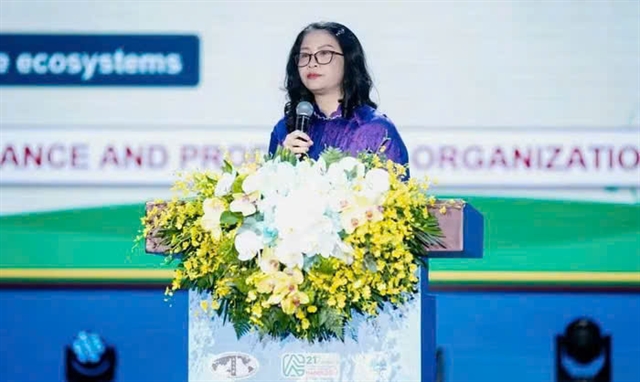
| Prof. Dr. Nguyễn Thị Lan, director of the Vietnam National University of Agriculture, delivers a speech at the congress. — Photos Trần Như |
HÀ NỘI — Experts have called for sustainable livestock development to combine higher productivity with lower emissions, better animal welfare and improved farmers' livelihoods, particularly those of small-scale producers.
At the 21st Asian-Australasian Association of Animal Production Societies (AAAP) Animal Science Congress 2026, held in Hà Nội from October 28 to 31, experts stressed the need to make the sector more efficient, environmentally friendly and inclusive.
At a session on sustainable livestock production, Prof. Dr. Nguyễn Thị Lan, director of the Vietnam National University of Agriculture, highlighted the sector's vital role in food security, rural livelihoods and economic growth.
However, it faces growing challenges, including climate change, environmental degradation, animal diseases and antimicrobial resistance. Consumers are also demanding higher standards of food safety, traceability and animal welfare.
Lan said the industry needed to shift its focus from production volume to efficiency and value, and from responding to problems to preventing risks. It should also adopt the One Health approach, linking human, animal and environmental health.
She outlined five priorities, including improving animal genetics and nutrition while conserving indigenous breeds, strengthening disease prevention, biosecurity and animal welfare; promoting low-emission and circular production, accelerating digital transformation, and improving access to finance, technology and markets for small-scale farmers.
Waste management should move beyond treatment towards resource recovery, reuse and biogas production, while crop and livestock farming should be better integrated, she said.
Digital technologies, automation and traceability systems could help reduce costs and strengthen consumer confidence, but must be accessible to smaller producers rather than benefiting only large enterprises.
Lan stressed that the transition required closer cooperation between businesses, universities, research institutions and farmers through joint research, technology transfer and training.
|
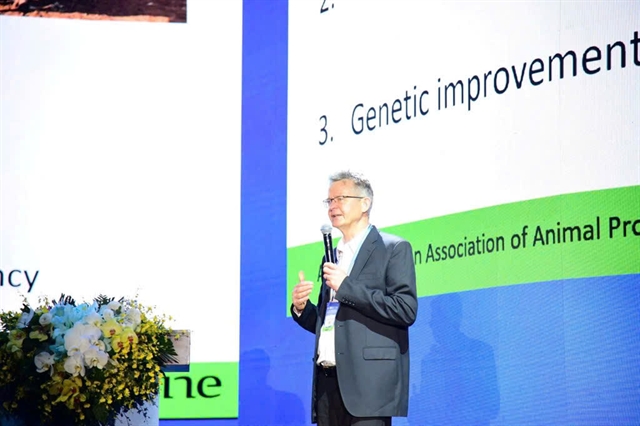
| Prof. Ermias Kebreab of the University of California in the United States speaking at the event. |
Low-emission production would remain difficult without improvements in breeding, feed and waste management, while food safety depended on effective disease control and traceability.
The transition would not succeed if small-scale farmers were left behind, she said.
Raising productivity while cutting emissions
Prof. Julius van der Werf of the University of New England in Australia said demand for animal protein in Asia would continue to rise as agricultural labour and natural resources became increasingly constrained.
The sector therefore needed to raise productivity and use resources more efficiently.
He cited Australia's experience over the past 50 years, during which genetic improvements helped increase beef production by around 30-40 per cent, despite the cattle herd remaining largely unchanged. Feed consumption and methane emissions per kilogramme of meat also fell significantly.
The goal should not simply be to breed animals that emit less methane, as they may also be less productive. Instead, breeding programmes should balance productivity and environmental performance to reduce emissions per unit of output.
He noted that breeding programmes in many developing countries remained constrained by inadequate data collection and a lack of centralised databases. Conserving indigenous breeds should also go hand in hand with improving their productivity to encourage farmers to continue raising them.
Prof. Ermias Kebreab of the University of California in the United States said the challenge was to produce better rather than simply more, meeting food demand while reducing emissions and improving farmers' incomes.
He introduced RationSmart, a mobile-based feed formulation tool developed with research partners in Asia and Africa, including Việt Nam. Expected to be launched in late 2026, it will recommend optimised feed rations and estimate methane emissions from tropical dairy cattle.
|
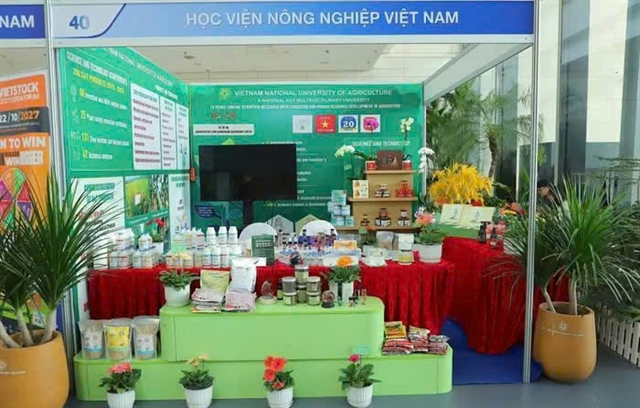
| Some products developed by the Vietnam National University of Agriculture are displayed at the event. |
Kebreab said combining genetic improvements with feed additives such as 3-NOP could reduce methane emissions by about 37 per cent. Methane reduction could also deliver relatively rapid climate benefits because the gas remains in the atmosphere for around 10 years.
However, technology would only make a meaningful difference if adopted on a large scale, requiring science-based incentives, private-sector participation and tangible economic benefits for farmers.
The congress is expected to strengthen research cooperation and help Việt Nam's livestock sector improve production efficiency, reduce emissions and pursue sustainable development. — VNS
Society
 Society
 Society
 Society
 Society
 Society
 Society
 Society
 Society
 Society
 Society
 Society
 Society
 Society
 Society