 Economy


Bamboo circus show tells Vietnamese village stories on Hà Nội stage
1.
|
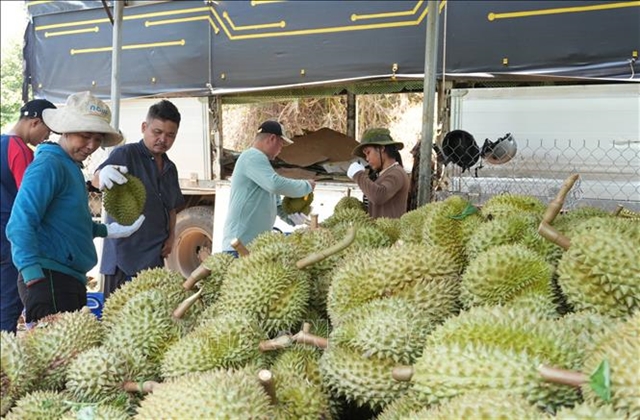
| Farmers in Lâm Đồng Province harvest durians for exports. — VNA/VNS Photo |
HÀ NỘI — Deputy Prime Minister Hồ Quốc Dũng on Friday called for production to be aligned more closely with market demand, and a commodity exchange for agricultural and aquatic products to be established.
He made the appeal at a meeting in Hà Nội to review production, sale and import-export activities in the agricultural, forestry and fishery sectors and discuss measures to meet the 2026 targets.
Deputy Minister of Agriculture and Environment Võ Văn Hưng reported that exports of agricultural, forestry and fishery products were estimated at US$62.89 billion in the first 10 months of 2026, up 7.8 per cent year-on-year. Imports reached $44.28 billion, up 9.2 per cent, resulting in a trade surplus of around $18.6 billion, an increase of 4.7 per cent.
The sector is expected to achieve its full-year growth target of 4 per cent, with fourth-quarter growth projected at 4.3-4.4 per cent. Exports are forecast to exceed $74 billion.
However, domestic production and sale face challenges, including declining rice cultivation areas in the Mekong Delta, abundant supplies of some commodities and high input costs. Export markets remain concentrated, while falling prices have affected earnings from key products. In the first 10 months, coffee export volume rose 18.1 per cent, but value fell 5.4 per cent; rice exports declined 5.7 per cent in volume and 10.8 per cent in value.
Weak links between production, procurement, processing and distribution, fragmented production and unstable purchase contracts remain major bottlenecks. Processing facilities operate at only 60-80% of designed capacity, while cold storage and logistics infrastructure remain inadequate.
Better forecasts
Concluding the meeting, Deputy PM Dũng described the sector's performance as encouraging and said the 4 per cent growth target is within reach.
He asked the Ministry of Agriculture and Environment to coordinate closely with the Ministry of Industry and Trade in monitoring production, harvesting, processing and sale of key products, accurately forecasting output and guiding production according to market demand and technical standards.
He also called for urgent planning of cultivation and farming areas to prevent spontaneous expansion, alongside digitalisation of data on growing areas, farming zones and packing facilities. Strict origin traceability and food safety controls are essential to prevent trade fraud, he noted.
The Deputy PM assigned the Ministry of Agriculture and Environment to work with the Ministry of Industry and Trade on a proposal to establish an agricultural and aquatic product exchange to promote products, facilitate trade and improve market transparency. Farmers, he stressed, must not be left to cope with bumper harvests and falling prices on their own.
He further urged greater investment in innovation, productivity and product quality improvement, and breeding technologies, particularly for pig, shrimp and fish, with scientific research closely tied to practical production and commercial outcomes.
The Ministry of Industry and Trade was tasked with ensuring sufficient supplies of essential goods for the upcoming Tết (Lunar New Year), stabilising the market, combating smuggling and counterfeit goods, and helping exporters respond to trade barriers.
The Deputy PM also called for stronger links between Vietnamese businesses and major overseas distribution networks, simpler administrative and customs procedures, and tighter controls to prevent smuggling and trade fraud. — VNA/VNS
Economy
 Economy
 Economy
 Economy
 Economy
 Economy
 Economy
 Economy
 Economy
 Economy
 Economy
 Economy
 Economy
 Economy




