 Society
Hà Nội takes on ‘socialist commune’ pilot
1.
 |
| An aerial view of Ba Vì National Park in Phú Thọ Province, parts of which have been proposed for transfer to Hà Nội. — Photo vuonquocgiabavi.com.vn |
HÀ NỘI — Nestled at the foot of Ba Vì Mountain, about 65 kilometres west of central Hà Nội, a small hamlet known as Mom is at a turning point. Within weeks, it could become part of the capital rather than remain in Phú Thọ Province.
Mom Hamlet lies within an area of just over 4,000 hectares in Phú Thọ proposed for transfer to Hà Nội. The proposal, put forward by the Hà Nội Party authorities, is undergoing public consultation ahead of further consideration in early November.
The buffer zone comprises 664 hectares in Thịnh Minh Commune, where Mom Hamlet is located, 481 hectares in Lương Sơn Commune and 332 hectares in Kỳ Sơn Ward.
Public consultations were held across 126 communes and wards from October 22 to 25 to ensure transparency and democratic participation and to provide a foundation for further refinement of the proposal.
The adjustment aims to streamline the national park's management, reduce the need for complex inter-provincial coordination, facilitate forest protection and develop an ecological space along the border between Phú Thọ and Hà Nội.
Surrounded by forests and the Đà River, Mom Hamlet can only be reached by a narrow road along the river that is riddled with potholes and exposed rocks.
Among its seven residential groups, five are within the territory proposed for transfer to Hà Nội's Ba Vì Commune.
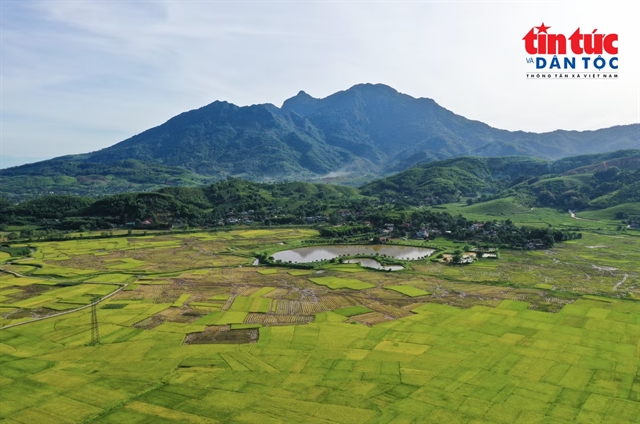 |
| Mom Hamlet is nestled at the foot of Ba Vì Mountain and surrounded by forests. — Photo baotintuc.vn |
On October 23, representatives from the hamlet's households gathered to learn about the proposal and cast their votes, the Tin tức & Dân tộc (News & Ethnicity) newspaper reported. At the meeting, 159 out of 163 households voted in favour of the adjustment.
Hopes for change
For Nguyễn Văn Truyền, head of the hamlet, the adjustment is expected to provide more job opportunities for young people.
Local residents' livelihoods depend primarily on agriculture. Most young people work at industrial parks, located 15-20 kilometres away, to earn a better income and support their families.
"When hearing that our area is being considered to become part of Hà Nội, many of us are hopeful that it will bring new opportunities to develop the economy and create new jobs," Truyền said.
Mom resident Đinh Thị Hòa, 68, hoped the change would improve her access to social welfare services, especially those concerning social insurance, welfare subsidies, support for people with meritorious services to the nation and poor households.
“I hope that the adjustment will not only facilitate better administrative management but also make it easier for us to access social policy programmes and public services,” she said.
Meanwhile, 58-year-old Nguyễn Mỹ Tịnh hoped that inter-commune roads and connections to major transport arteries near Hà Nội would be upgraded, helping to facilitate travel, trade and economic growth.
"We hope the authorities will promptly assess the current situation and prioritise infrastructure development plans, rather than letting the planning process drag on," he said.
Keeping community ties
The expectations and hopes were not lost on the hamlet's Party secretary, Nguyễn Trọng Lê, who chaired the meeting and said he had rarely seen such high attendance and enthusiasm from residents.
“Everyone was very excited and engaged. Many are eager for this plan to be implemented soon,” he said.
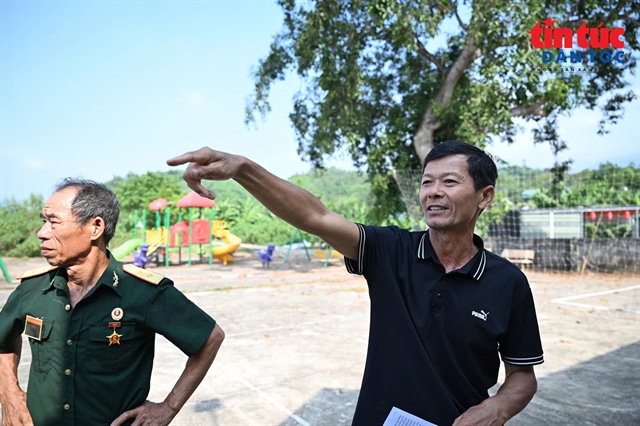 |
| Nguyễn Trọng Lê, secretary of Mon Hamlet's Party cell (right), speaks to local residents at a meeting on October 23 to seek their opinions on the proposed boundary adjustment. — Photo baotintuc.vn |
However, he also expressed concern about potential changes in community life following the adjustment, stressing that local customs, traditions and the spirit of solidarity and mutual support among families should be preserved.
“Even domestic matters such as assisting a family with funeral arrangements when a loved one passes away require attention," Lê said. "Regardless of any changes to administrative boundaries, the bonds between neighbours must be maintained as a vital part of our lives."
Residents in other areas are also being consulted about the adjustment, including those in Hà Nội's Ba Vì Commune.
According to the commune's chairman, Nguyễn Giáp Đông, by October 24, more than 90 per cent of nearly 6,000 households had voted in favour of the proposal.
Expert views
Speaking to Lao Động (Labour) newspaper about the adjustment, architect Đào Ngọc Nghiêm, vice president of the Việt Nam Urban Planning and Development Association, said careful consideration would be essential before any decision is made, noting that Hà Nội had undergone four administrative boundary adjustments throughout its history, involving both expansion and contraction.
“Drawing from experience, Hà Nội must carefully select the appropriate conditions and timing for any boundary expansion,” he said.
He added that, as Hà Nội aims to pursue green urban development, the adjustment to include forested areas within Ba Vì National Park could help the capital achieve its environmental goals.
"That's why its impact must be thoroughly examined and evaluated within the broader context of the capital’s overall development,” Nghiêm said.
Meanwhile, Đặng Hùng Võ, former deputy minister of Natural Resources and Environment (now the Ministry of Agriculture and Environment), said that the border area could benefit from Hà Nội's strategic position and favourable development conditions if it became part of the capital.
“An area that is part of the capital generally has greater development opportunities than one that merely borders it,” he said.
He also pointed out limitations that need to be addressed so that the area proposed for transfer can reach its full development potential, most notably transport connectivity.
“To attract visitors, especially international tourists, the first priority must be to improve transport infrastructure to create easier access to tourism and resort destinations,” he said.
The results of the consultation process will be submitted to the People's Councils at various levels by October 31, in preparation for their discussions scheduled for the first week of November.
The outcomes of these sessions will be forwarded to the Ministry of Home Affairs during the second week of November and subsequently submitted to the National Assembly for approval during its second session, which runs until November 17.
If the National Assembly approves the adjustment, Hà Nội and Phú Thọ authorities will prepare a plan for the handover and transfer of administrative boundaries, with completion expected by November 15. — VNS
Society
Society
 Society
.JPG) Society
 Society
 Society
 Society
 Society
 Society
 Society
 Society
 Society
 Society
 Society
 Society