 Talking Shop


Việt Nam, Denmark issue joint statement on establishment of Comprehensive Strategic Partnership
1.
 |
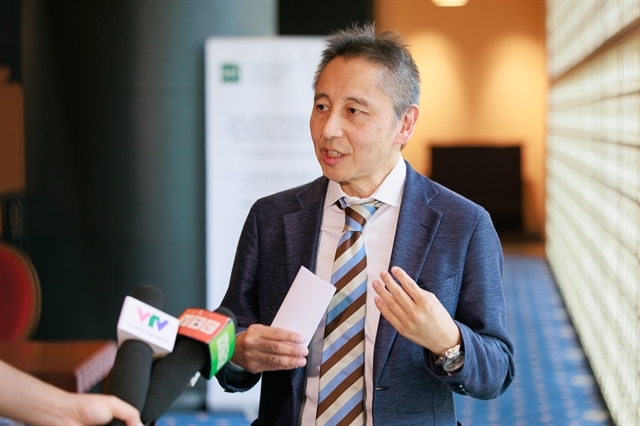
| Simon Dickie, chairman of the New Zealand–Vietnam Business Council. — Courtesy photo |
By Mai Hương
Timed with Party leader and President Tô Lâm's official visit to New Zealand, Chairman and co-initiator of the New Zealand-Việt Nam Business Council Simon Dickie, urged the upgraded Comprehensive Strategic Partnership to deliver tangible benefits for businesses.
In an interview with Việt Nam News, he outlines how both countries can unlock greater trade, investment and long-term partnerships by reducing market barriers, encouraging two-way investment, and strengthening private-sector engagement.
General Secretary and President To Lâm's visit to New Zealand is expected to inject fresh momentum into bilateral ties. What concrete outcomes would you like to see from the visit for businesses?
Việt Nam–New Zealand relations have reached an important milestone with the Comprehensive Strategic Partnership. I would like this visit to strongly focus on translating political momentum into practical commercial outcomes for businesses in both countries.
First, both governments should reaffirm a clear ambition to grow bilateral trade and investment beyond current targets, with a particular emphasis on diversifying the relationship beyond traditional commodities.
Second, there needs to be a stronger focus on reducing practical market-entry barriers. This includes improving regulatory alignment, product approvals, standards, customs and market-access processes, which can be significant impediments for smaller New Zealand businesses entering Việt Nam.
Third, we should see greater encouragement of two-way investment and joint ventures. The opportunity extends beyond New Zealand exporting more products; it lies in building partnerships with Vietnamese businesses and investing in Việt Nam's future growth, utilising New Zealand’s world-class capability in areas like food and agritech, education, healthcare, technology and sustainability.
Finally, the visit should establish a mechanism for ongoing private-sector engagement. We need businesses from both countries sitting down together regularly to identify opportunities and convert discussions into transactions, investment, and long-term partnerships. This is precisely the role we envision for the New Zealand-Việt Nam Business Council.
Which sectors now offer the biggest opportunities for bilateral cooperation, and what practical steps are needed to unlock them?
I see significant potential across several sectors, particularly food and agritech, education and skills development, healthcare and wellness, technology and digital transformation and green and sustainable development.
Food and agritech offer obvious complementarities, combining New Zealand's expertise in sustainable farming and food safety with Việt Nam's rapidly modernising agricultural sector and sophisticated consumer market.
In education, there is considerable scope to develop deeper institutional partnerships to meet Việt Nam's demand for vocational training and digital skills. Healthcare and wellness also present strong opportunities as Việt Nam's middle class expands, while New Zealand's specialised expertise can support Việt Na’s rapid development in clean technology and digital transformation.
As a practical next step, I recommend creating a regular, business-led New Zealand– Việt Nam sector forum supported by both governments. While we already have the trade architecture through agreements like CPTPP, RCEP and AANZFTA, the next step is making them work more effectively at the business level.
Actively identifying and removing regulatory or market-entry obstacles for commercially viable projects in priority sectors would have a far greater impact than signing another broad cooperation agreement.
Ultimately, the relationship should evolve from one primarily based on trade in goods to one built around investment, technology, knowledge and long-term partnerships. Additionally, establishing direct flights and improving the immigration system would greatly benefit individuals and companies looking to expand these trade possibilities.
Việt Nam is undertaking wide-ranging reforms to improve its business environment and attract high-quality investment. Which recent changes have been most encouraging for New Zealand businesses, and what further reforms would you like to see?
New Zealand businesses generally have a high degree of confidence in Việt Nam's long-term economic potential. What can sometimes make companies hesitate is not the underlying opportunity, but uncertainty around how regulations are interpreted and implemented, particularly at a local or provincial level.
I would therefore like to see continued progress towards greater transparency, consistency and predictability in regulatory and approval processes. Faster and more consistent processes for investment approvals, licenses, product registrations, customs and other market-entry requirements would make a significant difference.
I would also encourage greater dialogue between government and the foreign business community when new regulations are being developed. Businesses are often able to identify practical implementation issues that may not be apparent when regulations are designed.
Việt Nam does not need to convince New Zealand businesses that the opportunity exists. The opportunity is already very clear. The priority now is making it easier, faster and more predictable for good businesses to invest, operate and grow in Việt Nam.
In today's uncertain global business environment, what qualities do New Zealand companies value most in long-term Vietnamese partners?
In an increasingly uncertain global trading environment, I believe New Zealand businesses are looking for much more than a transaction when choosing a partner in Việt Nam. They are looking for trust, transparency, capability and a genuine long-term commitment to the relationship.
Việt Nam is a market where local knowledge and relationships are extremely important. A strong Vietnamese partner can provide invaluable insight into the market, customers, regulations and business culture. But the relationship has to work both ways. The best partnerships are built around complementary strengths rather than simply one company selling to another.
For New Zealand businesses, reliability and transparency are particularly important. They want confidence that their partner will communicate openly, honour commitments, and address problems quickly when circumstances change.
At the same time, Vietnamese businesses increasingly want international partners who are prepared to commit to Việt Nam rather than simply view the country as another export market. That means investing time, building relationships, developing local capability and understanding the Vietnamese market.
Ultimately, enduring partnerships are built through repeated interactions, transparency, and shared success. You cannot build resilience through a contract alone. You build it by investing in the relationship and creating value for both sides over the long term. — VNS
Talking Shop
 Talking Shop
 Talking Shop
 Talking Shop
 Talking Shop
 Talking Shop
 Talking Shop
 Talking Shop
 Talking Shop
 Talking Shop
 Talking Shop
 Talking Shop
 Talking Shop
 Talking Shop
 Talking Shop