 Economy



NA President meets with Chinese Premier in Beijing
1.
|
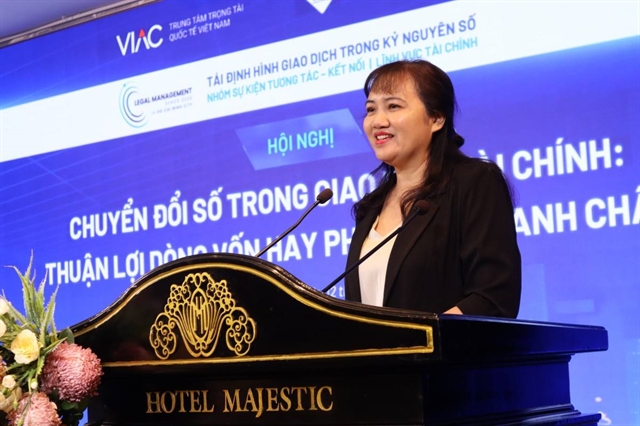
| Cao Thị Phi Vân, deputy director of ITPC, addresses the conference in HCM City on Wednesday. — Photo courtesy of ITPC |
HCM CITY — Vietnamese businesses should integrate legal governance into their core business strategies rather than treating it as a tool for resolving disputes after they arise, as digital transformation continues to reshape financial transactions and create new legal risks, experts said.
The recommendation was made at the conference “Digital Transformation in Financial Transactions: Facilitating Capital Flows or Complicating Disputes”, jointly organised by the Investment and Trade Promotion Centre of HCM City (ITPC) and the Vietnam International Arbitration Centre (VIAC) on Wednesday.
The event marked the opening of the Legal Management Series HCMC 2026 (LMS HCMC 2026), a programme focusing on legal governance in finance, trade and logistics.
More than 200 representatives from businesses, banks, credit institutions, law firms and legal organisations attended the conference to discuss how rapid digitalisation is transforming commercial transactions while creating increasingly complex legal and compliance challenges.
Speaking at the event, Cao Thị Phi Vân, deputy director of ITPC, said the 2026 series focus on sectors undergoing profound changes as a result of digital technology and deeper international integration.
She said businesses have traditionally viewed legal services as a means of resolving problems after they occur.
However, the fast-changing business environment now requires legal considerations to be embedded in transaction design, data governance, contract drafting and risk management from the outset.
“Legal governance must stay ahead of risk,” she said.
Experts noted that digital finance has expanded rapidly in Việt Nam, improving businesses’ access to capital, payment services and other financial products.
According to figures presented at the conference, 87 per cent of the population now has a bank account, while QR-code transactions increased by 128.2 per cent during the 2021-25 period.
Behind this rapid growth, however, are emerging risks involving data protection, online fraud, cyberattacks and innovative business models that remain insufficiently regulated.
Participants said the current legal framework is still scattered across different regulations, while technological innovation is evolving faster than policy development.
They called for continued improvements to laws governing data protection, digital identity, cybersecurity and consumer protection, while also strengthening oversight of financial technology (FinTech), introducing regulatory sandbox mechanisms and developing a legal framework for Open Banking.
For businesses, this means legal risks are no longer confined to conventional contractual clauses.
Risks can arise from unauthenticated data, inadequate digital identification procedures, electronic transactions lacking sufficient evidence or unclear allocation of responsibilities among parties operating on digital platforms.
The emergence of digital assets, crypto-assets and blockchain technology has further broadened the scope of these legal issues.
Phan Đức Trung, chairman of the Vietnam Blockchain and Digital Assets Association, said blockchain technology can enhance data storage and transaction traceability but cannot guarantee the accuracy of information entered into the system.
He said businesses must therefore ensure data quality from the beginning while clearly defining ownership, accountability and responsibility for data throughout digital transactions.
According to Trung, technological advances cannot replace effective governance.

|
| Particpants at the discuassion. — Photo courtesy of ITPC |
Instead, companies need a clear understanding of who they are transacting with, which data carries legal value, who is responsible for that data and how evidence can be established should disputes arise.
A key topic discussed at the conference was dispute resolution in digital financial transactions.
Experts warned that as digital platforms become increasingly integrated into commercial activities, disputes are likely to involve ownership rights over digital assets, platform liability, the evidentiary value of electronic data and the enforceability of contractual rights.
The challenges are particularly significant for crypto-assets, where proving ownership, preserving evidence and enforcing legal rights remain complicated.
Businesses should therefore consider dispute resolution mechanisms when negotiating contracts, particularly those involving cross-border transactions.
Participants agreed that this represents a fundamental shift in legal governance.
Rather than responding after disputes emerge, businesses should incorporate legal risk management into every stage of their operations, including partner due diligence, contract drafting, data management, platform selection and dispute resolution planning.
Cao Thị Phi Vân said LMS HCMC 2026 is intended not only to update businesses on legal developments but also to provide a practical platform where companies can exchange views directly with legal experts and experienced practitioners.
She added that ITPC would continue supporting enterprises through training programmes, trade promotion activities, export consultancy services and assistance in participating in international trade fairs and exhibitions.
The ultimate objective, she said, is not merely to help businesses comply with regulations but to strengthen their ability to anticipate risks, adapt to changes in the business environment and improve long-term competitiveness.
Experts concluded that in the digital economy, legal preparedness has become a strategic advantage.
As technology continues to reshape business models and financial transactions, waiting until disputes occur before seeking legal solutions is no longer a viable option. — VNS
Economy
 Economy
 Economy
 Economy
 Economy
.jpg) Economy
Economy
 Economy
 Economy
 Economy
 Economy
 Economy
 Economy
 Economy
 Economy
 Economy