 Environment

HCM City honours fallen soldiers with solemn musical tribute
1.
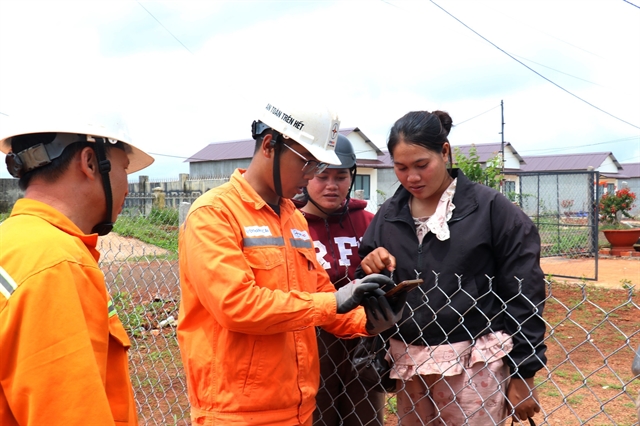 |
| Utility technicians guide residents in Bu Dăr Hamlet of Lâm Đồng's Quảng Trực Commune through EVN's customer app. — VNA/VNS Photo |
LÂM ĐỒNG — Lê Văn Lộc did things the old-fashioned way. For decades, the 65-year-old resident of Đắk Wil Commune in the Central Highlands province of Lâm Đồng trekked to the local utility office whenever he needed to check his bill or find out when the power might go out.
So when a technician from the power company suggested he try doing it all on his phone instead, he doubted it would work. It took the technician a little more than ten minutes to change his mind, enough time to walk him through installing the app, checking his bill, looking up a scheduled outage and making his first online payment.
"I thought it would be difficult. But it only took a few steps, and now I know this month's bill and the outage schedule without having to go to the power company," Lộc said.
Lộc's conversion is a small episode in a much larger campaign. Across Lâm Đồng's remote, often mountainous communes, the State utility EVN is pursuing two goals at once: bringing digital services to people who have rarely used a smartphone for anything beyond calls, and persuading businesses to generate more of their own power.
Both threads trace back to Resolution 57, a December 2024 Politburo resolution ordering a nationwide push on science, technology and digital transformation, and to Resolution 70, an August 2025 resolution on energy security that commits Việt Nam to expanding renewable power as it works toward net zero emissions by 2050.
The digital push shows up in small, repeated interactions between line workers and customers. EVN's customer app lets people track electricity use, pay bills and receive maintenance and outage alerts through Zalo, one of the country's most dominant messaging platforms.
Chief of Quảng Trực Commune's Bu Dăr Hamlet Vũ Minh Tiến said residents now get advance notice of planned maintenance through a community-wide Zalo group, letting them plan around power cuts instead of being caught off guard.
In nearby Tuy Đức Commune, resident Trần Văn Sơn said the app has completely changed how his household uses electricity – he now checks consumption every month and adjusts accordingly.
Businesses have taken to the tools just as readily. At Lâm Tâm Trading and Services, also in Bu Dăr, nearly every transaction with the utility – checking output, paying bills, registering new services – now happens online, which the company says helps it plan production around peak demand periods.
But the shift hasn't reached everyone equally.
Utility staff and local officials say that elderly residents and members of ethnic communities are often unfamiliar with smartphones, and that patchy telecommunications infrastructure in some areas makes the apps hard to use even for those who do try.
Đắk Wil has responded by forming door-to-door digital transformation teams of youth union volunteers and students who teach utility apps, online public services and cashless payments, said Hoàng Văn Tám, chairman of the commune's People's Committee.
Meanwhile, utility technicians have effectively taken on a second job. After repairing lines or swapping out meters, they say they routinely stay behind to help residents install software, register accounts and sign up for alerts, tasks that fall outside any formal job description but have become essential to extending the digital economy into border communities like these.
The scale of the underlying infrastructure is considerable: the utility's Tuy Đức branch alone maintains 225km of medium-voltage line and 232km of low-voltage line across rugged terrain, serving nearly 15,000 customers through more than 200 transformer substations.
Increasingly, the network runs on automation rather than manual checks, a shift that has improved reliability and customer service, according to director of Lâm Đồng Power Company Phan Sỹ Duy.
"SCADA monitoring, unmanned substations and automated remote metering have fundamentally changed how we manage the grid," he said.
Across the company's service area, almost all meters have been converted to digital smart meters, and 98.13 per cent report usage automatically rather than requiring a manual reading.
By cross-checking the national population database to verify new customers, the utility says it now takes just 2.22 days on average to connect a low-voltage household to the grid.
If digital tools are changing how people interact with the grid, a parallel shift is changing where their power comes from.
Lê Anh Vũ has seen it firsthand. His machine shop in Cư Jút Commune, which makes agricultural equipment, used to adjust its production schedule every dry season, when farmers pumping water for their coffee crops pushed local power demand to its limits.
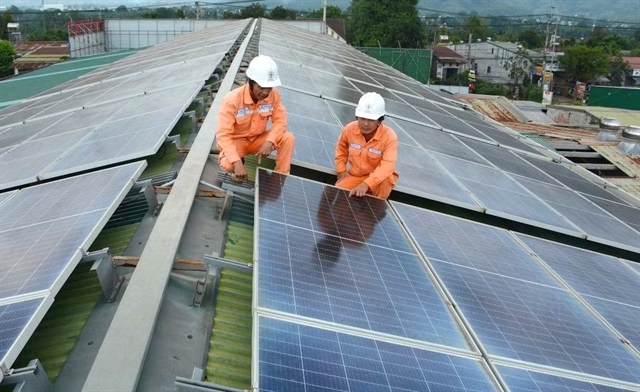 |
| Utility technicians inspect a rooftop solar system at a workshop in Lâm Đồng's Cư Jút Commune. — VNA/VNS Photo |
In 2020, Vũ spent more than VNĐ1 billion (US$38,000) installing a 100kW rooftop solar array across the workshop roof. Five years on, the system covers most of the shop's power needs and has already paid for itself.
The monthly electricity bill – more than VNĐ20 million ($760) before the panels went up – is now less than half that. Upkeep amounts to little more than periodically cleaning the panels, Vũ said.
"Demand for irrigation during the dry season here is enormous. We used to have to adjust our production plans around it. Since we installed solar, power for our machinery has been far more stable, and we're more in control of our own production," Vũ said.
Nearby, Green Charge LC has made a similar investment on a larger scale.
The company spent more than VNĐ2 billion ($76,000) on a 123kW solar system, split between its office and an electric vehicle (EV) charging station.
Grid electricity purchased for the office alone has fallen from about 3,000kWh a month to between 700 and 900, according to business manager Lê Xuân Cường – savings he says are helping fund the company's expansion into EV charging.
Green Charge LC now plans to add between 150 and 200 kilowatts of additional solar capacity and roughly 500kWh of battery storage to keep pace with rising demand at its charging stations.
Local officials describe these as pilot cases for a wider push. Đắk Wil, which gets abundant sunshine and has large tracts of undeveloped land, has designated solar power as a priority sector and is setting aside land to attract investors, Tám said.
For the utility, the appeal is as much about grid management as it is about economics. Vũ Thành Nam, acting head of the utility's Cư Jút branch, said solar power is becoming a key part of Việt Nam's energy transition as the country works toward net zero emissions by 2050.
"When people and businesses produce and use their own electricity, pressure on the national grid, especially during peak hours, drops significantly. It also diversifies supply and makes the system safer to operate, particularly in remote and border areas," Nam said.
Within the Cư Jút branch's service area, 89 farm-scale solar installations have a combined capacity of about 89 megawatts, alongside roughly 400 smaller rooftop systems installed by individual customers and businesses.
Officials say battery storage, still nascent in the region, will be the next frontier, helping smooth out supply as more solar comes online.
For businesses, the appeal increasingly extends beyond the electricity bill as export markets pay closer attention to emissions and sustainable production. For residents, the payoff is more basic: access to technology and services that were long out of reach.
For EVN, the two efforts serve different ends but point the same way. The digital tools make a distant utility feel closer – a bill checked, an outage flagged, without the trek into town.
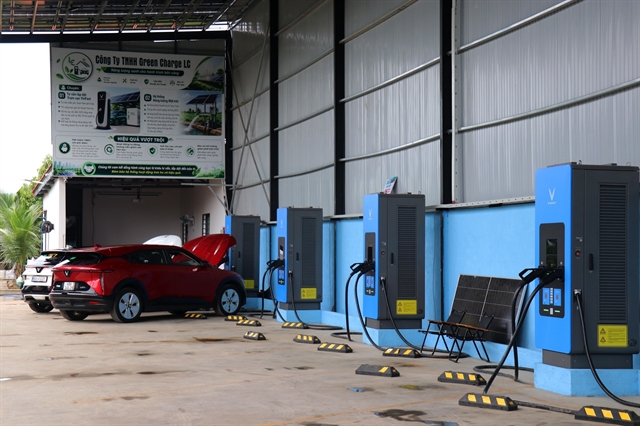 |
| Green Charge LC's EV charging station in Lâm Đồng's Cư Jút Commune, powered by a 123kW rooftop solar system. — VNA/VNS Photo |
The rooftop panels do something more structural: every one that comes online means less demand on a grid already stretched across some of the country's toughest terrain.
That work is far from finished. But in Lâm Đồng's border communes, a phone, a rooftop and a patient technician are starting to add up to something larger than any of them alone. — VNS
Environment
 Environment
 Environment
 Environment
 Environment
 Environment
 Environment
 Environment
 Environment
 Environment
 Environment
 Environment
 Environment
 Environment
 Environment