 Environment
Top Vietnamese leader hosts banquet in honour of Swiss President
1.
|
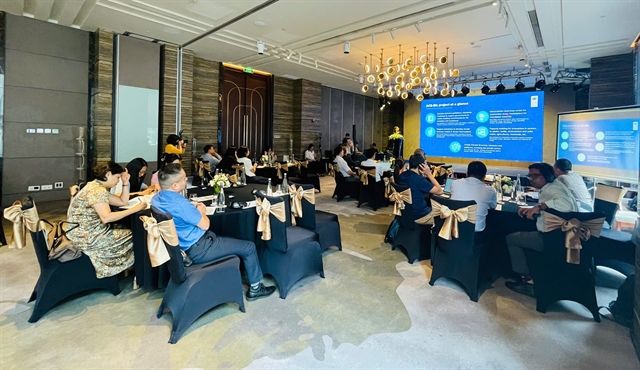
| Delegates listen to presentation at the event. — VNS Photo Thu Trang |
HÀ NỘI — A set of technical guidelines on the reuse of wastewater and sludge was announced on Tuesday afternoon in Hà Nội.
Lessons from the wastewater reuse pilot programme and the feasibility study for a treated-wastewater reuse system under the 'Accelerating circular economy for businesses' (ACE‑Biz) project were also shared at the event.
The ceremony was held by the United Nations Development Programme (UNDP) in Việt Nam, with support from the Government of the Netherlands, in collaboration with the Institute of Environmental Science and Engineering (IESE) and the DEEP C Industrial Zone Complex.
Industrialisation, urbanisation and the impacts of climate change are increasing pressure on Việt Nam’s water resources.
As water demand from the production sector continues to rise, the sustainable extraction and efficient use of water resources has become an urgent priority.
Although the legal framework, including the Law on Environmental Protection 2020, the Law on Water Resources 2023 and the National Roadmap for a Circular Economy to 2035, has provided a basis for reuse of treated wastewater, implementation remains constrained by a lack of technical guidance, standards and coherent management mechanisms.
The document is designed to support regulatory authorities, industrial zone developers and enterprises in selecting appropriate technological solutions to meet reuse objectives, manage risks, operate safely and control the quality of treated water to satisfy environmental protection requirements, providing a technical basis for scaling up water-circulation models in production.
Vũ Thái Trường, head of the Climate Change, Energy and Environment Division at UNDP in Việt Nam, said: “Wastewater reuse is not only a technical solution, but also a development solution.
"When water is circulated and used more efficiently, we not only reduce pressure on water resources but also increase resilience to climate change, promote the circular economy and improve businesses’ competitiveness”.
A central element of the programme is the feasibility study for the pilot treated-water reuse model at the Đình Vũ Industrial Park.
According to the study, the system is designed with a capacity of 1,000cu.m per day, utilising part of the effluent from a central wastewater treatment plant with a capacity of approximately 6,000cu.m per day for further treatment and return to serve various uses within the industrial park.
This approach not only helps reduce abstraction of fresh water resources but also improves operational efficiency of existing technical infrastructure.
The report evaluates three treated-water reuse scenarios: supply for cooling systems; irrigation and street washing; or further treatment to a higher quality for production use and a portion of domestic needs.
Each option is analysed comprehensively in terms of technical requirements, financial viability, environmental benefits and health and safety, enabling enterprises to choose the solution that best fits their needs and investment capacity.
A noteworthy aspect of the study is the combined methodology incorporating health‑risk assessment. Rather than focusing solely on effluent quality, this approach examines the entire chain from technology selection, system operation and quality monitoring to distribution network management to ensure treated water meets the requirements of each intended use while minimising risks to people and the environment.
Resource circulation
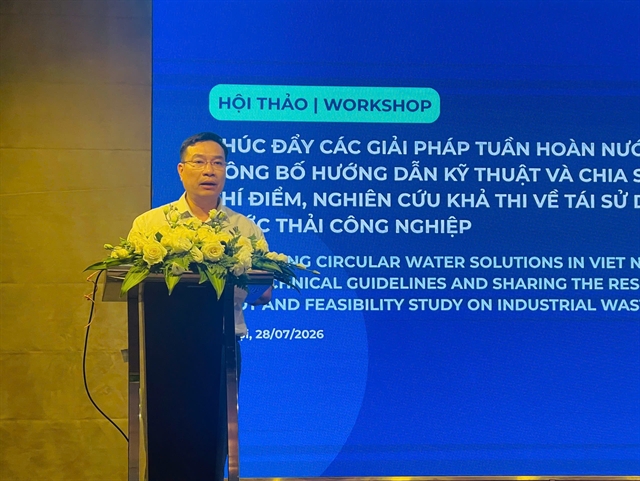
|
| Hồ Kiên Trung, deputy director of the Việt Nam Environment Agency, shares work to promote application of the circular economy in production, business and consumption. — VNS Photo Thu Trang |
Hồ Kiên Trung, deputy director of the Việt Nam Environment Agency (VEA) under the Ministry of Agriculture and Environment (MAE), said over the past period, the Politburo’s and Government’s resolutions for 2024–2025 identified the circular economy as an important driver of the new growth model, with private enterprises placed at the centre of the transition.
The Government’s decrees, together with the Law on Environmental Protection, have promoted the deployment of circular-economy solutions, including wastewater reuse and resource circulation measures.
The MAE’s plan to implement Prime Minister’s Decision 222/QĐ-TTg on the national action plan for circular economy sets out specific tasks to develop institutional arrangements, policies and support measures to promote application of the circular economy in production, business and consumption.
In addition, in carrying out the Government’s resolution on private-sector development, the MAE has led and coordinated with other ministries, sectors, localities and relevant organisations to draft guidance on identifying green projects and projects meeting circular-economy criteria and on applying an environmental, social and governance standard framework.
This draft is expected to be submitted to the National Assembly for approval at its October session.
“We welcome the pilot programme’s initial results – from the application of advanced treatment technologies and technical and economic feasibility assessment to the development of technical guidance to assist enterprises in referencing and applying suitable designs and implementations for wastewater reuse projects in line with environmental protection and water-resources management laws,” said Trung.
“These are valuable practical lessons that will help inform policy refinement and support wider replication of resource-circulation models going forward.”
Looking ahead, the VEA will continue to accompany the business community in implementing circular-economy solutions; coordinate with ministries, sectors, localities and partners to develop and finalise guidance, and create favourable conditions for the establishment and growth of more circular projects – contributing to more efficient use of resources, environmental protection and sustainable development. — VNS
Environment
 Environment
 Environment
 Environment
 Environment
 Environment
 Environment
 Environment
 Environment
 Environment
 Environment
 Environment
 Environment
 Environment
 Environment