Top Vietnamese leader hosts welcome ceremony for Swiss President
1.
|
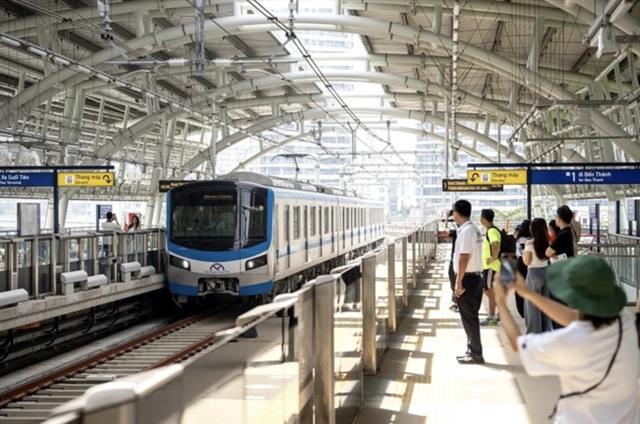
| Passengers wait for a metro train at a station in HCM City. The city plans to expand its urban railway network to 255km by 2030. — Photo: baochinhphu.vn |
HCM CITY — HCM City will accelerate the development of its urban railway network, with eight routes targeted for completion during 2026-30 to raise the total network length to 255km, according to the latest conclusion of the municipal Railway Network Development Steering Committee.
The conclusion was issued following the committee’s third meeting, chaired by HCM City Party Committee Secretary Trần Lưu Quang, who is also head of the steering committee, to review progress and set key tasks for the remainder of 2026.
The steering committee recognised the proactive, determined and responsible efforts of agencies and units in implementing railway development tasks.
To date, three of the six projects and works included in the city’s priority investment list for 2026-30 have been launched or started construction. Authorities are completing procedures and investment documents for the remaining projects.
Trần Lưu Quang asked agencies and units to overcome difficulties, maintain a proactive and determined approach and closely follow assigned schedules. He also called for greater research into and adoption of international experience to gradually improve the city’s capacity in railway management and organisation.
The steering committee agreed to add the Thủ Dầu Một–HCM City metro line, extending to Tao Đàn Station, and Metro Line No. 2, from Tham Lương through An Hạ to the Northwestern Urban Area, to the list of priority urban railway projects.
With the additions, the city aims to complete eight urban railway routes during 2026-30, bringing the total length of its urban railway network to 255km.
A further seven urban railway routes are planned for investment, with the goal of reaching 532km by 2035. Projects with favourable conditions and sufficient resources are to be implemented immediately so they can be completed ahead of schedule.
The city will also work with the Ministry of Construction to seek approval for the HCM City People’s Committee to be assigned as the managing or competent investment authority for the national railway route linking Chơn Thành, Bàu Bàng and Cái Mép, as well as the An Bình–Sài Gòn (Hoà Hưng) section.
The steering committee asked the city’s Party Committee and People’s Committee to speed up preparations for Metro Line No. 2 sections linking Bến Thành–Tham Lương and Bến Thành–Thủ Thiêm, as well as the Bến Thành–Cần Giờ metro line.
Procedures will also be expedited to start construction of four urban railway routes in the fourth quarter of 2026. They include the new Bình Dương City–Suối Tiên metro line, Metro Line No. 6 linking Tân Sơn Nhất with Phú Hữu, the Thủ Dầu Một–HCM City Metro Line No. 2 and the Tham Lương–An Hạ–Northwestern Urban Area section of Metro Line No. 2.
The city has also been asked to urgently complete the railway network planning scheme, ensuring synchronisation and long-term stability with a 100-year vision. The locations of stations, alignments and areas for transit-oriented development (TOD) must be identified promptly.
Flexible funding mobilisation
For the eight priority routes scheduled for completion in 2026-30 and the seven routes targeted for completion before 2035, the Party secretary requested close coordination between railway planning and urban development planning, while making effective use of land resources to generate funding for railway investment.
The city will proactively coordinate with central ministries and agencies to study and propose flexible mechanisms for mobilising, managing and using capital, including public-private partnerships (PPP), public investment and other lawful sources.
International experience should also be studied and appropriately applied to local conditions to mobilise resources and accelerate project implementation. The city will select and apply modern and unified technical standards, regulations and technologies, creating a fair competitive environment for businesses.
At the same time, it will establish clear roadmaps for receiving and mastering technology, increasing localisation and developing domestic capacity in research, construction, operation and maintenance.
HCM City will review successful experience in compensation, support and resettlement from existing projects to develop a unified process for new urban railway schemes. Authorities will also ensure adequate supplies of construction materials and promote the management and reuse of waste generated during construction.
In particular, detailed plans through 2030 must be urgently prepared using Gantt charts for the eight urban railway projects targeted for completion during 2026-30. Progress will be regularly updated so that difficulties can be identified and resolved promptly.
The municipal Department of Construction has been assigned to coordinate with the Party Committee Office to advise on consolidating the Railway Network Development Steering Committee and developing new working regulations suited to the city’s current circumstances. — VNS
 Society
 Society
 Society
 Society
 Society
 Society
 Society
 Society
 Society
 Society
 Society
 Society
 Society
 Society