 Sports
Top Vietnamese leader hosts banquet in honour of Swiss President
1.
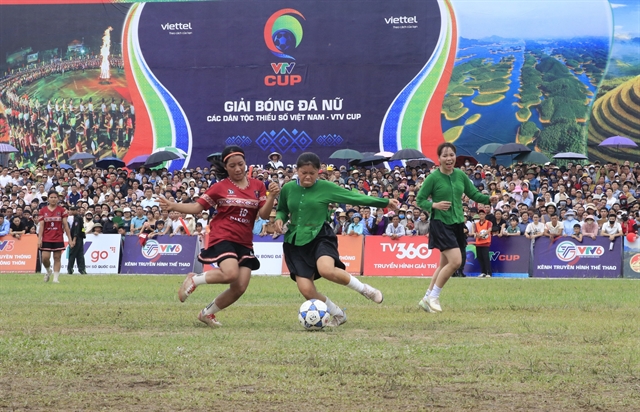 |
| Lục Yên of Lào Cai and Đắk Đoa of Gia Lai compete in the final of the 2026 Việt Nam Ethnic Minority Women's Football Championship - VTV Cup. — VNA/VNS Photo |
Anh Đức
For a week in late August, the most talked-about football in Việt Nam was not played by Nguyễn Xuân Son or Nguyễn Đình Bắc. It was played by women from ethnic minority communities in traditional dress on a pitch in Nghĩa Lộ, Lào Cai Province.
The inaugural Việt Nam Ethnic Minority Women's Football Championship, VTV Cup, brought 12 teams from nine localities together between August 23 and 29.
Some 15,000 spectators packed the stadium for the final, in which hosts Lục Yên edged Đắk Đoa of Gia Lai Province. The images travelled far beyond Việt Nam's borders, with French outlet Le Petit Journal among the international media outlets to take notice of the tournament, which was built entirely around amateur players and the communities they represent.
The most consequential viewer, though, may have been Đoàn Nguyên Đức.
On August 28, the Hoàng Anh Gia Lai chairman, the man whose academy reshaped Vietnamese men's football two decades ago, sent an official letter asking to take over the entire Đắk Đoa squad, with a view to registering the team for the national championship.
He also awarded the team VNĐ100 million (US$3,800) for reaching the final. HAGL has pledged facilities, nutrition, medical support and a modern training programme. With that support, a village team from the Central Highlands could soon become a professional club.
This development comes amid two other significant changes in Vietnamese women's football. In June, the National Women's Championship abandoned its old centralised format for a proper home-and-away league running from June to October.
Seven clubs now play in their own cities, in front of their own supporters, with foreign players permitted for the first time and support from FIFA's League Development Programme. It is, at last, a season rather than an event.
And from September 3, VTV3's prime-time slot has belonged to Đội bóng nữ làng Xuân (Spring Village's Women FC), a drama about a 19-year-old who defies her father's wishes to start a village women's team.
Director Trần Trọng Khôi has said openly that he follows the national women's side and believes their achievements have never received the attention they deserve. Two nights a week, millions of households are now watching women play football on national television.
Here is the thing: none of this is charity. These women earned it. While the men's game absorbed the headlines and sponsorship, the women delivered SEA Games gold after SEA Games gold and in 2023 became the first Vietnamese senior side to reach a World Cup.
Huỳnh Như scored 70 goals in 121 appearances and went to Portugal to play professionally when almost nobody here thought it possible. The women did all of it on modest wages, in front of empty stands, with a league that barely functioned as one. If the spotlight has finally swung their way, it is a debt being repaid, not a favour being granted.
Which brings me to the part that is on us. Attention is fragile. A viral tournament fades, a drama finishes its run and a league only survives if people come through the turnstiles. The clubs are playing at home precisely so that local fans can show up. So show up!
The timing matters more than usual, because the next month may define the next decade. At ASIAD 20 in Japan, new coach Hoàng Văn Phúc leads a squad in transition, without Huỳnh Như or Tuyết Dung, while blooding names such as Lưu Hoàng Vân and Ngọc Minh Chuyên.
Việt Nam open their campaign against Chinese Taipei on September 14 before facing Japan and Thailand. The quarter-finals are within reach, but this is really the first examination of whether a new generation can carry forward what the old one built.
Win or lose in Japan, the infrastructure is finally being laid. The women have waited long enough for it. Now they need us in the stands. — VNS
Sports
 Sports
 Sports
 Sports
 Sports
 Sports
 Sports
 Sports
.jpg) Sports
Sports
 Sports
 Sports
 Sports
 Sports
 Sports
 Sports