Việt Nam-Russia trade at structural turning point: report
1.
|
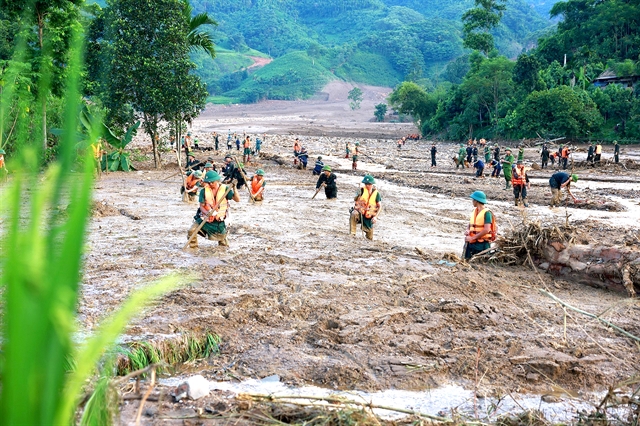
| Soldiers search for the missing after a landslide in Làng Nủ Village, Lào Cai Province in 2024. — VNA/VNS Photos |
HÀ NỘI — More than 600 people have been killed in nearly 400 major flash floods and landslides across the country since 2021, a toll that demands faster alerts and firmer, earlier evacuation orders, according to experts.
Flash floods and landslides are among the most dangerous natural disasters facing Việt Nam.
Statistics from the Department of Dike Management and Disaster Prevention and Control show that 394 major incidents have occurred nationwide over the past six years, killing 602 people and causing extensive damage.
One of the country’s recent most devastating disasters struck Làng Nủ Village in Phúc Khánh Commune, Lào Cai Province, on September 10, 2024. A flash flood and landslide buried the entire village, home to 35 households and 128 residents. The disaster killed 53 people, left 14 missing and injured 17 others.
In the central region, a serious landslide occurred in Trà Giáp Village, Trà Tân Commune, Đà Nẵng, on October 28, 2025, following several hours of heavy rain. Thousands of cubic metres of soil and rock collapsed from a mountainside, burying part of National Highway 40B and completely cutting off traffic.
The Mekong Delta is also facing growing erosion risks. Since the beginning of 2026, Cần Thơ City has recorded 207 riverbank erosion sites stretching a combined 17.7 kilometres. Eight locations have been classified as particularly urgent, prompting the declaration of emergency natural disaster situations. The estimated cost of reinforcing and repairing the sites is VNĐ1.6 trillion (US$61.4 million).
More recently, heavy rain associated with Typhoon Narra triggered flash floods and landslides between August 21 and 28. Three people were killed in Lạng Sơn and Điện Biên provinces, while three others were injured in Hà Nội, Sơn La and Quảng Ninh.
More than 1,750 others houses were flooded. Some 2,531 households were cut off, while 32,930 hectares of rice and other crops were inundated or affected. Landslides were reported at 310 locations on roads and other transport routes.
Multiple causes
Dr Trương Bá Kiên, deputy executive director of the Centre for Meteorological and Climate Research under the Institute of Meteorology, Hydrology, Environment and Sea Sciences, said increasingly extreme climate change was a major factor behind flash floods and landslides.
.jpg)
|
| Prolonged heavy rain caused landslides in Hữu Kiệm Commune, Nghệ An Province on August 25. |
Other contributing factors include intense and prolonged rainfall, geological and tectonic conditions, steep terrain, geomorphology, rock formations, weathered soil, vegetation cover, land use and meteorological and hydrological conditions.
Professor Dr Đỗ Minh Đức of the University of Natural Sciences at Việt Nam National University Hà Nội said areas prone to flash floods and landslides often have complex geology, including igneous rock formations and major fault systems. Fractured bedrock and thick layers of weathered soil create favourable conditions for landslides.
Heavy rain falling on steep hillsides where forests have been cleared or land has otherwise been disturbed can disrupt the ecological balance, alter vegetation and ground cover, change runoff patterns and reduce the soil’s ability to retain water. The result is a greater risk of erosion and landslides, the experts said.
Deforestation and logging can also cause trees, rocks, gravel and waste to be swept downstream. These materials may form temporary barriers that hold back water before collapsing and releasing a destructive surge.
Riverbank and coastal erosion is driven not only by climate change, waves and high tides, but also by dredging and sand and gravel extraction in estuarine areas, as well as other hydrological and marine factors.
Mai Văn Khiêm, director of the National Centre for Hydrometeorological Forecasting, said that issuing warnings precise enough to identify individual residential areas and villages remains a challenge not only in Việt Nam, but also in technologically advanced countries such as Japan and the US.
The Southeast Asia Flash Flood Guidance System cannot yet pinpoint exactly where flash floods or landslides will occur. It supports forecasters by identifying rainfall thresholds that could trigger flash floods in individual sub-watersheds over one-, three- and six-hour periods. The system is updated at the corresponding intervals and identifies areas at risk of landslides during the following 24 hours, with updates issued every six hours.
Warnings for specific locations depend on the accuracy of rainfall forecasts and the results of local surveys. Compared with the situation before 2021, more landslide-prone areas have now been mapped for monitoring and warning purposes.
.jpg)
|
| Nearly 800 homes in Tràng Định Commune, Lạng Sơn Province, were submerged on August 23. |
More heavy rain expected
Moderate to heavy rain is expected nationwide in September and October, according to Nguyễn Đức Hòa, deputy head of the Climate Forecasting Division.
In November, the heaviest rain is expected from Hà Tĩnh to Huế and along the south-central coast.
Experts urge residents to monitor official warnings, report danger signs and stay away from rivers, streams and flooded roads, especially avoiding bridges and culverts during downpours. People should not fish, collect firewood or swim during rainstorms, and they must keep clear of floodwaters near downed power lines.
Evacuation should prioritise children, older people and the sick, and should be completed promptly, because risk peaks from midnight to early morning. Residents should head to sturdy shelters such as schools or hospitals with essentials.
Authorities are directed to issue prompt alerts, inspect hotspots, evacuate high‑risk areas, clear waterways, control traffic and keep response teams on standby. — VNS
 Society
 Society
 Society
 Society
 Society
 Society
 Society
 Society
 Society
 Society
 Society
 Society
 Society
 Society