 Talk Around Town

Việt Nam, Singapore promote cooperation through Party-to-Party channel
1.
 |
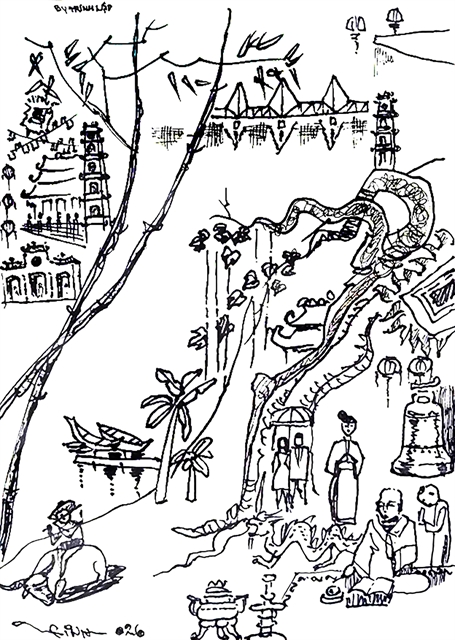
| Illustration by Trịnh Lập |
Phạm Hoàng Văn
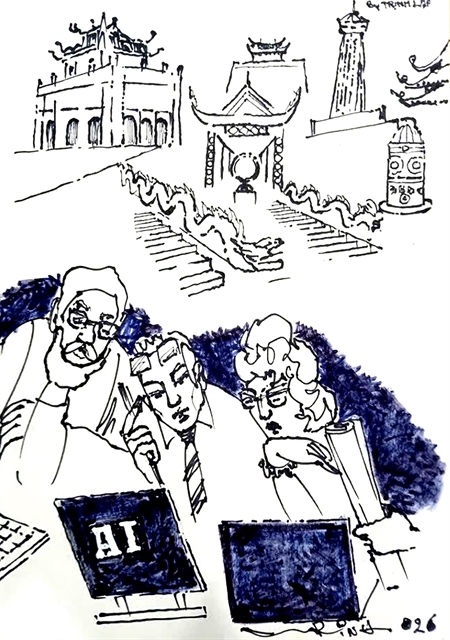
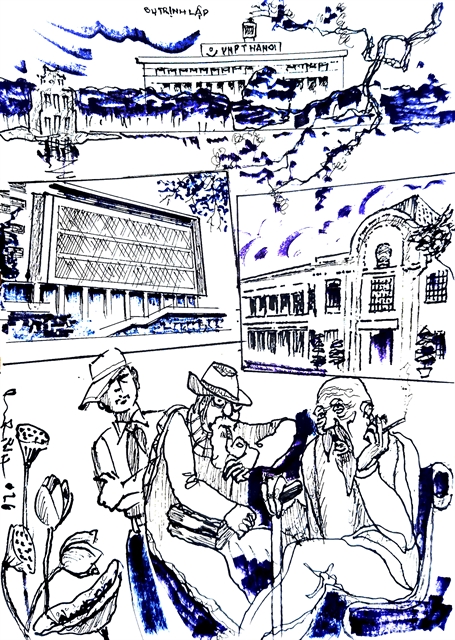
Proposals have been made to demolish the Hà Nội Post Office, to be replaced with a replica of Báo Ân Pagoda by Hoàn Kiếm Lake. Other changes are being considered: a new victory gate at the northern end of the lake; the Soviet-style Children's Palace to be demolished; and a giant financial tower to be built on Lê Phụng Hiểu Street.
I don't want to discuss here whether the Hà Nội Post Office is beautiful or not, nor do I want to discuss whether the ancient Báo Ân Pagoda was beautiful or not. I don't want to discuss, on a personal level, how deeply a person can become attached to a building in Hà Nội for many years.
I want to ask another question: if we accept replacing a current building with a reconstruction of another historic building that has been gone for more than a century, only because the former structure used to exist on that piece of land, then what kind of precedent are we setting for the city of Hà Nội?
The Hà Nội Post Office today is not merely a building standing on a piece of land. It has become a layer in the history of this city. It has its own architectural life and the memories of many generations of Hanoians.
But if the rule has been set that a structure from an earlier historical period can come back and the structure standing today has to recede to make space, then the story won't end with Báo Ân Pagoda.
What comes next? Suggestions say the Celestial Palace. If the Celestial Palace gets rebuilt, then can we continue to ask about reconstructing other architectural sites of the great Thăng Long Citadel of olden times? Báo Ân Pagoda, for example, existed for 44 years in the 1800s. The image of the pagoda does not exist in people's minds today, but there's still Hòa Phong Tower standing by Hoàn Kiếm Lake that reminds us of the distant pagoda.
If we take the scale of Hà Nội under the Nguyễn Dynasty as the norm, then what are we going to do with buildings of later times? The streets, the buildings, the villas and offices that were built after that time – where would they go?
If we are going to reconstruct Thăng Long Citadel correctly according to the structure of a historic time and era, then it should have its walls erected, its trenches dug and filled with water. Then, how do we treat the urban spaces that currently occupy the walls or trenches?
It sounds illogical. But a precedent doesn't have to be illogical from the first step. It only needs to be accepted in principle.
Hà Nội Post Office has existed for more than half a century and it does exist in the hearts and minds of the people of Hà Nội and beyond. As do Hà Nội's Children's Palace, Friendship Palace, the central building of Hà Nội Train Station and Thăng Long Bridge. They all represent contemporary architecture and reflect the architectural trends of the city in the 20th century.
When you demolish an existing building to resurrect a past image that you imagine, you destroy the historical layer that society has accumulated. A replica of a past construction will not bear in it the soul or state of the time it is being built. A contemporary culture cannot tell its story with temples and communal houses, pagodas or other pieces of construction belonging to the past.
These aforementioned buildings were established during the rebuilding of the country with the help of socialist countries in the Soviet Union and Eastern Europe. They have become the real material memories of Hà Nội, and their values should be considered for their historical architecture, urban studies, community-shared memories and their usefulness.
Living memories
Paul Doumer, the governor-general of French Indochina from 1897 to 1902, presumably said that he arrived in Hà Nội too late to be able to keep the Citadel of Hà Nội intact. What makes us really think is not which side of history he stood on, but that even a public figure from a different time realised the value of the existing city and the need to preserve it.
What are we doing to the layers of our own history? If one day the former Museum of the Revolution has to give way to a new structure, then in a few decades, how are future generations going to treat it?
What if they also think it's time to replace it with a new building that's more valuable? They could just use the rhetoric we're using today to replace it.
A city does not just boast one layer of history; it consists of layer after layer from many eras: the old, the new, the lost, the existing and the future yet to be born.
I'm not against studying history, nor am I against restoring lost memories. The issue is: how do we restore them? How many layers does history have and on what grounds are we demolishing the existing layer to reconstruct another that's already gone?
If the Post Office has to give way to rebuild Báo Ân Pagoda, we are replacing a real building with a replica of a pagoda. As a post office, it serves a purpose for everyone, regardless of their religion or beliefs. When it becomes a Buddhist pagoda, people of other religions won't see themselves entering it.
Only then would we realise that we had just let go of a real gem to reach for a silhouette that is not of real value. Then we would have destroyed a great piece of architecture with style and grace for something that may not reflect the state of mind of our society today. A replica of any type, scale or grandeur can never replace an authentic work that, over time, has somehow become an architectural gem.
What we preserve
Hà Nội Post Office bears an avant-garde style, with an adjacent building in Art Deco style. Meanwhile, Hà Nội Children's Palace is a brilliant example of Việt Nam's contemporary style, designed by Lê Văn Lân, who continued the style of Bauhaus from early 20th-century Germany, followed by the socialist-realist style in Soviet countries.
Then there is the building belonging to the Việt Nam Museum of History, which used to be the Tax Hotel, built in 1903 by architect Henri Vildieu in the French classical style. Vildieu served as an official architect for the French in Indochina and designed some prominent works in Hà Nội, including today's Government Office, the Supreme Court, the Post Office and Hỏa Lò Prison, partly preserved today as a museum.
If today we take restoring history as an excuse to erase a living history, then tomorrow another generation can use the very same excuse to erase all that we build today and try to protect.
A civilised city cannot just look back or forward to the future by erasing the current time. It has to understand that the current time will be history tomorrow. Therefore, we need to be cautious not only about building what, keeping what or restoring what item of history, but we also need to agree upon a principle for similar decisions in the future.
Do not open Pandora's box. Once it's open, the consequences may not be in our control. — VNS
Talk Around Town
 Talk Around Town
 Talk Around Town
 Talk Around Town
 Talk Around Town
 Talk Around Town
 Talk Around Town
 Talk Around Town
 Talk Around Town
 Talk Around Town
 Talk Around Town
 Talk Around Town
 Talk Around Town
 Talk Around Town
 Talk Around Town