 Talk Around Town

HIIVE by fusion brings business and golf closer in Bình Dương
1.
 |
| Illustration by Trịnh Lập |
Nguyễn Mỹ Hà
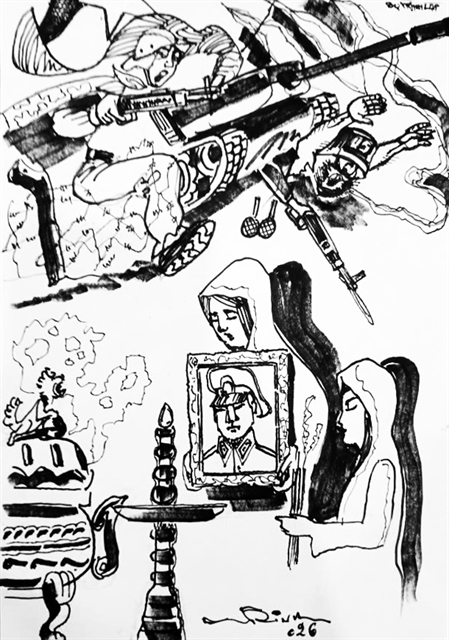
Not war, time, nor even a certificate recognising him as a war martyr has been able to change her resolve: 80-year-old Nguyễn Thị Lệ has waited for her beloved for nearly 60 years. His last promise — "After this battle, I'll come back for you and marry you," – still resonates with her.
An ongoing 500-day campaign across the country is searching old battlefields using advanced technology to find the remains of fallen soldiers and repatriate them to their families. It is the largest such undertaking ever launched in Việt Nam.
In June, the discovery of a mass grave containing the remains of about 900 people, reportedly liberation fighters killed in action during the 1968 Tết Mậu Thân Offensive, on the northern outskirts of Sài Gòn, was announced on national television.
During the search, a set of remains was found bearing the name Huỳnh Văn Quên.
"Chị Hai ơi! Có thể tìm thấy anh Hai rồi (Big Sister, maybe they have found Big Brother)," Lệ heard over the phone soon afterwards from Quên's younger brother.
The next day, Lệ again visited the home of Quên, whose name means "Forget", even though he has never been forgotten.
Back in 1968, after the Tết Offensive came to an end, word reached the family that her then-boyfriend Quên had died. Lệ visited his house, and his mother took her in and gave her a pair of gold earrings and a gold band as keepsakes, which she has worn ever since.
Every year, she visits Quên's family, like a daughter-in-law, and joins them in holding a death anniversary ceremony to remember and pray for the fallen soldier. His younger brothers and their wives all call her Chị Hai (Big Sister).
In a video clip released by Hồ Chí Minh City media, Lệ said once she gave her word to him, she would never love anyone else.
"He and his fellow soldiers used to be stationed in my village. We helped them, bringing them water, rice and medicine. I made patches for his clothes. Then he fell in love with me and said he would ask for my hand," she recalled.
"We wrote letters, and he wrote a verse, saying:
'Sending this letter away, I'm waiting for one to return,
'Letter, please don't get lost, for I'm waiting for you, my dear'."
But he did not come back, not in 1968 or the years that followed.
"I didn't believe he had died, so I kept waiting," she said in the video clip.
When peace came in 1975, only then did Lệ start to doubt whether her boyfriend Quên was still alive. But she continued visiting his home and treating his family like her own. She kept all the letters carefully stored for a time, but the paper could not survive the passing years.
The phone call finally came, not to confirm his death, but to let her know that she would be reunited with him, after more than five decades.
After the news was broadcast on TV, a former fellow soldier of Quên came forward. He said he had been wounded and treated alongside Quên in a field clinic. They later recovered and moved on to separate assignments. He remembered that Quên was a bright, good-looking young man who was always cheerful and firmly believed in the ultimate victory of the national reunification cause.
More light was shed on Quên's story. National Archives Centre III revealed documents signed on January 2, 1978, awarding a Tổ Quốc Ghi Công (Motherland Remembers) certificate to more than 130 families of war martyrs, including Huỳnh Văn Quên.
Signed by Prime Minister Phạm Văn Đồng, page 5 states: "War martyr Huỳnh Văn Quên, corporal of the Việt Nam People's Army, originally from Đức Tân Commune, Tân Trụ District, Long An Province, who sacrificed his life in the Anti-American Resistance War for National Salvation on March 2, 1968."
The discovery of the fallen soldiers, and the story of Lệ's faithful years, have moved many Vietnamese people, many who shared the loss of loved ones. With the search and return of remains of fallen soldiers, there is more hope that many other families will receive news about their missing loved ones, many of whom have been unaccounted for since as far back as the 1930s.
Through local administrative authorities, families of fallen soldiers have received invitations to provide DNA samples, and all newly recovered remains will undergo DNA testing before solemn reburial ceremonies are held.
"Please make Lệ an official 'Wife of a Fallen Soldier'," many online commenters have written after reading her story, "so that she can receive remuneration during the remaining years of her life."
Now Lệ's boyfriend is finally returning to her, 58 years later, in a solemn ceremony, his urn draped in the national flag.
There are still several weeks of DNA testing before it can be confirmed that the remains are her beloved's, but she is already preparing to dress in her best clothes for their long-awaited "reunion".
Time passes, but love endures. And we remember not only war martyrs, but their surviving loved ones, too. — VNS
Talk Around Town
 Talk Around Town
 Talk Around Town
 Talk Around Town
 Talk Around Town
 Talk Around Town
 Talk Around Town
 Talk Around Town
 Talk Around Town
 Talk Around Town
 Talk Around Town
 Talk Around Town
 Talk Around Town
 Talk Around Town
 Talk Around Town

_med.jpg)