 Talk Around Town

Enterprises should promote development of Vietnamese brands in overseas markets
1.
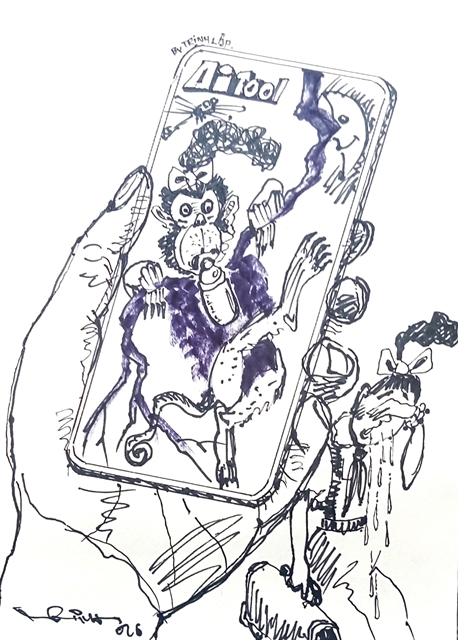 |
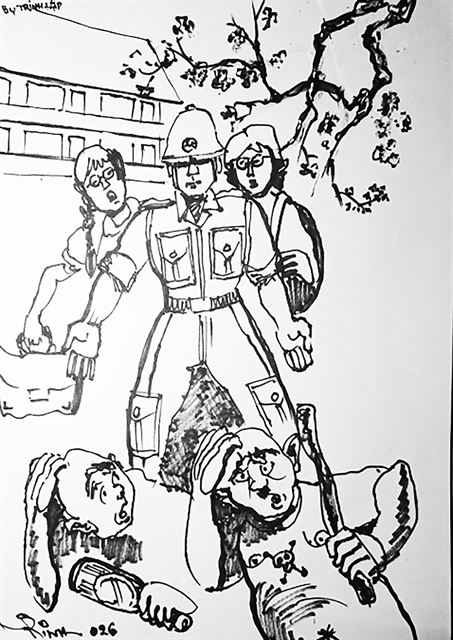
Illustration by Trịnh Lập
by Huyền Trang
Two Hà Nội students have used artificial intelligence to humiliate a classmate – and in doing so exposed a deeper problem about how young people use technology.
The incident quickly garnered attention on social media, with many people expressing anger and condemning the two girls' actions as cruel and deeply harmful.
The parents of the two have asked the school to allow them to stay at home for a while so that they can be supervised and “re-educated”.
The victim has not said anything publicly, but it is not hard to imagine how the poor girl is feeling.
Imagine a 17-year-old walking into a classroom, fearing every whisper could be a judgment. She might be advised by well-meaning people to go off social media and ignore things, but can she truly shake off the feeling that everyone is judging a distorted version of her that does not even exist?
The fact that ordinary young people can inflict such pain on others with a few clicks of a mouse also raises the all-important question of technological ethics.
Technology is a necessary part of modern life, and most adults agree that AI tools make life more convenient.
But the incident is a painful reminder that, in the hands of people who lack digital ethics, technology can become a destructive weapon.
According to 2023 data from UNICEF Việt Nam, one in five young people in the country has experienced cyberbullying.
And now, the emergence of AI has fundamentally altered the nature of cyberbullying, making it far more sophisticated than in the past.
In the past, online harassment was largely limited to hateful comments or the uploading of real photos, but AI-driven tools now allow perpetrators to post images, videos and information that only exist in their warped minds.
It should surprise no one that people often struggle to tell the difference between a malicious fabrication and the truth.
“I just thought it would be a funny joke; I didn't expect such serious consequences,” is a common phrase we hear from students who bully others online.
If taken at face value, this normalises such cruelty and removes all responsibility and sense of agency.
AI tools are also used to create fast-spreading fake news, affecting people, organisations and the country.
Vũ Thị Hạnh, an AI expert at the Viettel Data Service and Artificial Intelligence Centre, says: “AI can be exploited by perpetrators of violence if we do not have the laws and skills to protect one another.”
I am generally in favour of people having access to technology, but incidents like this prove that the issue is complicated.
Cyberbullying is not a new issue in Việt Nam. There have been many students who had to change schools or fell into depression just because of a “meme” or a virtual boycott campaign.
Lately, I have been thinking to myself, “Why does this keep happening? Why do young people see humiliating others as something normal?”
The young are not born with malice, and so what shapes this “meme-ification” of others’ pain?
One thing I have realised is that most educational TV programmes, textbooks and parents only teach adolescents how to behave in the physical world – such as helping with chores or being polite to elders -- but rarely how to behave in the virtual world, where the younger generations spend most of their time.
Whether it's cyberbullying with or without all these new tools, I believe the best way to deal with it is to show adolescents that respect does not stop at the school gates.
But it also requires a dual approach.
Social media platforms must move beyond being passive hosts and become active guardians of digital safety by using advanced AI moderation systems to quickly find harmful content, while also making it easier for people to report it.
Beyond technology, the broader community must move from being silent bystanders to active protectors.
Families and schools must collaborate to foster digital literacy, teaching the younger generations that the line between joking and cruelty is thin.
There are books to help educate children on becoming responsible “digital citizens”.
The values and ways of thinking of young people are largely shaped by the influences around them, including media and education.
When the young become used to viewing the digital world through a more humane and nuanced lens, they will be less likely to engage in harmful online behaviours and more inclined to build positive, supportive connections. — VNS
Talk Around Town
 Talk Around Town
 Talk Around Town
 Talk Around Town
 Talk Around Town
 Talk Around Town
 Talk Around Town
 Talk Around Town
 Talk Around Town
 Talk Around Town
 Talk Around Town
 Talk Around Town
 Talk Around Town
 Talk Around Town
 Talk Around Town