 Talk Around Town
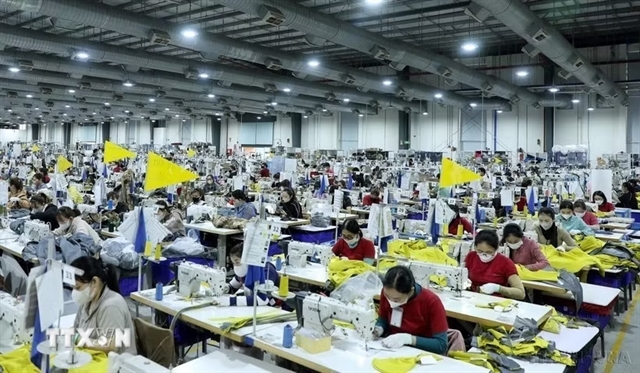
Textile exports face dual challenges of sustaining orders and boosting efficiency amid growing competition
1.
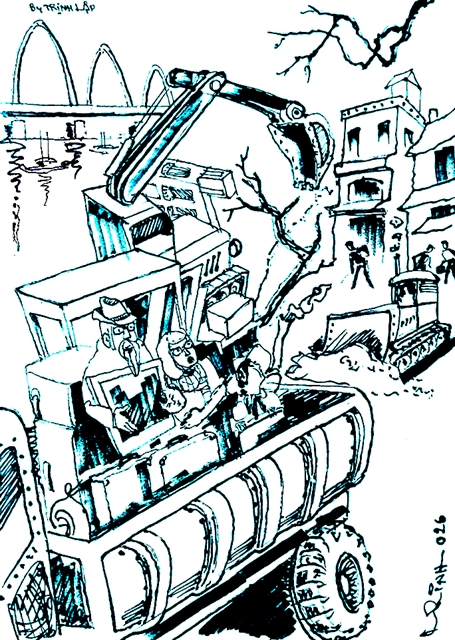 |
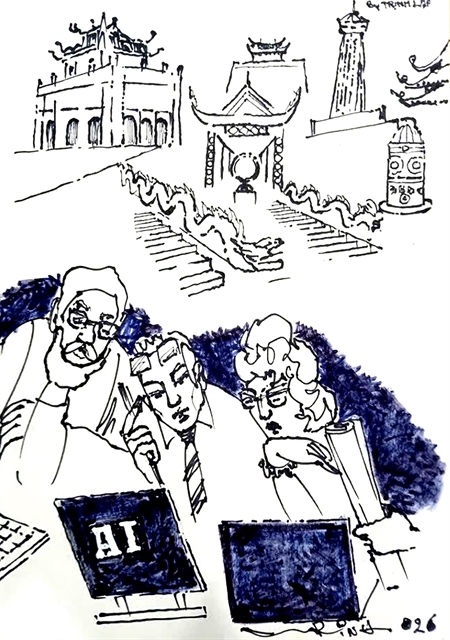
| Illustration by Trịnh Lập |
by Nguyễn Mỹ Hà
Bulldozers rolled into Lane 310 Nghi Tàm Street, Hà Nội, last week, 11 months after the Tứ Liên Bridge project began, as residents quietly removed their house number plates — small keepsakes from a neighbourhood about to vanish.
To put it this way, try to imagine being in the position of residents who have built and established their homes over many years, but now are asked to leave. Leaving does not only mean leaving a familiar house. A stable three to four-storey home is not easy to build in financial terms, and having accumulated enough to construct such a property, residents now face the challenge of starting again on allocated land and building new homes. The project provides each resident VNĐ2.5 million per person per month to rent accommodation until their new homes are completed.
The Tứ Liên project, valued at nearly VNĐ20,000 billion (US$760 million), has been described as one of the city’s key transport works. It is expected to be completed in 2027. The 5.5km bridge and connecting roads will link Tây Hồ Ward with Đông Anh District, connecting downtown Hà Nội with the northern neighbourhoods and the National Exhibition Centre and is expected to significantly reduce travel time to Nội Bài International Airport.
As of 2026, Hà Nội has nine bridges crossing the Red River. Three of them — Long Biên (1902), Chương Dương (1985) and Thăng Long (1985) — were all built in the 20th century.
Long Biên was the first, constructed during the French colonial era with local labour and completed in 1902. Thăng Long was initially developed with Chinese design input and experts, before Soviet assistance from 1978 helped complete the structure in 1985 as a major dual carriageway bridge. The supply of construction materials and technical support also enabled further industrial development, with factories later contributing to subsequent bridge projects, most notably Chương Dương Bridge built by Vietnamese engineers and workers.
Six other bridges were completed in the early 21st century, including Thanh Trì (2007), Vĩnh Tuy (2009), Vĩnh Thịnh (2014), Nhật Tân (2015), which directly links central Hà Nội with Nội Bài International Airport, Văn Lang Bridge (2018) and Vĩnh Tuy 2 (2023).
In 2025 alone, seven additional bridges were launched, with a plan to build 28 bridges in total by 2035. The Tứ Liên Bridge is among them. It is classified as a Group A project, the highest category of importance, and is expected to improve transport connectivity and in turn support economic and social development in the northern Red River region.
So far, authorities in Hồng Hà Ward have cleared up to 95 per cent of the land required for construction, a significant milestone achieved within a short timeframe.
In other projects, further land clearance is underway to make space for bulldozers to advance development linked to growth and infrastructure expansion.
Seven bridges starting construction within a single year raises the question of whether Hà Nội is moving too fast and too far ahead.
Alongside bridge works, land clearance for the City Belt Road 2.5 project in Trung Hòa-Nhân Chính has also prompted residents to seek support and clarification.
"My sisters-in-law have filed a letter of complaint," said a resident of more than 30 years in the affected area. "We need to follow the land law and make sure that procedures are being applied. You will need to know the law well to protect your rights."
She added that before signing any land clearance document, residents have the right to know their future land allocation, current market value, reimbursement rates and any additional land they occupy that is not recorded in ownership documents but has no dispute with neighbours, which would also be compensated.
Stick to the law, stick together so that you will find strength and support from people whose situation is like yours. Be courteous and patient as the elected officials must follow the law too and they are paid with your taxes to serve you.
Giving up your own property and established life for public development is a major undertaking, but verbal thanks are not enough.
The woman, who currently owns 600 square metres, said the market value of her land could be as high as VNĐ160 billion ($6 million), while the proposed reimbursement would be VNĐ60 billion ($2.3 million), which she does not agree with.
She said she would continue to pursue the case until a final settlement is reached, while stating she would comply with the law regardless of the outcome.
As bulldozers move in and new roads take shape, what remains are the small things people carry with them — memories, routines and fragments of a neighbourhood that no compensation can fully replace. — VNS
Talk Around Town
 Talk Around Town
 Talk Around Town
 Talk Around Town
 Talk Around Town
 Talk Around Town
 Talk Around Town
 Talk Around Town
 Talk Around Town
 Talk Around Town
 Talk Around Town
 Talk Around Town
 Talk Around Town
 Talk Around Town
 Talk Around Town