 Talk Around Town
Singapore DPM calls for stronger ASEAN through Singapore-China cooperation
1.
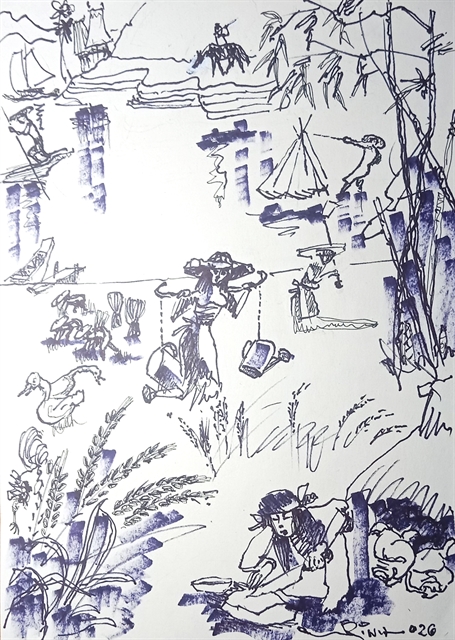 |
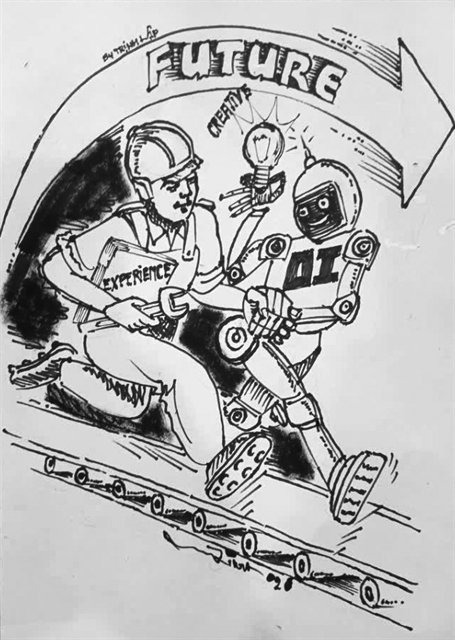
| Illustration by Trịnh Lập |
Nguyễn Mỹ Hà
As children, we are taught the proverb "Có công mài sắt, có ngày nên kim" — that with enough patience, even a bar of steel can be ground into a needle. It is a lesson in perseverance that most of us accept, but rarely expect to see proven so literally.
Having been on the other side of life, I've never seen any actual evidence to prove it until recently, when a woman in her 40s made a video of her farmer mother, who still uses the knives she said she bought in 1991. The two knives, one a small Thai fruit knife with a long thin blade, has been used until one has been worn down to a triangle measuring just 1–3cm per side; the other, a Vietnamese cutter that was 30cm long, has been reduced by one-third.
It was frankly jaw-dropping to see both the quality of the steel and the firmness of the handles, neither having broken over the years. The owner is a 75-year-old farmer, who uses the knives everyday to prepare her veggies for the market, where she sells them for a living. Her daughter proudly presents her mother's valuable assets as proof of her mother's practice of thrift — with enough will and perseverance, one of her knives could indeed be ground down to a needle — over the course of more than 30 years.
Northerners have been known as particularly thrifty, due to harsh climatic conditions, where the farming life heavily depends on weather. You'll never know when a drought, a storm or a flood may hit, so people are always thinking ahead and preparing for difficult times. Besides, a knife's function is simple. As long as it is still sharp, it can still be of use.
Being thrifty is a quality that has helped our people make the most of limited material resources to overcome mighty challenges during wars, famine and economic hardships, and help families accumulate and build their wealth over time.
The newly-elected Prime Minister Lê Minh Hưng, one week into the role, directed relevant ministries, sectors and provinces to save regular spending by at least 10 per cent. Chairing the Central Emulation and Commendation Council's first meeting for the current term, he called for stronger links between emulation campaigns to meet the country’s ambitious economic targets of achieving high economic growth while improving people's living standards.
At the meeting he spoke of the importance of practising thrift and preventing waste, and said that saving at least 10 per cent in recurrent expenditures had already been achieved, with an additional 5–10 per cent reduction targeted. If the total savings add up to 20 per cent, the state budget could gain an additional VNĐ360 trillion (US$13.7 billion) for other priorities.
"You are requested to practise thrift at all levels of governance, across ministries and economic sectors. All localities must cut back on purchasing, organising conferences and seminars, and save on transportation and study tours," he was quoted as telling the meeting. He also added that saving on energy, electricity, petrol and gas consumption would help boost economic growth.
At the end of the first quarter, the National Statistics Office released its quarterly report. It indicated that 91,800 businesses withdrew from the market. At the same time, new businesses joining the market reached 96,000, an increase of 31.7 per cent over the same quarter of 2025.
In the same period, more than 600 new businesses in agriculture, forestry and fisheries were registered, marking an increase by around 90 per cent compared to the same quarter of 2025. Nearly 13,800 new businesses in industry and construction registered, an increase of 60 per cent, and 43,000 new businesses were created in the service sector, an increase of 56.6 per cent.
The office also reported that a survey on business growth in processing and manufacturing showed that more than 23 per cent assessed their business activities as better than the last quarter of 2025. Nearly half said their businesses were stable, and around one-third reported being in difficulty.
Among them, foreign-led businesses were most positive as 80 per cent predicted their business and manufacturing activities in the second quarter would be better and more stable than in the first. The rate in state-owned and non-state businesses was 79.6 per cent and 77.3 per cent, respectively.
Regarding volumes of production, more than 23.8 per cent said their output in the first quarter of 2026 increased compared to the fourth quarter of 2025, 45.3 per cent reported stability and 31 per cent said production volumes were lower.
Regarding business orders, 22 per cent of businesses recorded an increase in the first quarter compared to the previous quarter, almost half reported stable new orders, and 29 per cent reported a decrease.
Meanwhile, only 17.7 per cent of exporting businesses confirmed they had more new orders, 55 per cent reported stable orders, and 27.3 per cent said there was a decrease.
The decreasing number of production volume, new orders and export orders hover around 30 per cent, which is alarming if strong decisions are not made to reverse the trend. The good points are the majority of businesses boast stable production volumes and orders with a slightly upward trend.
The new government has already sent signals that they mean business, with solid results and specific economic indicators to achieve.
In due course, if we all in each capacity practise thrift, not necessarily as severely as the knife-wielding "queen of thrift", fasten our belts, and stay focused towards our common goals of stability and improved living standards for all, we will get there. — VNS
Talk Around Town
 Talk Around Town
 Talk Around Town
 Talk Around Town
 Talk Around Town
 Talk Around Town
 Talk Around Town
 Talk Around Town
 Talk Around Town
 Talk Around Town
 Talk Around Town
 Talk Around Town
 Talk Around Town
 Talk Around Town
 Talk Around Town