 Politics & Law
University of Economics HCM City hosts international student research conference
1.
|
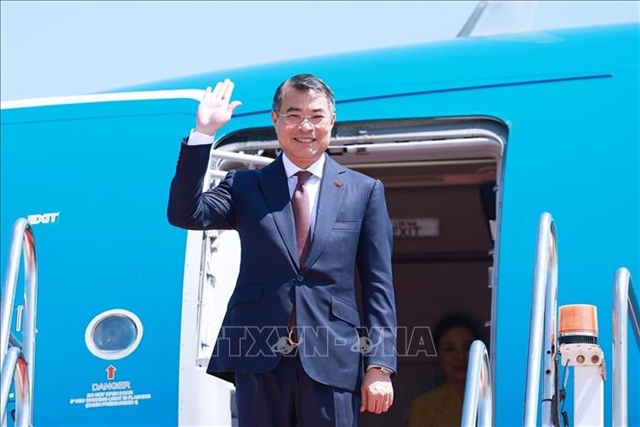
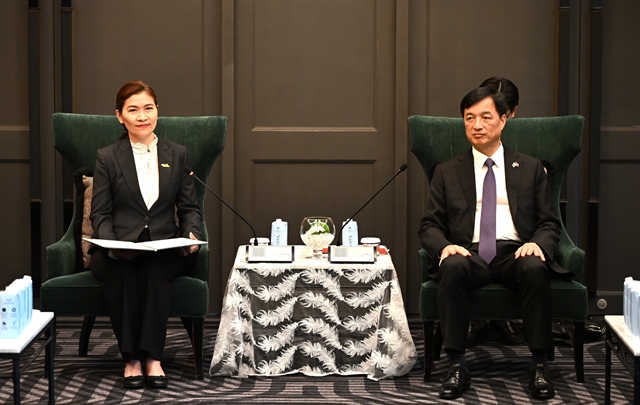
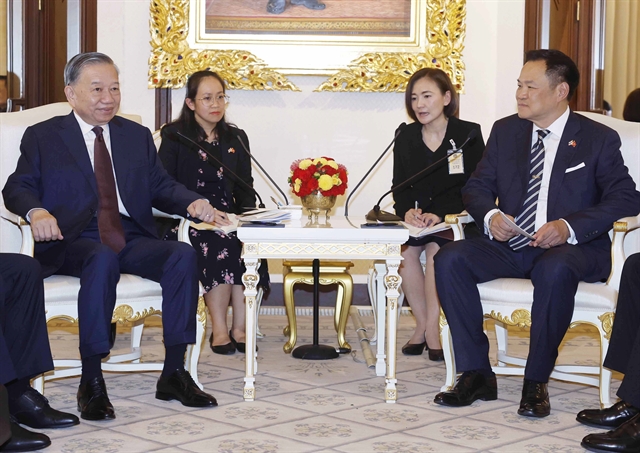
| Nguyễn Duy Ngọc, permanent deputy head of Việt Nam’s Central Steering Committee for the Development of Science, Technology, Innovation and Digital Transformation meet with Assoc Prof Dr Chaowaree Adthalungrong from Thailand’s National Science and Technology Development Agency in Bangkok on Thursday. — VNA/VNS Photo |
BANGKOK — A visiting delegation from Việt Nam’s Central Steering Committee for the Development of Science, Technology, Innovation and Digital Transformation held talks with Thailand’s National Science and Technology Development Agency (NSTDA) on Thursday, opening up prospects for deeper cooperation and greater exchanges of experience in institutional development and sci-tech governance.
The Vietnamese delegation was led by the committee's Permanent Deputy Head Nguyễn Duy Ngọc, who is also a Politburo member, Secretary of the Party Central Committee, and head of the Party Central Committee’s Organisation Commission.
At the meeting, Assoc Prof Dr Chaowaree Adthalungrong, Executive Director of the NSTDA’s National Centre for Genetic Engineering and Biotechnology (BIOTEC), said the two countries share many similarities in climate, natural conditions, crops and challenges relating to disease management in plants and livestock. Given these similarities, she said, strengthening the partnership was essential to address common challenges.
Over recent years, NSTDA has built strong partnerships with Vietnamese research institutes and organisations in agriculture, biotechnology, energy and sustainable development. Notable examples include joint projects on cassava value chains, salt-tolerant rice, biotechnology products and an initiative on green energy cooperation and development in the Mekong basin.
Chaowaree expressed her hope that the latest discussions, focusing on salt-resistant rice, poultry vaccines and BIOTEC’s areas of expertise, would lay the groundwork for broader long-term collaboration between the two sides.
Addressing the meeting, Ngọc praised the extensive experience and longstanding cooperation between BIOTEC, NSTDA and Vietnamese agencies, expressing his hope that the discussions would soon deliver tangible outcomes across research, production and practical application.
He stressed that Việt Nam has clearly defined its strategic direction through Resolution No 57-NQ/TW, which places science and technology, innovation and digital transformation at the centre of the country’s future development strategy.
Highlighting similarities in the development orientations of the two countries, Ngọc said he believes the meeting would provide valuable lessons for Việt Nam, particularly in fostering breakthroughs, encouraging innovative thinking in governance and developing practical business models.
He proposed that both sides strengthen dialogue and information-sharing in order to establish joint research and application platforms, beginning with relatively simple projects before progressing to more advanced solutions, particularly in biotechnology applications for agriculture, healthcare and medical services.
As part of the working programme, the Vietnamese delegation also conducted field studies and examined several of Thailand’s notable policy and management models currently implemented at NSTDA.
Among them was the autonomous sci-tech agency model, which allows national shared-use research centres to operate flexibly with autonomy in finance, recruitment and commercialisation outside the conventional state salary framework.
The delegation also studied Thailand’s integrated governance model under the Ministry of Higher Education, Science, Research and Innovation (MHESI), which consolidates science and technology, innovation, higher education and research within a single ministry to optimise resources.
In addition, Vietnamese officials reviewed Thailand’s science and technology cluster system, which is closely linked to special economic zones and supported by internationally standardised shared infrastructure, including a synchrotron particle accelerator. The model is expected to provide useful reference points for Việt Nam as it considers restructuring its national network of high-tech parks in the coming years. — VNA/VNS
Politics & Law
 Politics & Law
 Politics & Law
 Politics & Law
 Politics & Law
 Politics & Law
 Politics & Law
 Politics & Law
 Politics & Law
 Politics & Law
 Politics & Law
 Politics & Law
 Politics & Law
 Politics & Law
 Politics & Law