 Politics & Law
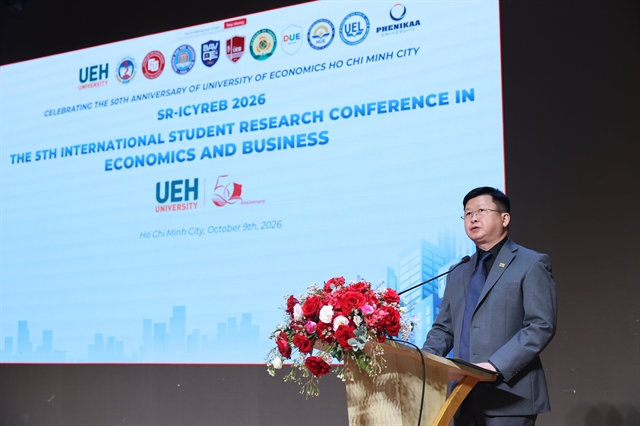
University of Economics HCM City hosts international student research conference
1.
|
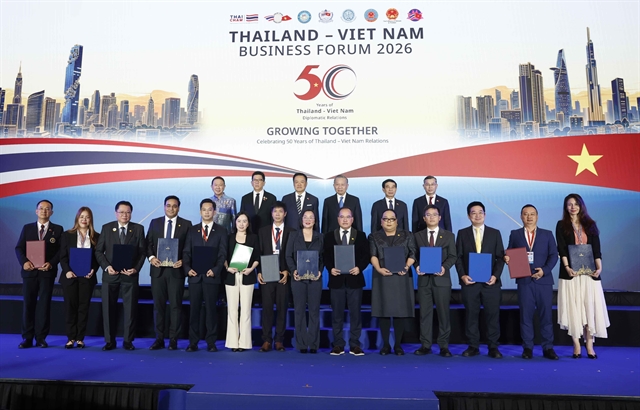
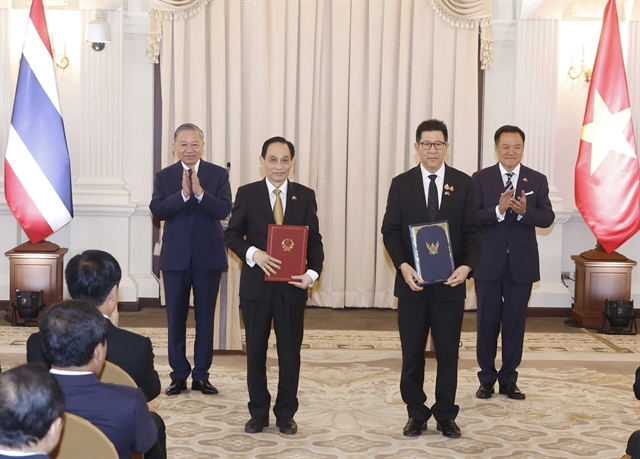
| Party General Secretary and State President Tô Lâm and Thai Prime Minister Anutin Charnvirakul witness the exchange of cooperation agreements at the Thailand–Việt Nam Business Forum 2026 in Bangkok on Thursday. — VNA/VNS Photo Thống Nhất |
BANGKOK — Việt Nam and Thailand should move beyond traditional bilateral cooperation and jointly build an economic space that complements both countries and ASEAN at large, said Party General Secretary and State President Tô Lâm as he attended the Thailand–Việt Nam Business Forum 2026 in Bangkok alongside Thai Prime Minister Anutin Charnvirakul on Thursday.
The event was attended by Thai and Vietnamese senior officials as well as representatives of nearly 700 businesses from both countries.
Addressing the forum, the top Vietnamese leader said the event was a major highlight of his visit to Thailand, demonstrating the determination of both countries to deepen the Việt Nam–Thailand Comprehensive Strategic Partnership in a substantive, effective manner.
While political relations provide a foundation of trust, economic cooperation must generate momentum for development, said Lâm, adding that businesses must take the lead in turning governmental commitments into tangible results for the people.
He stressed that Việt Nam and Thailand are two important ASEAN economies that share a strong friendship, deepening political trust and increasingly intertwined development interests.
This year, the two countries celebrate the 50th anniversary of diplomatic relations. The elevation of ties to a Comprehensive Strategic Partnership in May 2025 has opened a new phase of cooperation with higher expectations for vision, quality and effectiveness. The two sides are actively implementing the 2025-2030 action programme to translate new strategic cooperation directions into reality.
The General Secretary and President noted that the world is entering a period of profound restructuring, with rapid changes observed in supply chains, digital technologies, artificial intelligence, green transition, the circular economy and energy security, which are reshaping national competitive advantages.
In this context, a complementary economic space between Việt Nam and Thailand should enhance each country’s position in ASEAN value chains, strengthen the bloc’s resilience and contribute to the region’s sustainable growth.
Việt Nam and Thailand could jointly establish supply chains, production and distribution hubs, trade and service platforms, and new growth drivers for both countries and ASEAN, he said.
Charnvirakul also made observations on global volatility, adding that ASEAN member states need to cooperate more closely to strengthen resilience and respond to external shocks.
He noted that Thailand and Việt Nam share close and interdependent ties, with both benefiting from each other’s development. Thailand is currently Việt Nam’s largest trading partner in ASEAN, while Việt Nam is Thailand’s second-largest trading partner in the bloc.
Bilateral trade has reached nearly US$24 billion and is approaching the target of $25 billion. Thailand is also the eighth-largest foreign investor in Việt Nam.
Both countries are stepping up economic reforms to generate new growth drivers. Future cooperation should focus on preparing for the economy of the new era, particularly in green growth, renewable energy, digital transformation, science, technology and innovation.
The Thai PM said the success of Thailand–Việt Nam cooperation would not be possible without the strong role of the private sector, adding that he hoped their ties would continue to flourish and jointly contribute to sustainable development and prosperity in both countries.
Lâm urged the business communities of both countries to focus on building Việt Nam–Thailand value chains within the ASEAN sphere. Bilateral cooperation should move beyond conventional trade towards joint production, processing, distribution and branding, he said.
He noted that the two countries should promote the three connectivities of production, infrastructure and transformation to establish a complementary economic space. These three pillars would enable them to move beyond conventional market relations and become mutually reinforcing links in ASEAN’s production, service and new growth networks.
The top Vietnamese leader added that economic cooperation should also extend more into daily life through tourism, services and digital finance.
Việt Nam–Thailand cooperation should be measured by concrete projects, new technologies, new jobs, higher value-added products and more tangible benefits for people, thus introducing new vitality into a dynamic, resilient and connected ASEAN, he said.
At the forum, the Vietnamese and Thai leaders witnessed a signing ceremony for 17 strategic memoranda of understanding between businesses from the two countries. — VNS
Politics & Law
 Politics & Law
 Politics & Law
 Politics & Law
 Politics & Law
 Politics & Law
 Politics & Law
 Politics & Law
 Politics & Law
 Politics & Law
 Politics & Law
 Politics & Law
 Politics & Law
 Politics & Law
 Politics & Law