 |
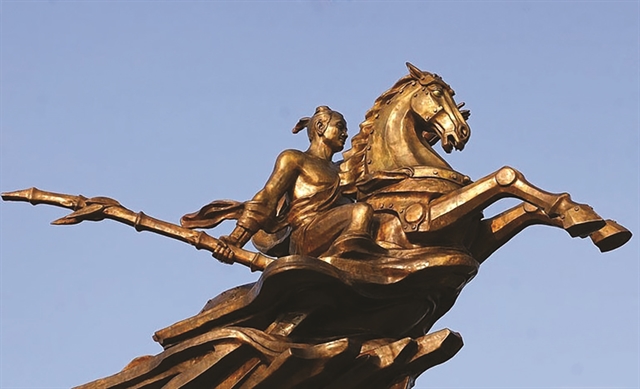
| GIÓNG GALLOPS: Statues of Saint Gióng riding a horse can be found in many locations across Việt Nam. Pictured is the Saint Gióng monument at Sóc Temple in Sóc Sơn Commune, Hà Nội. New Hanoi Photo |
by Nguyễn Mỹ Hà
As the Year of the Horse ushers in the second quarter of the 21st century, it arrives not as the start of a new zodiac cycle, but as a symbol laden with meaning – evoking endeavour, speed and noble aspiration deeply embedded in Vietnamese cultural memory.
"Mã đáo thành công" is more than a familiar wish for the Lunar New Year in 2026. It is also a phrase widely used when people embark on a new business, a new job or set out on an adventure in a new land, reflecting the enduring hopes that success will arrive as surely as a horse returning home at full gallop.
The horse has long been a respected and cherished figure in Vietnamese culture, most notably through the legend of Saint Gióng, who rode an iron horse to drive away foreign invaders in the nation’s distant mythical past. Saint Gióng – also known in literature as Phù Đổng Thiên Vương or Sóc Thiên Vương, the Celestial King of Sóc Temple, is one of the four immortal saints of Vietnamese folk belief. He embodies youthful strength, moral courage and an unyielding will to resist foreign aggression.
During the 11th century under the Lý Dynasty, King Lý Thái Tổ posthumously honoured Saint Gióng as the nation’s protector, recognising him as the first hero to successfully defend the country before laying down his weapons and ascending beyond the mortal realm.
Several versions of the legend exist and researchers have yet to agree on a definitive account. According to Việt điện U linh tập (The Collection of Tales of the Spirit World of the Việt Realm), compiled in the 14th century, Saint Gióng was born in a village at a time when foreign invaders overran the country. As a baby lying in his cradle, he was unable to speak or sit up.
When the king sent envoys across the land to recruit talent to repel the invaders – promising rewards and honours – the three-year-old child suddenly spoke, asking his mother whether the call was true.
Upon her confirmation, he requested large quantities of steamed rice. After consuming three large mats of rice and pickled eggplant, the child grew tall and strong. He volunteered to join the army and instructed the king’s envoy to have an iron horse, an iron rod, an iron armour and helmet forged so that he could defeat the invaders.
Riding the iron horse into battle, he fought fiercely, and when his rod broke, he uprooted a golden bamboo tree to continue the fight. With the enemies defeated and peace restored, he rode to Mount Vệ Linh, climbed a banyan tree, removed his cape and weapons and ascended to the sky, completing his transformation from mortal child to immortal guardian.
Though legendary, many locations in the tale still exist today, including Phù Đổng Village, Sóc Temple and Gióng Temple in Sóc Sơn District on the outskirts of Hà Nội.
Dating back to the 11th century, the Gióng Festival takes place from the sixth to the eighth day of the fourth lunar month and features one of the largest ceremonial processions following the king’s carriage.
More than ten festivals dedicated to Saint Gióng are held in districts around Hà Nội, re-enacting battles and rituals such as Gióng’s final bath and meal or the use of golden bamboo trees in combat.
The Gióng Festival at Phù Đổng Temple in Gia Lâm District has been recognised by UNESCO as an Intangible Cultural Heritage of Humanity. Over time, it has retained its core spirit without slipping into spectacle or excessive commercialisation. The festival continues to reflect its origins as a harvest-praying celebration, remaining one of the most widespread and enduring festivals in northern Việt Nam.
Horses occupy a prominent place in Vietnamese culture, closely linked to daily life, labour and warfare. They symbolise warlords, sacred heroes and scholars who succeeded in royal examinations. As such, the horse is both a familiar companion and a figure worthy of reverence.
Their qualities are often described as resilience, wisdom and faithfulness, yet horses are also known for being short-tempered, proud and difficult to tame. If ignored, these traits are believed to hinder long-term success – a reminder that strength without discipline can become a liability.
This duality appears in folk verses such as: “Em có chồng rồi như ngựa có cương, Ngõ em em đứng, đường trường anh đi”, likening marriage to a horse with reins, where restraint defines belonging and each person must follow their own road.
In the southern folk melody Lý Ngựa Ô (The Black Horse Tune), a proud man adorns a black horse with a golden saddle to carry his beloved home and show her the world. These original folk tunes have been adapted into many popular songs and are widely played during spring festivals and cultural programmes.
In 1789, after defeating Qing invaders, Emperor Quang Trung famously sent an envoy on horseback carrying a peach blossom branch to his wife, Princess Ngọc Hân of the Lê royal family, to announce victory – a gesture that fused military triumph with poetic tenderness.
The phrase "Mã đáo thành công", derived from Han Chinese tale and meaning "returning horses bring success", also names a classic painting depicting eight galloping horses — a powerful image of momentum, unity, success and prosperity, often displayed during the Year of the Horse. — VNS
Why horses still gallop through proverbs in Việt NamIn traditional folklore and classical Chinese (Han) tales, many proverbs and sayings place the horse at the centre of attention, reflecting its symbolic role in daily life, morality and social values.“Ngựa quen đường cũ,” meaning "a horse keeps going back to the familiar path", refers to the idea that old habits die hard;“Ngựa non háu đá,” literally "like a young horse eager to kick", describes someone who is young and inexperienced yet overly aggressive;“Một con ngựa đau cả tàu bỏ cỏ,” meaning "when one horse falls sick, the whole stable stops eating", symbolises a shared sense of solidarity in the face of hardship;“Đường dài mới biết ngựa hay,” literally "a long journey reveals a good horse", conveys the idea that time will tell true ability;“Thẳng như ruột ngựa,” meaning "as straight as a horse’s gut", describes someone who is very straightforward and blunt;“Hàm chó vó ngựa,” literally "dog’s jaws and horse’s hooves", refers to coarse, rude or animal-like behaviour;“Lên xe xuống ngựa,” meaning "to mount a carriage and dismount a horse", stands for a life of wealth, leisure and privilege;“Thay ngựa giữa dòng,” meaning "to change horses midstream", warns against switching leaders or strategies halfway through;“Ngựa Hồ chim Việt,” meaning like a "Hu horse or a Việt bird" always longing for its homeland, expresses nostalgia and deep attachment to one’s roots;“Ngựa hay có tật,” meaning "a good horse often has its vices", reminds that no one is perfect;“Mã đáo thành công,” literally meaning "returning horses bring success", is used to wish for achievement and good fortune;“Ngưu tầm ngưu, mã tầm mã,” meaning "buffaloes seek buffaloes, horses seek horses", is equivalent to the saying “birds of a feather flock together”; and“Tái ông mất ngựa,” literally meaning "the old man lost his horse", reflects the belief that fortune and misfortune are unpredictable. VNS
 Talk Around Town