 Society

Việt Nam, Denmark issue joint statement on establishment of Comprehensive Strategic Partnership
1.
|
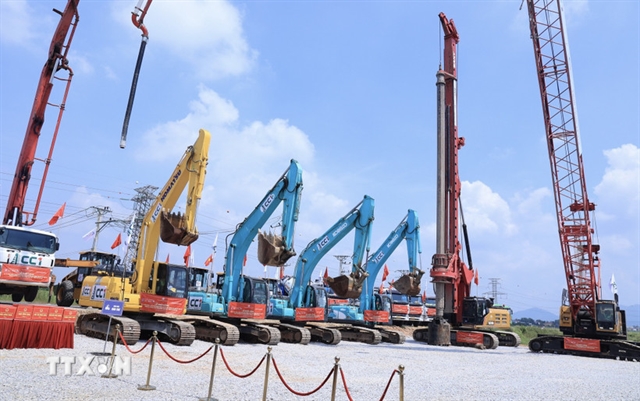
| Launching construction of a component project of Ring Road 4. VNA/VNS Photo |
HÀ NỘI — Hà Nội has been implementing measures to accelerate progress on the Ring Road 4 – Capital Region project and the road connecting Gia Bình Airport with the city, chairman of the Hà Nội People’s Committee Vũ Đại Thắng has said.
Hà Nội has also proposed that the Government and ministries support the removal of several obstacles related to investment mechanisms, construction materials and infrastructure coordination to ensure the progress of strategic transport works in the capital region.
Thắng said at a meeting of the State Steering Committee for national key transport projects that the city is directing departments, sectors and relevant localities to speed up the implementation of two major transport projects: the Ring Road 4 – Capital Region route and the road connecting Gia Bình Airport with Hà Nội.
To ensure rapid progress, Hà Nội has proposed that the Government consider adjusting certain elements of the investment policy for the Ring Road 4 project, particularly those related to the allocation of site-clearance funding among localities, he said.
These adjustments aim to align with the practical conditions of project implementation while optimising overall investment costs.
The city has also asked ministries and sectors to support the regulation of construction material supplies within the capital region, as demand for fill materials for major infrastructure projects is currently very high, especially as works like Gia Bình Airport and its connecting transport routes are being implemented.
All site clearance had been completed by 2025, enabling simultaneous construction of project components.
In Hà Nội, the project's parallel roads have largely been completed and are expected to be put into operation in the second quarter this year.
For the BOT component, which includes an elevated expressway and several large bridges, investors are carrying out construction to schedule.
The city has advanced more than VNĐ6 trillion (US$228 million) from the budget to support enterprises implementing the project.
Passing through Hà Nội, Hưng Yên and Bắc Ninh provinces, Ring Road 4 has a total length of about 120km and an investment of about VNĐ85.8 trillion ($3.3 billion).
Alongside the Ring Road project, the road connecting Gia Bình airport with the capital is also being accelerated by local authorities.
In several areas, such as Phù Đổng Commune and the former Đông Anh district, about 80 to 86 per cent of site clearance has been completed, with the entire process expected to finish in March.
However, several sections passing through Bắc Ninh Province, particularly a 1.6km section in Từ Sơn city and Phú Khê Ward, have not yet begun site clearance.
Hà Nội has asked the locality to accelerate the clearance to ensure the project’s overall progress.
For the public-private partnership component, the investor has already been approved and asked to work closely with local authorities to implement the project while ensuring security and order in areas along the route.
The road connecting Gia Bình airport runs parallel to the Lào Cai–Hải Phòng railway line, so close coordination among infrastructure projects is required, Thắng said.
In addition, the route corridor also includes a 500kV power transmission line, which requires coordinated planning with the electricity sector.
The city has asked that sector investors, particularly the National Power Transmission Corporation and the Vietnam Electricity Group, coordinate with Hà Nội and relevant agencies to ensure synchronisation between the railway, road infrastructure and the 500kV transmission system, avoiding repeated construction that would waste public funds.
Under the master plan, Gia Bình Airport in Bắc Ninh Province is intended to serve security and defence purposes and may operate as a dual-use airport in the future.
The direct road connecting the airport with the capital’s centre is expected to help complete the region’s transport network, improve regional connectivity and reduce pressure on the current aviation infrastructure system. VNS
Society
 Society
 Society
 Society
 Society
 Society
 Society
 Society
 Society
 Society
 Society
 Society
 Society
 Society
 Society