 Society

Powering Việt Nam's experience economy
1.

|
| A corner of Kinh Bắc ward, Bắc Ninh Province. — VNA/VNS Photos |
BẮC NINH — The northern province of Bắc Ninh aims to build a data-driven smart city system by 2030 and break into the global top 50 in a major international smart city ranking, authorities said.
The province plans to use digital transformation and science and technology and innovation to improve urban management and public services, while making data the backbone of decision-making.
The strategy puts residents and businesses at the centre of smart city development, with authorities seeking to improve the quality of public services, living conditions and the province's competitiveness.
Chairman of the provincial People's Committee Phạm Hoàng Sơn said developing a smart city was a priority for Bắc Ninh.
By 2030, the province aims to establish a provincial mechanism for coordinating smart city development, introduce data-driven governance and operate smart monitoring and management systems across the province and in key urban areas.
It plans to incorporate smart city development into urban planning and gradually build a City Information Model (CIM) to analyse data, support decision-making and manage urban growth.
The longer-term goal is to connect the CIM with a digital twin of the city, creating a virtual model that can be used to monitor and plan urban development.
Bắc Ninh also plans to develop an ICT architecture to allow different digital systems to communicate with each other while strengthening cybersecurity and data protection.
Security requirements are expected to be built into the design of smart city projects funded by the state, rather than added later.
The province is also prioritising telecommunications and internet infrastructure, data centres, cloud computing, the Internet of Things and artificial intelligence.
Transport, energy, public lighting, water supply and drainage are among the sectors earmarked for greater use of smart technology.
A key component of the strategy is the Intelligent Operations Centre, or IOC, which is being developed as a platform for monitoring and managing the province.
Băc Ninh Province piloted 15 scenarios on its provincial IOC system through August 31, covering areas including socio-economic management, public investment, administrative procedures, population data, healthcare, education and transport.
The system is intended to allow provincial leaders to monitor information and respond to issues digitally, moving towards management based on real-time data.
Under a government plan to integrate camera feeds, population data and IOC systems, the province is included in the second phase, scheduled from October 2026 to December 2027.
The provincial police have been assigned to lead the implementation.
|
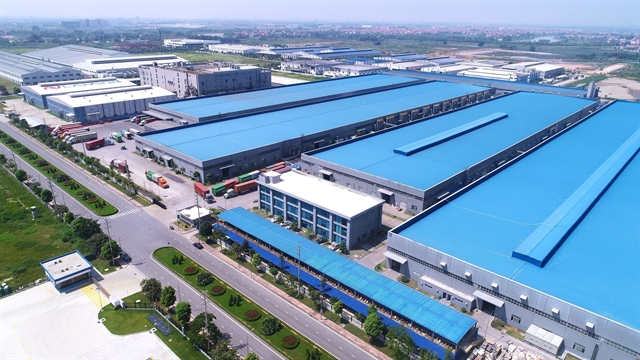
| Hiệp Hòa industrial zone in Bắc Ninh Province. |
Digital platforms are also being developed for public administration, transport, healthcare, education, tourism, public security and systems for receiving reports from residents.
Several urban areas, including Bắc Giang, Kinh Bắc, Từ Sơn, Thuận Thành and Việt Yên, have introduced technology-based tools for traffic management, urban order, public lighting, environmental monitoring and natural resource management.
The province currently operates two integrated data centres and has 495 dedicated data connections serving Party and state agencies. The network links authorities from the provincial level to communes and supports shared digital services and online video conferencing under the two-tier local government system.
Ambition for a global ranking
To meet its 2030 target, Bắc Ninh has identified four main priorities: setting up a provincial smart city coordination council; developing smart city plans from the provincial level down to communes and wards; establishing an ICT architecture; and creating policies to encourage innovation.
The province also plans to introduce a regulatory sandbox allowing new technologies to be tested under controlled conditions before wider deployment.
It will assess its smart city development against international standards, with the goal of entering the top 50 of a respected global ranking such as the IMD Smart City Index.
The ambition goes beyond technology, with authorities saying digital infrastructure should ultimately translate into better governance and quality of life.
Data is being treated as a development resource, while smart services are intended to address practical needs of residents and businesses.
The smart city programme is part of Bắc Ninh's broader development plans, including its ambition to become a centrally governed municipality in the future. — VNS
Society
 Society
 Society
 Society
 Society
 Society
 Society
 Society
 Society
 Society
 Society
 Society
 Society
 Society
 Society